Introduction
In today’s growing and developing import and export business, delivery speed is vital for maintaining customer satisfaction and a competitive advantage. Also, behind every on-time delivery lies a crucial component of trade compliance. Working with international export regulations, HS codes, HTS Harmonized Tariff Schedules, and Incoterms confirms that goods move across the regions without issues. When organizations minimize compliance, they risk shipment delays, penalties, or even capture goods, directly affecting global supply chain services. For organizations involved in DDP shipping or DAP shipments, understanding and using Importer of Record services is necessary to confirm smooth logistics work.
How Do Trade Compliance Checks Influence Global Delivery Speed?
Trade compliance checks directly affect how quickly goods move across global borders. Correct documentation, product classification, & regulatory approvals help prevent customs delays. Businesses that manage compliance requirements early can minimize clearance delays, avoid penalties, & maintain smoother delivery timelines.
Strong compliance processes also improve shipment visibility and help companies respond faster to changing trade requirements. Proper planning ensures reliable logistics performance across different markets.
Delays Caused by Non-Compliance with Delivery
Non-compliance can have critical consequences for delivery timelines. A missing export register or inaccurate import export registration details can result in customs officials holding goods at the port. Also, miscategorizations under the wrong HS Code or incorrect application of the HTS Harmonized Tariff Schedule can lead to customs delays or revaluation of taxes.
Many importers-exporters neglect documentation accuracy or underestimate local customs clearance support requirements. Also, failure to follow the Generalized System of Preferences (GSP) rules can result in denied special tariffs, increasing both costs and clearance time. Such lapses not only delay the delivery schedule but also delay overall logistics and supply chain efficiency.

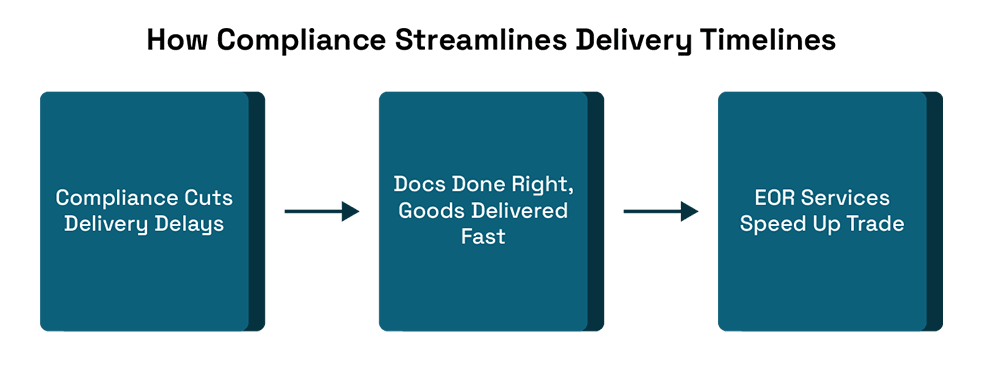
How Compliance Streamlines Delivery Timelines
When businesses prioritize compliance, it transforms delivery speed and efficiency. Takes exact approval with Incoterms such as DAP (Delivered at Place) or DDP, shipping confirms that both buyers and sellers know their commitments in terms of customs, taxes, and documentation. This clarity stops confusion and simplifies the customs process.
Using experts for EOR services or Importer of Record services allows shippers to handle local import laws effectively, minimizing risks during customs inspection. Also, with comprehensive customs clearance support and export customs brokerage, businesses gain faster access to global trade. In the long run, comprehensive import-export support increases predictability and dependability across global supply chain services.
What Causes Trade Compliance Delays in Global Shipping?
Many factors contribute to trade compliance delays in international shipping. Inaccurate HS Code categorization, incorrect product valuation under the HTS Harmonized Tariff Schedule, or missing certificates of origin are common reasons. A lack of understanding of import and export business regulations in different countries further adds difficulty.
For organizations engaged in DAPs or DDP shipping, missing or incomplete documentation can lead to extended verification periods. Also, neglect of Generalized System of Preferences (GSP) eligibility or failure to follow local import laws can result in penalties and prolonged customs holds. Even experts of importers and exporters sometimes misjudge the time required for import-export registration or goods approval inspection, which directly affects delivery timelines.
What Can Shippers Do to Avoid Trade Compliance Delays?
To reduce delays, shippers must use a dynamic approach to compliance. Working with experts providing Importer of Record (IOR) services confirms that all import documentation, permits, and duties are managed correctly. Organizations should also invest in export customs brokerage and customs clearance support to have a smooth flow at borders.
Using technology-driven global supply chain services can automate compliance checks and documentation review. Maintaining accurate export registers, following the latest international export regulations, and complying with Incoterms standards can hugely reduce clearance times. Most importantly, working with providers giving comprehensive import-export support confirms that every stage from registration to customs release is fully compliant and optimized for speed.
Conclusion
Trade compliance is not just a legal obligation; it’s a major advantage for every importer and exporter. By understanding HS codes, HTS Harmonized Tariff Schedules, Incoterms, and programs such as the Generalized System of Preferences, businesses can minimize delivery disruptions. Using IOR services, customs clearance support, and export customs brokerage confirms timely delivery while maintaining global trade integrity. In an interconnected world where every delay impacts the bottom line, compliance is the key to confirming faster, smarter, and more efficient logistics within the import and export business systems.
DID YOU KNOW?
In 2025, the UK cleared 91.3 million customs declarations for international goods trade, showing the growing importance of accurate documentation and trade compliance in global shipments.
FAQs:
How does automation improve trade compliance and shipment speed?
Automation helps businesses check documents, verify compliance requirements, and identify errors before shipment. Digital tools improve accuracy, reduce customs delays, & support faster global delivery
How does non-compliance affect delivery timelines?
Non-compliance can cause customs holds, penalties, or shipment rejections due to incorrect documentation, valuation errors, or HS Code misclassification, leading to significant delays.
How do IOR services help in trade compliance?
Importer of Record (IOR) services handle all import responsibilities, including documentation, duties, and permits, ensuring full compliance with local regulations and faster delivery.
What are common causes of trade compliance delays?
Delays often occur due to missing export registers, inaccurate product classification, incorrect application of HTS Harmonized Tariff Schedules, and failure to meet GSP rules.
How can businesses avoid trade compliance delays?
Businesses can partner with experts offering IOR and customs brokerage services, maintain accurate documentation, follow Incoterms, and stay updated with international regulations.