The Growing Shift Toward AI-Driven Global Trade
Global trade networks are in a spot because of a lack of semiconductors, problems with shipping in the Red Sea, delays at customs, tensions between countries, and suppliers who are not very reliable. Industries such as automotive, IT, aviation, and medical equipment manufacturing have seen slowdowns. This is because their supply chains are having trouble keeping up with changes in the market. Traditional trade models that once relied heavily on manual coordination and predictable sourcing patterns are no longer sufficient in today’s fast-moving global environment. As cross-border trade gets more complicated, businesses have to think about how they handle buying things, moving them around, keeping track of what they have in stock, and working with the people who supply them. Artificial Intelligence is now becoming a part of supply chains that help make decisions, so organizations can react more quickly when problems come up and keep everything running smoothly with their cross-border trade and supply chains.
AI-powered systems help analyze trade data. They improve how we manage inventory and orders. These systems can even predict when shipments will be delayed. They make supply chains work better and help with customs clearance. Companies that do not use AI in trade operations may have problems. They might not know much about their suppliers, it may take them longer to respond to issues, and they could have compliance risks. They might not be able to connect with the global trade system.
Why AI Is Becoming Essential in Modern Supply Chains
Artificial Intelligence is really changing the way modern supply chains work. As global trade gets more complicated and people need things faster, Artificial Intelligence is becoming very important. Companies that import and export are using Artificial Intelligence systems a lot now to guess what people will want to buy. They use these systems to track shipments as they are happening. They also use them to find out if suppliers are going to cause problems before they actually do. In industries such as automotive, IT, aviation, and medical equipment, even minor delays can impact production schedules and customer commitments.
AI-driven tools are really useful for companies. They help companies figure out the trade routes. They also help with customs paperwork. Keeping track of inventory and orders. This means companies can do processes faster and more accurately. Companies can avoid delays. Make their supply chains work better. They can also see what is going on with their logistics when they move things across borders. Trade rules and transportation are always changing. So now people think of AI as something they must have. It is not a nice thing to have anymore. AI helps companies work smarter and follow the rules.
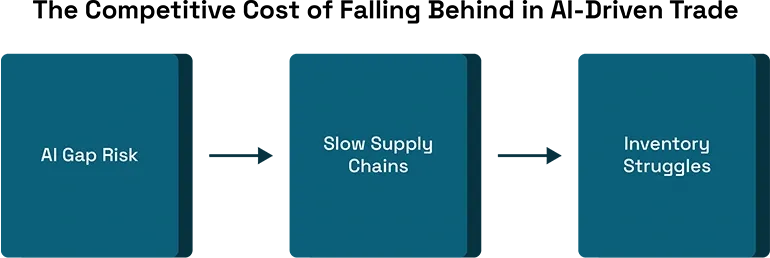
The Competitive Cost of Falling Behind in AI-Driven Trade
Companies that do not use intelligence or AI will have a tough time keeping up with other businesses. The reason is that global trade networks are using AI more and more. If a company does not use technologies, it might get left out of the supply chain. This is a problem because the supply chain is moving very fast. When businesses do not use AI, they often have problems. For example, it takes them longer to respond to things. They also have a time tracking their shipments. In sectors such as automotive, IT, aviation, and medical equipment, where speed and precision are critical, outdated systems can lead to customs clearance delays, export documentation complexity, and inefficient supplier onboarding processes.
Companies have a time when they do not have digital trade intelligence. This makes it really hard for companies to know when problems are going to happen. Companies struggle to manage the things they have in stock. Companies also find it hard to do things quickly when the market changes. When companies have to pay more to run their business and their supply chain plans are not good, things get even worse for them.
Barriers Slowing AI Adoption in Global Trade
Despite the growing importance of AI in modern supply chains, many businesses involved in import export operations still face significant barriers to adoption. Small companies and mid-sized companies usually do not have a lot of money to spend on digital systems. This is because the costs are very high. They also have a time finding people who are good at managing systems that use artificial intelligence. In places where things are being shipped across borders, it is hard to keep track of everything because the systems are old and do not work well together. This makes it hard to see what is going on with the suppliers and the shipments, and the customs processes.
In addition, many businesses are hesitant to adopt AI because they resist change and are unsure about trade rules. For industries such as automotive, aviation, medical equipment, and IT infrastructure, it is becoming increasingly crucial to overcome these hurdles to keep operations running. They need to improve their supply chains and stay competitive in a world where AI is becoming increasingly important in trade.

Conclusion: Adapting to the Future of AI-Driven Trade
Artificial intelligence is changing how business is done around the world. Artificial intelligence impacts how companies follow rules and regulations. It also changes how things are moved around and how companies keep track of everything. If companies do not start using intelligence to help them, they will not be as good as other companies. They will not be able to do things quickly or as well. This is not just about governments making rules that can stop companies from doing business in places. Companies can also be left behind if they do not have computer systems, if they are not using the internet to help them, and if they take too long to make decisions.
Companies that put money into transformation and make their supply chains better will be able to handle problems that come up. They will also be able to get into the market. For industries such as automotive, aviation, IT, and medical equipment, the future of trade with countries will depend on the ability to adapt to change and keep going even when things get tough. These companies will need to work within supply chains that are becoming smarter and more connected all the time. Transformation and supply chain optimization are very important for businesses like these.
DID YOU KNOW
“The Organization for Economic Co‑operation and Development (OECD) predicts that artificial intelligence could increase global exports by as much as 40% by 2040.”
FAQs
1. How does AI affect developing countries and SMEs?
The World Economic Forum says that even though artificial intelligence is made to help things run smoothly, like knowing when people will want more of something, this might actually make some people feel left out.
2. What is the World Trade Organization (WTO) doing about this?
The World Trade Organization recognizes the threat of winner-take-all economics in trade. The World Trade Organization is working to change trade policies so that rules about intelligence are the same everywhere, and everyone can benefit from trade, including the World Trade Organization.
3. How can organizations avoid being excluded?
To prevent lockouts in a globally fragmented landscape, businesses and governments are taking the following actions: Digitizing Transactions, Adopting Global Standards, Fostering Ecosystem Interoperability.
4. How is this Affecting India?
India is in a group of countries when it comes to rules about exporting technology around the world. This means India does not have access to the best artificial intelligence computers, which is the highest level of artificial intelligence computing equipment that India needs.
5. How can AI help businesses avoid trade disruptions in global supply chains?
AI is really useful for businesses because it helps them see what is going on in their supply chain. This means businesses can predict when something might go wrong.