The development & deployment of artificial intelligence have developed in the last few years, & its applications hold the power to transform human society & economic activities. The context for the current AI landscape discusses why it is timely & important to study how trade can be a vehicle for the development & sharing of AI, & how AI can help trade to continue to be a force for good by developing the benefits of trade to more economies &individuals.
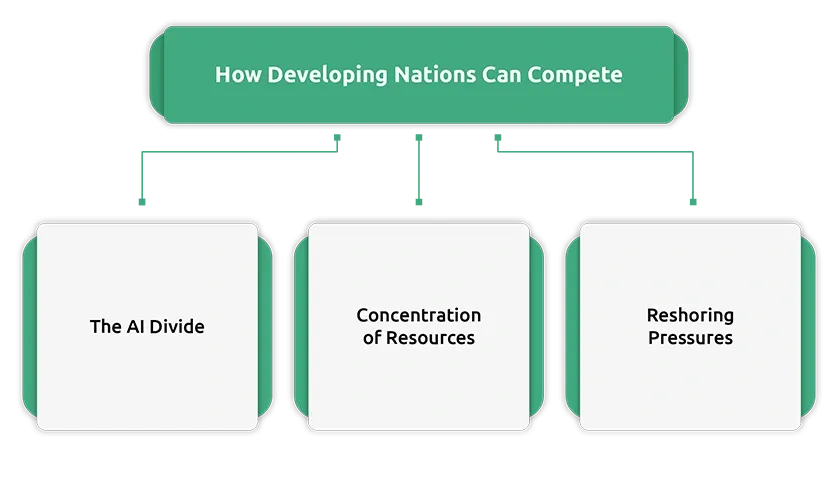
How Developing Nations Can Compete
To transform AI from a changing into an economic driver, developing economies are focusing on some main use points. One main area is the development of service exports, where AI tools are growing the productivity of service workers & enabling local producers & small-to-medium enterprises to overcome traditional issues & participate more easily in global e-commerce & digitally deliverable services. Countries are adopting targeted national strategies by creating complete AI roadmaps, developing STEM & AI literacy into education systems, & encouraging the use of open-source models to democratize access to advanced AI technologies. Infrastructure & data growth remain useful for competitiveness, as governments work to enhance access to reliable electricity, high-speed internet, & cloud computing resources while also building data-sharing ecosystems that support localized development & long-term digital growth.
The Main Challenges
Despite these opportunities, developing nations face significant structural barriers:
The AI Divide: Less than a third of developing countries currently have national AI strategies in place, compared to the majority of developed economies.
Concentration of Resources: The developing network, such as semiconductors & huge data centers, is highly concentrated in a few wealthy nations, causing global trade in AI-related hardware to outpace broader, more inclusive trade growth.
Reshoring Pressures: Because AI automates many labor-intensive processes, updated economies have increasing incentives to “nearshore” or “reshore” production, which replaces traditional managing export models for developing countries.
How AI is configuring the global trading system
- AI is accelerating the development of digital trade
AI is developing trade in digitally delivered services such as cloud computing, financial technology, logistics management, software, & data analytics. AI systems also improve global supply chains through predictive logistics, automated inventory management, & faster cross-border coordination.
This has increased the importance of cross-border data flows & digital trade rules. As economies become more data-driven, governments are under growing pressure to update rules on digital taxation, data governance, privacy, & market access.
- AI is changing the complete advantage & industrial competition
AI is changing the sources of economic competitiveness. In many industries, access to updated computing power, semiconductor capacity, research ecosystems, & large datasets is becoming more important than low labor costs.
This has increased industrial competition between many economies. Governments are increasingly using subsidies, industrial policy, & investment screening to strengthen domestic AI industries & reduce dependence on foreign technologies. As a result, trade policy is becoming more closely connected to technological leadership & economic security.
- AI is increasing the strategic importance of semiconductors
Updated AI systems mainly depend on high-performance semiconductors & computing networks. This has made semiconductor supply chains one of the most strategically important parts of the global economy.
Governments increasingly treat semiconductor production as a national security priority. Export controls on updated chips, restrictions on semiconductor technology transfers, & domestic production incentives have become central features of geoeconomic competition.
- AI is contributing to fragmentation in global trade governance
Countries are developing different approaches to AI regulation, including rules on cybersecurity, data protection, algorithmic accountability, & digital competition.
These differences create regulatory fragmentation that can act as a non-tariff issue to trade, especially for technology firms operating across many areas. The divergence of digital regulations also makes it more difficult to establish common global trade rules for AI-related industries.
- AI risks widening inequalities within the global economy
Economies with strong digital networks, updated research capacity, & access to computing power are likely to benefit most from AI-driven trade and productivity gains.
Many developing economies face many challenges, including limited digital network, lower investment capacity, & dependence on imported technologies. This develops concerns about a widening “AI divide,” where advanced economies dominate high-value digital sectors while developing economies struggle to move up global value chains.

Development connected with AI
Beyond many challenges, the fast development of AI introduces additional, mainly severe risks. These added many uses, disinformation campaigns, cyber or biosecurity threats, risks arising from malfunction, such as unsafe products, biased decision-making, or opacity to human supervision, & broader systemic risks linked to labour markets, data privacy, & environmental impacts. A growing segment of the AI research community also warns of more huge scenarios, including existential risks to humanity, either from the deliberate misuse of AI or from the possible development of superintelligent AI systems that operate beyond human control.
Conclusion
Artificial intelligence is mainly developing global trade, giving developing nations both important opportunities & difficult structural challenges. As AI continues to expand the scope of digital services, improve supply chain efficiency, & redefine industrial competitiveness, it also demands a fundamental shift in how economies approach development, skills development, & trade participation. Competing in this developing landscape will depend on their ability to strategically use AI for service export growth, strengthen national AI ecosystems through education & open-source adoption, & invest in fast digital networks such as connectivity, cloud computing, & data systems.
Did you know?
Foreign direct investment (FDI) flows fell by 11% in 2024 before rebounding by 5% in 2025, reflecting the impact of geopolitical tensions and economic uncertainty. But beyond short-term swings, deeper structural shifts are becoming clearer.
FAQ
1. Can developing nations compete in AI-driven global trade?
Yes, developing nations can compete by leveraging AI for service exports, improving digital infrastructure, and adopting national AI strategies that focus on skills development and innovation ecosystems.
2. What opportunities does AI create for developing countries in global trade?
AI enables better access to digital markets, improves productivity in services, supports SMEs in e-commerce, and enhances participation in globally deliverable digital services like IT, finance, and analytics.
3. What are the biggest challenges developing nations face in AI-driven trade?
Key challenges include limited digital infrastructure, a lack of AI talent, high costs of advanced technologies, dependency on imported hardware, and the widening global AI divide.
4. How does AI change global trade and competitiveness?
AI shifts competitiveness from low-cost labor advantages to factors like computing power, data access, research capacity, and advanced digital ecosystems, reshaping global value chains.
5. How can developing nations reduce the AI gap with advanced economies?
They can invest in broadband and cloud infrastructure, promote STEM and AI education, adopt open-source AI tools, and build supportive regulatory and innovation frameworks.