Growing markets have firmly developed themselves as useful engines of global development, serving as catalysts for rapid industrial growth, automation, & unprecedented middle-class development. These markets not only signal upcoming economic progress but simultaneously create unique development ecosystems where Industry &, technologies, & digital platforms work, knowledge sharing, enhance multi-actor collaboration, & strengthen flexible production capabilities.
Understanding Digital Infrastructure in Export Markets
Digital infrastructure in export markets refers to the hardware, software, & regulatory frameworks enabling cross-border digital trade. It covers international connectivity, cloud computing, payment gateways, & Digital Public Infrastructure. This connectivity minimizes transaction costs, streamlines customs processes, & determines how effectively your business scales globally.
Why Digital Infrastructure Matters in Exporting
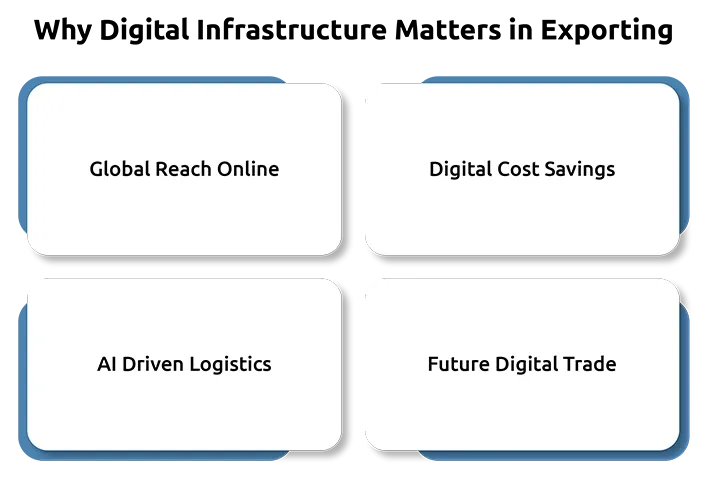
Digital infrastructure plays an important role in enhancing market access, reducing operational costs, & updating global trade efficiency for emerging export markets. Online platforms and cloud-based supply chain systems allow businesses, especially small & medium-sized enterprises, to reach international markets without depending mainly on traditional physical agents, mainly using entry issues & operating expenses. The growth of cross-border digital services such as consulting, software development, & data management has increased the tradability of services, enabling businesses to operate beyond geographic limitations through digital networks. Updating technologies, with IoT & AI-driven analytics, also enhances supply chain resilience by using logistics operations, enhancing real-time visibility, & helping businesses respond more easily to unexpected risks in global trade and transportation systems.
Key Components of Export Digital Infrastructure
To successfully enter & operate within foreign markets, businesses must carefully evaluate many layers of a country’s digital ecosystem. Easy, fast network & stable connectivity are needed because network speed, latency, & international data transfer efficiency directly affect digital operations, customer experience, & real-time business communication. Equally important are secure & efficient digital payment systems, which enable smooth cross-border transactions, minimize financial risks, & enhance customer conversion rates through faster & lower-cost payment processing. Strong identity verification frameworks & digital public network support secure customer onboarding, electronic authentication, digital signatures, & regulatory compliance, allowing businesses to operate more easily within increasingly digitalized global trade environments.
Strategic Considerations for Your Business
Businesses entering global markets must carefully assess regulatory compliance needs, mainly around data privacy & cross-border data flows. Many countries are updating digital regulations to secure customer information & national data risk. India’s Digital Personal Data Protection Act establishes rules for how organizations collect, store, process, & transfer personal data. Failing to deal with such regulations can lead to operational disruptions, financial penalties, & reputational risks. Companies should therefore build strong compliance frameworks that align with local cybersecurity, taxation, & digital governance standards before expanding into new countries.
Characteristics of emerging markets
A defining characteristic of developing markets is the notably fast growth trajectory. This growth is often characterised by natural difficulties. When contrasted with highly developed economies, emerging markets show unique challenges, including heightened currency volatility & greater political instability. These factors can mainly create important issues for many organizations. This demographic profile mainly contributes to a developing labour force & an increasingly changing customer market that is mainly accepting of development market entry strategies. The network development in these developing economies, mainly the development of digital networks, represents an important and changing transformation, often addressing previously poor technological foundations. These updating economies mainly face the challenge of managing volatile regulatory environments, marked by sudden policy shifts that substantially influence investment landscapes & corporate strategies.
The Role of Technology in Closing the Gap
Technology is mainly in control of bridging the digital & socioeconomic divides. By giving accessible platforms, internet connectivity, & AI tools, technology democratizes access to opportunities. It is transforming vital sectors by delivering needed education, healthcare, & economic growth to neglected populations worldwide.
- Connection between Education & Skills Gap
Technology is creating more learning opportunities, especially for disadvantaged communities & geographically isolated populations that mainly had limited access to quality education. Digital learning platforms & online educational resources allow students to study at their own pace, helping overcome risks such as teacher shortages, poor network, & limited academic materials in remote or deprived regions. Virtual classrooms, recorded lessons, & interactive learning tools make education more flexible & accessible, enabling learners to gain knowledge regardless of their location or economic background.
- Managing Healthcare Access
Digital development is playing an important role in minimizing gaps in healthcare access, especially for people living in village-based, remote, or risk-prone countries where medical network & specialist availability are limited. Technologies such as telehealth platforms, video consultations, & remote patient monitoring devices enable healthcare providers to deliver timely & consistent medical support without the need for patients to travel long distances. These advancements are mainly useful for adults, individuals managing long-term illnesses, & communities with limited healthcare facilities, as they update access to diagnosis, follow-up care, & health management while minimizing costs & travel issues.

Conclusion
Digital networks have become a defining factor in the complete & growth potential of developing export markets. While these economies are mainly updating through industrialization, digitalization, & developing global development, persistent gaps in connectivity, payment systems, regulatory frameworks, & cybersecurity continue to limit their full participation in digital trade. Structural challenges such as uneven network development, policy volatility, & the urban-rural digital divide further complicate the ability of businesses to operate efficiently across borders.
Did you know?
The United States and the European Union, China is an established industrial powerhouse, followed by several other emerging economies of the Global South.
FAQ
1. What is digital infrastructure in emerging export markets?
Digital infrastructure refers to the systems and technologies that enable cross-border digital trade, including broadband connectivity, cloud computing, digital payment systems, and regulatory frameworks that support online transactions and data flow.
2. Why is digital infrastructure important for export growth?
It helps reduce trade costs, improves market access, enables faster customs processing, and allows businesses—especially SMEs—to compete in global markets through digital platforms and cloud-based systems.
3. What are the major challenges faced by emerging export markets?
Key challenges include poor internet connectivity, outdated systems, weak cybersecurity frameworks, fragmented payment gateways, and inconsistent digital regulations across countries.
4. How does digital infrastructure affect small and medium-sized enterprises (SMEs)?
SMEs often benefit from digital tools but also face barriers such as high setup costs, limited access to advanced technology, and difficulties integrating with global payment and logistics systems.
5. How can emerging markets improve their digital infrastructure?
They can invest in broadband expansion, strengthen digital public infrastructure, improve cybersecurity systems, harmonize regulations, and promote digital literacy to support inclusive economic growth.