Technology is becoming one of the most important factors in developing global trade growth. In today’s digitally connected economy, countries & businesses that can quickly adopt updated technologies such as artificial intelligence, cloud computing, automation, blockchain, & digital payment systems are gaining an important advantage in global markets. Technology access no longer only supports operational efficiency, it directly affects supply chain usability, production speed, market growth, customer engagement, & regulatory compliance. As global trade continues to change toward digital ecosystems, nations with strong digital networks & development capabilities are better ready to attract investment, increase exports, & compete mainly on a global scale. Unfair access to technology is creating new gaps between developed & developing economies, making digital ability an important component of long-term trade success.
The Shift From Traditional Trade Advantages to Digital Competitiveness
The transition from traditional trade advantages depending on physical geographic proximity, raw materials, & cheap labor to digital competitiveness represents a fundamental transformation of the global economy. Today, national and corporate success is focused on the ability to move, process, & use cross-border data flows.
Major Challenges in Technology-Driven Global Trade
The important opportunities created by technology-driven trade, the digital transition also introduces some challenges & risks that can affect global competitiveness. One of the biggest concerns is the growing digital divide, where unequal access to high-speed internet, updated technologies, & digital skills limits the ability of developing & least-developed economies to fully participate in global digital trade. Businesses operating across borders also face regulatory breakdown, as countries continue to develop different rules related to cross-border data flows, artificial intelligence governance, privacy standards, & cybersecurity needs. These inconsistent regulations increase compliance complexity & operational costs for many companies. In addition, the growth of digital commerce has created challenges in taxation & competition policies. Since many digital products & services are abstract, governments often struggle to apply traditional tax frameworks, leading to risks over digital services taxation & increasing tensions in global trade relations.
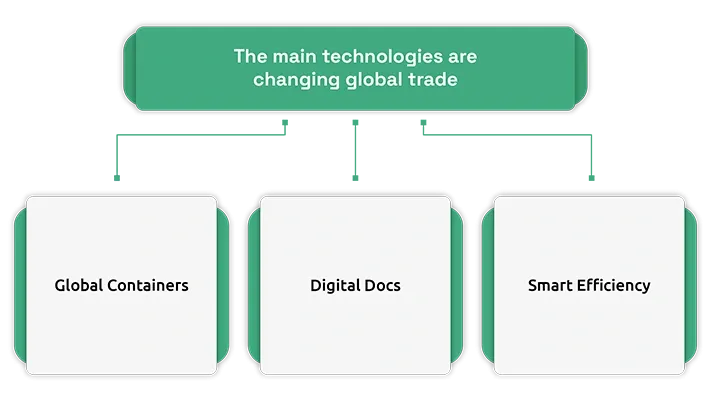
The main technologies are changing global trade
International trade has directed the global headlines recently. Much of the discussion has been focused on the risk of a trade war, the tit-for-tat tariffs, & the health of the global trade order. While extremely important, these exchange are missing a brighter side of international trade how developing technologies in the Fourth Industrial Revolution are changing trade by making the processes more inclusive & efficient.
Technological issues isn’t new for the global trade system. The steam power revolution connected the world like never before. The development of shipping containers laid the foundation for globalization. Technologies such as Optical Character Recognition to read container numbers, Radio Frequency Identification & QR codes to identify & trace shipments, & basic digitization of trade documents have enhance the usability and efficiencies of global trade.
Artificial Intelligence & Machine Learning
Artificial Intelligence & Machine Learning can be used to develop trade shipping routes, manage & truck traffic at ports, & translate e-commerce search queries from one language into other languages & respond with translated inventory.
More than efficiency gains & better customer services, AI is also being used to make global trade sustainable. Google launched Global Fishing Watch in 2016, which is a real-time tool using machine learning to reduce illegal fishing by giving a global view of commercial fishing activities based on ship movements & satellite data. It can be used by governments & other organizations to identify irregular behaviours & develop usable policies.

3D-printing
The review board is still out on the impact of 3D-printing on global trade. There are studies that predict that once high-speed 3D-printing is mass-adopted & cheap enough, global trade may decrease by as much as 25%, since 3D-printing requires less labor & minimizes the need for imports. Others argue that such views are too optimistic & don’t take into account the difficult & reality of huge manufacturing. The impact of 3D-printing on global trade is real, especially as faster & cheaper methods of 3D-printing become available.
Mobile payments
From Apply Pay to Alipay to M-Pesa, mobile payments are changing the way we live & connecting more people to market opportunities. According to the World Bank Global Inclusion Database, the number of people who gained access to bank accounts increased by 20% between 2011 & 2014, & mobile money accounts were a main drive for financial inclusion, especially in growing economies.
Blockchain
Blockchain and blockchain-based distributed ledger technologies can have tremendous impact on the global trade supply chain. Trade organizations such as Dubai Chamber of Commerce and Industry have also launched an initiative to leverage blockchain technology to address global trade issues such as high costs and lack of transparency and security.
Conclusion
Technology access is mainly changing the global trade competitiveness in 2026 & beyond. Updated technologies such as artificial intelligence, blockchain, cloud computing, mobile payments, & automation are changing how countries & businesses manage supply chains, conduct cross-border transactions, & compete in global markets. Nations with strong digital network, development capabilities, & technology adoption strategies are gaining a clear competitive advantage through enhance efficiency, faster market access, improved transparency, & smarter decision-making.
Did you know?
Global growth is projected to remain subdued at about 2.6% in 2026, while growth in developing economies excluding China slows to around 4.2%. Major trading partners, including the United States, China, and Europe, are also losing momentum, weakening demand, and tightening financial conditions.
FAQs
1. Why is technology access important for global trade competitiveness?
Technology access enables countries and businesses to improve operational efficiency, strengthen supply chains, reduce trade costs, enhance communication, and expand into international markets more effectively. Advanced technologies also help organizations adapt quickly to changing global trade conditions.
2. Which technologies are having the biggest impact on global trade in 2026?
Key technologies transforming global trade include artificial intelligence (AI), machine learning, blockchain, cloud computing, mobile payment systems, automation, and 3D-printing. These technologies improve logistics, transparency, digital transactions, and supply chain management.
3. How does artificial intelligence improve international trade operations?
Artificial intelligence helps businesses optimize shipping routes, forecast demand, automate customs and compliance processes, manage inventory, and improve customer experiences through data-driven decision-making and predictive analytics.
4. What are the major challenges of technology-driven global trade?
Some of the biggest challenges include the digital divide, cybersecurity risks, regulatory fragmentation, cross-border data restrictions, digital taxation issues, and unequal access to advanced technologies in developing economies.
5. How can developing countries improve their digital trade competitiveness?
Developing countries can improve competitiveness by investing in digital infrastructure, expanding internet access, promoting digital skills training, supporting innovation ecosystems, strengthening cybersecurity frameworks, and encouraging technology adoption across industries.