From minimizing costs to improving productivity, artificial intelligence (AI) is changing global trade & creating new opportunities for companies of all sizes & geographical locations to grow their reach in the global economy. But while AI gives the promise of balancing the playing field mainly for small businesses in developing economies, it could just as easily risk deepening existing divides if risks to inclusive adoption are not improved, as this joint survey by ICC & the World Trade Organization identifies.
Why AI Adoption Matters for Export Economies
AI adoption is important for export economies to manage global development, minimize trade-related costs, & survive changing geopolitical tensions. It allows businesses to move beyond traditional trade barriers by using logistics, accurately predicting foreign demand, & staying discoverable to global buyers using AI-driven supplier search algorithms.
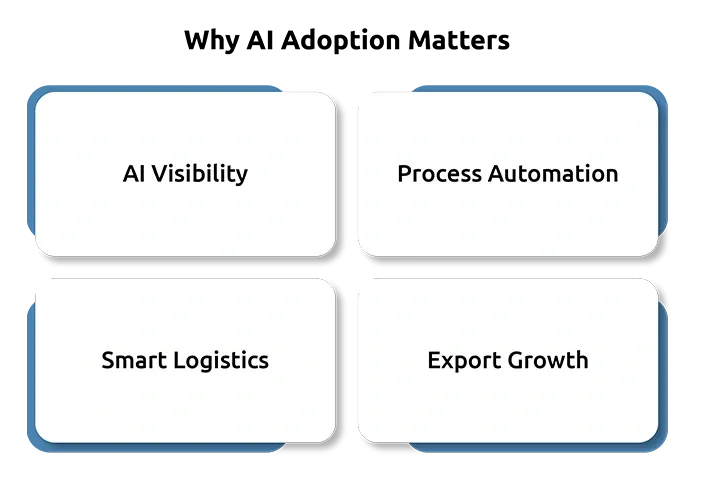
Why AI Adoption Matters
Artificial intelligence is becoming important for improving global trade development by improving visibility, minimizing costs, supporting market expenses, & developing supply chain resilience. Global buyers now mainly depend on AI-driven platforms & algorithmic filtering systems to identify & evaluate suppliers, meaning exporters without strong AI-optimized digital visibility risk becoming less visible in global markets. Developing AI into trade-related operations can mainly minimize costs by automating logistics, documentation, compliance management, & communication processes, with some businesses reporting trade cost reductions of up to 50%. AI also helps companies change their export opportunities by analyzing large volumes of market data to identify developing customer trends, new demand patterns, & markets that may otherwise remain unnoticed. In an increasingly uncertain global trade environment marked by changing tariffs, geopolitical tensions, & supply chain issues, AI-powered predictive analytics & real-time management tools help businesses enhance supply chain resilience through better forecasting, risk management, & operational stability.
How Businesses Are Using AI to Transform Global Trade
A joint survey managed by the International Chamber of Commerce and the World Trade Organization highlights the growing role of artificial intelligence in global trade activities. The survey found that nearly half of participating businesses already use AI to support trade-related operations, while around 90% reported measurable benefits such as improved efficiency, improve export opportunities, & a huge range of traded products. Many businesses also experienced main cost savings, with some reporting reductions of up to 50% in areas such as communications & compliance management. The results suggest that AI could create new growth opportunities for micro-, small-, & medium-sized organization in lower-income economies by helping them improve exports & access new global markets. Despite its strong potential, AI adoption remains uneven globally, as many businesses continue to face challenges related to regulatory inconsistancy, skills shortages, security concerns, & limited trust in AI systems.
Policy recommendations to achieve inclusive AI for global trade
Secure the free flow of data & prohibit unsupported data localisation to support AI development, deployment & scale. AI systems depend on access to large, diverse data sets; without usable cross-border data flows, their performance, accuracy & global applicability are mainly limited.
Boost digitalisation, ensuring interoperable digital trade systems & secure data exchange. Digital network is a necessity for AI adoption AI cannot be developed mainly where core processes remain analogue or disconnected.
Ensure a strong role for business in transportation AI-related trade policies & international standards, & delivering practical solutions through public & private partnerships. Businesses must be involved not only in policymaking as the primary developer & deployer of AI but also in piloting initiatives that build capacity & operationalise commitments, mainly in developing economies.

Main Barriers to AI Adoption in Low-Income Export Economies and How to Overcome Them
Artificial intelligence is changing global trade through automation, predictive analytics, & smarter supply chain management. Many low-income export economies still face the main barriers to large-scale AI adoption. These challenges limit their ability to compete easily in increasingly digital global markets.
One of the biggest issues is limited digital infrastructure. Many low-income economies continue to struggle with poor internet connectivity, unstable electricity supply, & inadequate cloud or data center network. Since AI systems depend mainly on reliable digital networks & computing power, a weak network mainly slows adoption. Governments & the private sector can address this challenge by investing in broadband expansion, improving power infrastructure, & increasing access to affordable cloud technologies.
Skills shortages also remain an important risk. Many low-income export economies face a lack of AI specialists, data scientists, & digitally trained workers. Limited technical education & ongoing brain drain toward developed economies increase the problem. Developing digital education programs, investing in workforce training, & creating partnerships between governments, universities, & technology organizations can help build stronger AI talent ecosystems.
Conclusion
Artificial intelligence is mainly changing an important factor in international trade development, helping businesses improve efficiency, minimize operational costs, improve supply chain usability, & inhance into new global markets. Without its growing potential, AI adoption remains uneven across low-cost export economies due to challenges such as limited digital networks, high production costs, skills shortages, weak regulatory frameworks, & cybersecurity concerns. These risk increasing the global digital divide & limiting the inclusion of developing economies in increasingly technology-driven trade ecosystems.
Did you know?
The growth rate in advanced economies is nearly twice that of developing ones. This reflects how existing infrastructure and technological readiness make adoption easier and faster, further concentrating AI capabilities in advanced economies.
FAQ
1. Why is AI adoption important for low-income export economies?
AI adoption helps export economies improve productivity, reduce operational costs, strengthen supply chain efficiency, and remain competitive in increasingly digital global markets. It also enables businesses to identify new export opportunities and respond more effectively to changing consumer demand.
2. What are the biggest barriers to AI adoption in developing export economies?
Some of the biggest barriers include limited digital infrastructure, high implementation costs, lack of skilled workers, poor data availability, cybersecurity concerns, and weak regulatory frameworks. These challenges often slow digital transformation and reduce global trade competitiveness.
3. How can governments support AI adoption in low-income economies?
Governments can support AI adoption by investing in broadband and digital infrastructure, improving technical education, creating clear AI regulations, offering financial incentives for businesses, and encouraging public-private partnerships focused on digital innovation.
4. How does AI help businesses involved in international trade?
AI helps businesses automate logistics, improve compliance management, forecast demand, reduce trade-related costs, analyze market trends, and strengthen supply chain resilience. It also improves visibility to international buyers using AI-driven supplier discovery platforms.
5. Can small businesses benefit from AI in global trade?
Yes. AI can help micro-, small-, and medium-sized enterprises (MSMEs) improve efficiency, access new international markets, diversify exports, and compete more effectively with larger companies through affordable cloud-based AI solutions and digital trade platforms.