Brief overview
The global freight industry is undergoing a big change from manual, reactive processes to proactive, autonomous decision-making systems. Made by Artificial Intelligence & machine learning, this allows logistics networks to independently verify data, using routes in real-time, & cover difficult supply chains with minimal human action. As of 2026, early adopters are noticing important efficiency benefits, including up to 27% shorter order lead times & 25% higher labor output.
What Is Autonomous Decision-Making in Freight?
Autonomous decision-making in freight refers to AI-driven systems that clarify real-time data to automatically plan, use, & execute logistics operations like rerouting shipments or selecting carriers to minimize human action. It moves beyond mere automation of tasks to a system that independently adjusts inventory levels or booking freight based on traffic or weather issues.
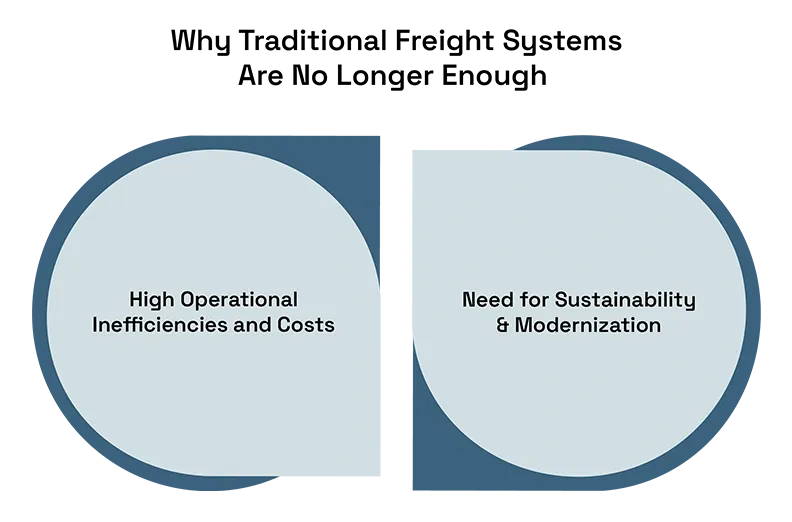
Why Traditional Freight Systems Are No Longer Enough
Traditional freight systems are no longer useful because they were made for balance & linear processes, whereas modern commerce needs high speed, instability management, & full digital transparency. The shift from a “push” to a “pull” economy—where consumers demand fast delivery has exposed past, asset-heavy, & manual logistics operations as too slow, hidden, & hard.
Here is why past freight systems are falling behind:
- Inability to Meet Modern Customers’ Expectations
The 15-Minute Economy: The growth of e-commerce & fast delivery means “next-day” is no longer fast enough, demanding distributed, hyper-local, & on-demand delivery capabilities that traditional systems cannot support.
Real-time Visibility Demands: Customers now demand end-to-end visibility, moving away from “black box” services to full tracking, data integration with ERP systems, & fast proactive updates.
- High Operational Inefficiencies and Costs
Manual Processes: Traditional forwarding & freight processes depend on manual management, which is slow & faulty. Automation can minimize these operational costs by up to 40%.
Poor Capacity Utilization: Traditional models often go from poor load use & high levels of empty-running, mainly in road freight.
High Costs of issue: Traditional models react to issues, whereas modern supply chains need prepared control to avoid developing risks & delay fees, which can jump by 40% during peak rises.
- Lack of Durability
Weakness in Global Networks: Supply chains optimized only for cost rather than strength have proven weak, unable to adapt to sudden geopolitical issues, natural disasters, or unexpected demand shifts.
- Need for Sustainability & Modernization
Sustainability Pressures: Governments & investors are demanding green supply chains. Traditional, carbon-intensive trucking methods are under pressure to shift toward sustainable, efficient, & hybrid transport options.
- Increased Logistics Complexity
Divided Logistics Networks: Managing a high volume of small, fragmented shipments for e-commerce, combined with a workforce shortage & high turnover, makes manual management impossible.
Main Pillars of Autonomous Freight Decision Systems
Autonomous freight decision systems depend on an interconnected framework to manage to move goods safely & easily without human action. These systems are mainly made on three or four core technological pillars that enable them to interpret the environment, plan routes, & execute actions in real-time. The main pillars of autonomous freight decision systems are:
- Perception & Environmental Awareness
This pillar enables the vehicle to detect & understand its surroundings by using an integration of advanced sensors such as LiDAR, radar, cameras, & GPS/IMU systems. It plays an important role in making real-time conditional awareness for autonomous navigation. Through object detection & verification, the system identifies & categorizes nearby vehicles, road users, cyclists, & other issues on the road. It also performs clear localization, allowing the vehicle to determine its exact position within a high-definition 3D map. Environmental management helps the system recognize lane markings, traffic signs, & changing weather conditions, ensuring safe & adaptive driving in changing environments.
- Prediction & Behavioral Forecasting
With the environment, the system moves to expecting future behavior to ensure safe & easy decision-making. This added directive prediction, where artificial intelligence is used to predict the future movements of surrounding road users, such as whether a vehicle is likely to change lanes, stop suddenly, or merge into traffic. Scenario modeling judges many possible outcomes by analyzing real-time traffic conditions along with historical data patterns. This helps the system assess potential risks in advance & prepare for different driving situations, enabling safer & more informed autonomous decision-making.
- Planning & Decision-Making
This component acts as the main brain of the system, responsible for making safe & easy management decisions by adding information from insights & prediction units. It ensures the vehicle selects the best possible path forward by verifying real-time conditions & predicting future conditions. Through path planning, the system calculates the best route, with decisions related to speed control, braking, lane changes, & easy navigation around challenges. Together with mission planning, it handles the whole journey from the origin to the destination, mainly updating routes depending on traffic conditions, road blockages, weather changes, or other operational constraints. These functions enable intelligent, dynamic, & target based routes.

Conclusion
Automatic decision-making is updating the future of world freight operations by moving logistics from manual, reactive processes to intelligent, self-driving systems. By using real-time data, AI-driven prediction, & automated planning, freight networks can now respond quickly to fraud, use routes, minimize costs, & improve whole delivery execution with minimal human involvement. This transformation is not only improving operational efficiency but also enabling more transparency, strength, & usability across global supply chains.
Did you know?
By 2030, automation will reshape how logistics companies plan and move freight, especially as major ports adopt fully automated crane and yard systems that speed up container unloading and improve schedule reliability.
FAQ
1. What is autonomous freight?
Autonomous freight refers to the use of self-driving trucks, autonomous ships, and drones that transport goods without direct human intervention. These systems use AI, sensors, and GPS to navigate.
2. What is the impact of AI in logistics in 2026?
AI is expected to move from predictive analysis to action-oriented solutions, managing end-to-end supply chain visibility and automating complex tasks like customs clearance.
3. What are the benefits of autonomous ships?
Autonomous ships reduce operational costs, optimize fuel efficiency, and increase safety by reducing human error. They can also operate 24/7.
4. How do AI-driven trucks operate?
They use a combination of sensors, cameras, LiDAR, & radar along with AI algorithms to interpret their surroundings, make real-time decisions, and navigate traffic safely.
5. What challenges does autonomous freight face?
Autonomous freight faces challenges such as regulatory restrictions, high costs, cybersecurity risks, and a lack of infrastructure readiness. These factors slow down large-scale adoption across global logistics networks.