The automotive spare parts trade is becoming increasingly complex as global vehicle fleets expand and customer expectations shift toward faster, more reliable service. Traditional forecasting methods, which relied heavily on historical sales data and manual planning, are no longer sufficient to handle the dynamic nature of today’s markets. This is where AI-driven demand forecasting is transforming the industry.
Artificial intelligence enables businesses to analyze vast datasets, identify patterns, and predict demand with a high degree of accuracy. For import-export companies operating across IT, aviation, medical, and automotive sectors, this advancement is not just beneficial—it is becoming essential. Accurate forecasting helps reduce uncertainty, improve planning, and ensure that critical spare parts are available when and where they are needed.
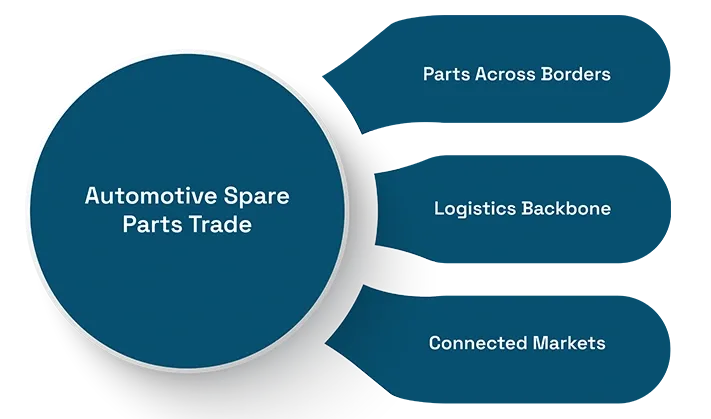
Automotive Spare Parts Trade
The automotive spare parts trade is about moving automotive parts around the world. This includes things like engine parts, brakes, electronics, and other accessories. These parts are sourced from multiple countries and distributed across various markets, making the supply chain highly interconnected and sensitive to disruptions.
Demand variability is a problem in this sector. There are a lot of things that affect how many spare parts are needed, like how old a vehicle’s condition is. For businesses involved in cross-border trade, managing demand variability for parts is really important for these businesses to be successful.
International freight services play a vital role in ensuring that spare parts reach their destinations on time. At the same time, compliance with global trade regulations is critical. They use things like an importer of record service and an exporter of record service to help with all the paperwork and rules that international freight services have to follow.
Additionally, using systems like HS code and the HTS harmonized tariff schedule helps to identify products during cross-border transactions. These systems, combined with trade terms, make customs clearance smoother and reduce delays. The use of HS code and the HTS tariff schedule is key to the accurate identification of products. It ensures that products are correctly identified during border transactions.
AI-Driven Demand
AI-driven demand forecasting brings a level of precision to the automotive spare parts trade, and it helps businesses to forecast demand accurately. By using machine learning algorithms, they can look at sales, current market data, and weather. AI-driven demand forecasting makes it easier for businesses to make decisions.
Companies can change the way they make decisions with this approach, from reactive to proactive decision-making. Instead of responding to shortages or excess inventory, businesses can anticipate demand and adjust their strategies accordingly. This makes the service better, for businesses, it also helps companies save money on things they do not need.
Another key advantage is the ability to handle complex datasets. AI systems can process information from multiple sources simultaneously, providing insights that would be difficult to achieve through traditional methods. For example, predictive analytics can identify which spare parts are likely to experience increased demand in specific regions, enabling businesses to plan their shipments more effectively.
Moreover, when we use AI with tools, it makes things more efficient. Businesses are using the trade compliance software for import and export rules. The use of AI and compliance technology together makes the supply chain stronger and able to respond. Businesses are adopting AI and trade compliance software for import export to ensure accuracy.
Digital Integration and Predictive Analytics in Trade
Digital integration is changing the way automotive spare parts are traded globally. Analytics and cloud-based platforms, and real-time tracking systems, are enabling businesses to gain greater visibility into their operations.
These technologies help with making decisions by giving us useful information about what people want, how well suppliers do their jobs, and how well we move things from one place to another. For example, we can use data from internet-connected vehicles to predict when we will need parts, so businesses can prepare in advance.
Automation is also making it easier for businesses to handle customs clearance and documentation. This reduces manual errors and speeds up cross-border transactions. Automation is really helping with this. It is making a big difference for businesses in how they do customs clearance and paperwork.
The growing use of AI also addresses common industry questions, such as how to handle trade rules or how to make distribution networks work better. AI technology is useful for managing trade requirements and distribution networks, and the use of AI helps companies to stay ahead.

Conclusion
AI-driven demand forecasting is revolutionizing the automotive spare parts trade by enabling more accurate predictions, improved efficiency, and better resource management. Global trade is getting more complicated all the time. So businesses that export spare parts need to find new and innovative solutions to stay ahead of the competition. The automotive spare parts trade needs to use forecasting to stay competitive.
For import-export companies working across automotive, IT, aviation, and medical sectors, the integration of AI and digital tools can be really helpful. These import-export companies can use services to move goods around the world, follow all the rules, and make sure their supply chain is running smoothly.
The industry is changing all the time. People who use Artificial Intelligence to make plans will be able to do what the customers want. The companies that use Artificial Intelligence will be able to meet customer demands and reduce risks. They can build resilient global operations with Artificial Intelligence.
Did You know?
“The accuracy of demand forecasting in the automotive spare parts industry is critical to operational efficiency and financial performance.”
FAQs
What is AI-driven demand forecasting in automotive spare parts?
It uses artificial intelligence to predict future demand for spare parts based on data patterns and trends.
How does AI improve spare parts availability?
AI helps businesses anticipate demand accurately, reducing stock shortages and excess inventory.
Why is demand forecasting important in global spare parts trade?
It ensures timely supply, minimizes delays, and improves customer satisfaction across international markets.
What data is used in AI-based forecasting?
It includes historical sales, market trends, vehicle usage data, and external factors like weather and seasonality.
Can AI reduce operational costs in the spare parts trade?
Yes, by optimizing inventory levels and improving planning, AI helps lower storage and transportation costs.