Introduction
The growing geopolitical instability across standard trade routes has pushed governments and industries to explore different stations for global freight services connecting Asia and Europe. The Middle Corridor, also known as the Trans-Caspian Global Transport Route, has grown as a possible participant in the conventional Northern station. Indian exporters and importers are now growing, and whether this alternative can support competitive logistics, lower import duties and tariffs, and strengthen supply chain improvement strategies. Incoterms-based shipping methods such as Delivered Duty Paid service, DAP (Delivered at Place), and other delivery arrangements are increasing in usage. The requirement for predictable logistics timelines, real-time shipment tracking, and dependable import export documentation has become vital for India-Europe trade.
The Middle Corridor as a ‘Plan B’
The station has gained momentum as a viable ‘Plan B’ following disruptions in the Northern Corridor due to sanctions, political tensions, and operational issues. For traders reliant on long-distance multimodal logistics, the route provides a shorter maritime leg, complemented by rail and road connectivity across Central Asia, the Caspian Sea, and onward to Europe. For Indian manufacturers shipping under HS Code or HTS Harmonized Tariff Schedule classifications, alternative routes like this become necessary for cost evaluation when calculating customs values and approval charges. A more predictable route reduces the demands on Importer of Record responsibilities and Exporter of Record documentation requirements, ultimately helping businesses improve risk management and maintain competitiveness in the European market.

The Middle Corridor and Trade Diversification
The growth of the Trans-Caspian Route is also combined with a local push toward trade variation. Countries along the corridor, from Azerbaijan and Kazakhstan to Georgia and Turkey, are investing heavily in multimodal hubs that support faster logistics processing, simplified border guidelines, and standardized Import export documentation. For Indian exporters working within the Generalized System of Preferences (GSP) system or similar long-term arrangements, a trade corridor that allows smoother customs management, quick logistics shipping, and greater dependability can hugely strengthen competitiveness in the European trades.
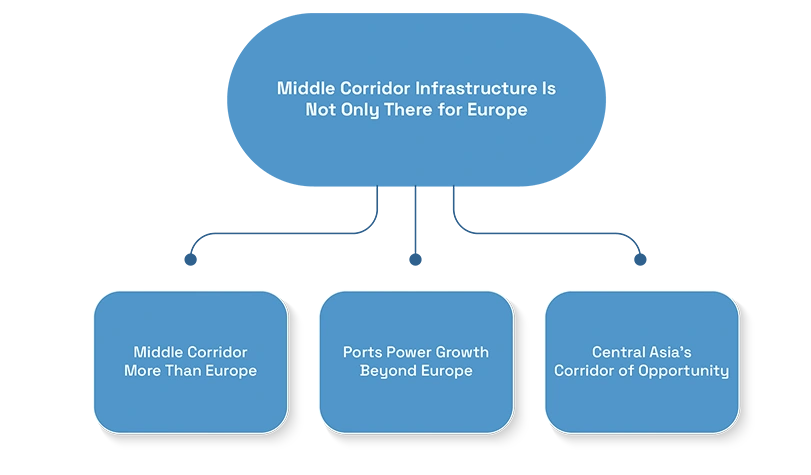
Middle Corridor Infrastructure Is Not Only There for Europe
The Trans-Caspian route is not simply created as a bypass to Europe; it also supports the expansion of trade among Central Asian economies, the Middle East, and the Indian subcontinent. Ports such as Aktau, Baku, and Turkmenbashi are expanding capacity to manage higher container throughput, which encourages regional manufacturers to use better supply chain improvement standards. Logistics organizations in the region are combining last-mile delivery services and advanced live shipment tracking systems to provide transparency across multiple administrations. For businesses depending on Importer of Record services in new trade zones, these improvements mean fewer administrative difficulties and smoother customs clearance under the varied HS code system.
Synergy with India’s Trade Strategy
India’s trade policies have increasingly focused on building various shipping and multimodal logistics dependencies rather than depending on a single route or partner economy. The Middle Corridor works with New Delhi’s vision of stronger Eurasian connectivity and provides an additional land-sea alternative that reduces exposure to seaport issues. The corridor also complements India’s desire to simplify International freight services through trusted IOR services and improved Exporter of Record definition guidelines that simplify responsibility for customs agreements.
Challenges to the Growth of the Middle Corridor
While the Trans-Caspian route is promising, many working challenges continue to slow its mass adoption. Inconsistent customs systems across multiple states, differences in HS code categorizations, and overlapping documentary requirements can increase administrative burdens. Importers who must confirm correct Importer of Record responsibilities may face agreement gaps if documents are delayed or inconsistent among customs systems. Infrastructure along the route, while improving, still requires deeper investment in high-value rail lines, systematic logistics guidelines, and a storage system that supports temperature-sensitive and valuable cargo.
Conclusion
The Middle Corridor has quickly changed from a local trade initiative into a viable alternative for India-Europe shipments. Its quick expansion shows strong possible for reducing geopolitical risk, improving logistics dependence, and allowing exporters to balance costs under difficult Incoterms and customs systems such as GSP, DAP, and DDP. While challenges remain in infrastructure, customs consistency, and harmonization of import-export documentation, ongoing investments and growing container capacity signal that the Trans-Caspian route is moving closer to becoming a scalable ‘Plan B’ for Indian trade.
DID YOU KNOW?
In the first nine months of 2024, cargo traffic on the Trans-Caspian International Transport Route (TITR), also known as the Central Corridor, increased by 70 percent to 3.4 million tons.
FAQs:
What is the Middle Corridor or Trans-Caspian Route?
It is a multimodal trade network connecting Asia and Europe through Central Asia, the Caspian Sea, and onward to Turkey and European markets, serving as an alternative to the traditional Northern route.
Why is the Middle Corridor gaining importance for India?
Geopolitical tensions and instability along major shipping routes have encouraged Indian importers and exporters to explore more reliable pathways that offer predictable logistics and diversified market access.
How does the Middle Corridor help in reducing logistics risks?
By shortening maritime exposure and using a combination of rail, road, and sea transport, the route allows for better timeline reliability, real-time tracking, and lower dependency on congested ports.
What are the biggest challenges in using the Middle Corridor?
Customs inconsistencies, varying HS code documentation requirements, limited harmonization, and ongoing infrastructure development across multiple countries still pose operational challenges.
Can the Middle Corridor support Incoterms like DDP and DAP shipping?
Yes. As logistics infrastructure improves, the route is increasingly supporting shipping models like DDP and DAP by providing clearer customs processing, stronger IOR/EOR support, and more structured documentation processes.