Introduction
The global transition to electric mobility has created a fast-growing dependency on global supply chains, and nowhere is this more apparent than in India’s dependence on China for core EV components. While India is promoting local manufacturing through various policy initiatives, a significant portion of critical EV parts still enter the country fully sourced from China. This dependence affects everything from pricing and Import duties and tariffs to Import export documentation, Incoterms selection, and the broader working of logistics for EV manufacturers and importers. As businesses evaluate agreements with the HTS Harmonized Tariff Schedule and determine correct HS code classifications, it becomes clear that the EV sector continues to face issues deeply tied to Chinese imports.
Key components are imported 100% from China.
Despite rapid innovation in India, many components remain almost completely imported from China. Lithium-ion battery cells, battery management systems, magnet motors, controllers, and advanced semiconductor chips continue to be shipped in bulk. These parts are technologically difficult and require a manufacturing chain that China has spent decades improving these systems. The absence of a local equivalent creates challenges for importers who must guide Importer of Record responsibilities, understand the impact of the generalized system of preferences (GSP) where applicable, and manage precise Import export documentation to stay compliant. Even when organizations depend on International freight services or Delivered Duty Paid service providers, the dependence on Chinese suppliers has minimal pricing flexibility and working dominion.
How dominant is China in EV imports?
China’s dominance is not just a result of low-cost manufacturing but also its combined supply chain optimization capabilities. The country has positioned itself as a global hub by controlling raw materials, refining capacity, and precision component production. For Indian EV brands, this means that the majority of core components entering the country under DAP or other Incoterms are ultimately tied to Chinese factories. Even the logistics used for shipment combination, live shipment tracking, and last-mile delivery services frequently work around China-origin cargo. While India is exploring alternative partnerships in Korea, Japan, and Europe, the huge volume and competitive pricing of Chinese parts make them difficult to replace. As a result, importers must guide HTS tax systems and HS code classifications carefully to maintain approval and cost efficiency.
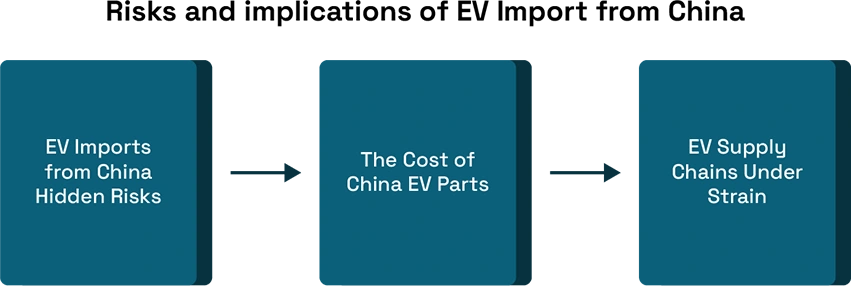
Risks and implications of EV Import from China
Importing components simply from China comes with economic, working, and geopolitical risks. High Import duties and tariffs, exchange rates, and changing customs regulations increase the cost burden on businesses. Any interruption due to trade restrictions, port delays, or approval issues can affect production timelines and market availability. Organizations must also participate in the Importer of Record responsibilities when importing under DAPs or other Incoterms, confirming everything from Exporter of Record definition approval to document accuracy. Working with Chinese suppliers also exposes businesses to possible product quality inconsistencies, where delays in verification or technical communication may grow into costly issues. Without strong Supply chain optimization plans, the EV market in India becomes unsafe due to price unreliability and unpredictable lead times.
How One Union Solutions helps you import from China
One Union Solutions simplifies the import process by providing end-to-end management customized for EV businesses that depend on Chinese components. From handling Import export documentation to managing IOR services and confirming the correct HS code and HTS classification, the company provides a smooth agreement system. Its International freight services support cost-effective shipping routes, while Real-time shipment tracking increases supply chain visibility. For businesses looking hands-off importing service, the Delivered Duty Paid service confirms duties, customs clearance, and logistics are fully managed. With a focus on Supply chain optimization, the company reduces risks related to delays, documentation inconsistency, and tariff miscalculations, helping importers stay competitive while sourcing from China.
Conclusion
India’s EV sector is growing rapidly, but the dependence on China for necessary components continues to change manufacturing costs and market dynamics. Understanding Import duties and tariffs, Incoterms, logistics challenges, and documentation requirements becomes necessary as businesses guide this dependency. By working with expert partners like One Union Solutions, importers can simplify operations, reduce risks, and maintain approval while confirming uninterrupted access to high-quality EV components. The path to EV self-reliance begins with smarter importing, major planning, and effective supply chain management.
DID YOU KNOW?
Although India’s EV market is growing rapidly, it is still inferior to China’s. Despite having an estimated 6.9 million tonnes of rare earth reserves, India is dependent on imports from China due to its underdeveloped processing capabilities.
FAQs:
- Why does India depend heavily on China for EV components?
India relies on China because China controls battery cell manufacturing, semiconductor production, magnet motors, BMS systems, and raw material refining. India currently lacks the large-scale manufacturing ecosystem to produce these components locally.
- Which EV components are still imported 100% from China?
Key components such as lithium-ion battery cells, BMS units, controllers, magnet motors, wiring assemblies, and advanced power semiconductors are almost entirely imported from China due to their technical complexity.
- What are the major risks of importing EV parts from China?
Risks include high import duties, tariff fluctuations, geopolitical tensions, port delays, HS code misclassification, quality inconsistencies, and supply chain disruptions affecting production timelines.
- How do Incoterms like DAP or DDP affect EV imports from China?
Incoterms define cost and responsibility sharing. Under DAP, the importer handles customs duties and clearance. Under DDP, the supplier or service provider manages duties, taxes, and delivery, making the process simpler but often more expensive.
- How can One Union Solutions support EV imports from China?
One Union Solutions manages end-to-end importing: HS code classification, Importer of Record (IOR) services, customs documentation, freight booking, real-time tracking, DDP shipping, and supply chain optimization to reduce delays and compliance risks.