
Introduction
As the EU–UK trading landscape continues to develop in 2026, businesses on both sides are challenged with new layers of complexity at the border. Customs checks, Import export documentation, Import duties and tariffs, HS code and HTS Harmonized Tariff Schedule verification, and Incoterms decisions such as DAP or Delivered Duty Paid service have become central to cross-border planning. Many organizations that once moved goods smoothly across the Channel now face issues that hugely affect logistics performance and working continuity. This growing pressure on border systems is changing supply chain optimization for European and UK traders, specifically as governments implement new security and approval systems.
New biometric systems are causing delays at the EU-UK borders
A major contributor to blockage in 2026 is the introduction of new biometric checks across EU-UK borders. These systems, intended to increase security, require delivery, mainly drivers involved in International freight services and last-mile delivery services, to complete face scans, fingerprint verification, and real-time identity confirmation before entry. While effective in theory, these biometric processes have led to slower vehicle movements and extended waiting times at critical ports. For businesses depending on predictable timelines under Incoterms such as DAP and DDP, any disruption in the customs clock directly impacts delivery scheduling and inventory turnover. Even companies benefiting from preferential arrangements under the generalized system of preferences (GSP) have not been spared from these delays, as biometric queues apply to all categories of shipments regardless of tariff benefits.
Key EU–UK Border-Related Costs in 2026
Border delays now translate into measurable financial burdens. Every additional hour spent waiting at customs results in increased demurrage, overtime, warehousing expenses, and storage consumption, placing heavy strain on logistics budgets. Slow processing of HS code and HTS classifications also triggers approval reviews that can lead to temporary holds on goods. Moreover, the Importer of Record for UK-bound shipments has expanded, with authorities demanding stronger evidence of product origin, valuation, and regulatory conformity. This creates a heavier administrative load, mainly for companies unfamiliar with the Exporter of Record definition and issues. Real-time shipment tracking has become necessary to maintain visibility, yet even the best systems cannot eliminate congestion created by manual inspections and biometric queues. As a result, businesses face cascading costs across the complete supply chain, from procurement to final distribution.

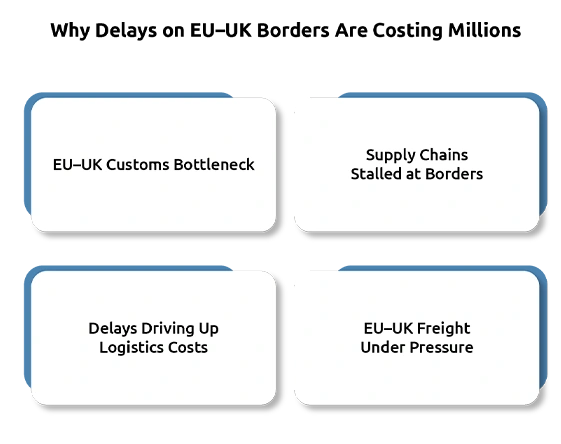
Why Delays on EU–UK Borders Are Costing Millions
The increasing effect of these delays is valuable. When vehicles carrying high-value goods are held at borders, production schedules collapse, retail availability declines, and buffer stock requirements increase. These disruptions reduce supply chain optimization efficiency, forcing organizations to maintain larger inventories to reduce uncertainty. For industries working under lean logistics methods, even minor delays can grow rapidly into six-figure monthly losses. The wave effect extends further when penalties are imposed for late deliveries under DAPs or other Incoterms arrangements. Also, long queues reduce the capacity of carriers to complete multiple deliveries per day, weakening throughput and increasing freight rates. For manufacturers, the customs clock becomes more than a procedural delay; it becomes a huge working risk that affects profitability across the board.
How does One Union Solutions help you to reduce delays at–EU-UK Borders?
One Union Solutions plays a crucial role in minimising these border-related inefficiencies. By managing IOR services, handling all Importer of Record responsibilities, and confirming approval with HS code classification, they stop customs that frequently lead to detention. Their expertise in Import export documentation reduces processing errors, while their coordination of International freight services confirms that each good moves under the most suitable Incoterms, whether DAP, DDP, or others. Through live shipment tracking, strategic Supply chain optimization, and simplified last-mile delivery services, we help businesses maintain predictable timelines even amid biometric system slowdowns. Their Delivered Duty Paid service further simplifies customs clearance by allowing companies to transfer agreement and tax burdens to a single accountable partner.
Conclusion
As 2026 brings more biometric guidance and regulatory security, the cost of delays at EU–UK borders is set to rise. Organizations that mainly strengthen their logistics plans, refine their Incoterms choices, and partner with agreement providers such as One Union Solutions will be better positioned to protect their supply chains from disruptions. The customs clock is ticking, and only those prepared for its challenges will stay competitive in the growing European trading environment.
DID YOU KNOW?
According to the United Kingdom’s import statistics, the UK’s imports from the European Union in 2024 were $336.78 billion, up 3% from the previous year. According to the United Kingdom’s export statistics, the total value of UK exports to the European Union in 2024 reached $212.18 billion, down 4% from the previous year. The total value of UK-European Union trade in 2024 exceeded $548 billion.
FAQs:
- Why are EU–UK border delays increasing in 2026?
Delays are rising due to new biometric security checks, stricter HS code and HTS classification reviews, increased customs documentation requirements, and higher inspection rates at ports.
- How do biometric checks affect delivery timelines?
Biometric scans for drivers, such as face and fingerprint verification, slow down vehicle movement, creating long queues and increasing customs processing times.
- What types of costs do border delays create for businesses?
Businesses face demurrage fees, storage charges, overtime payments, increased freight rates, disrupted schedules, and higher buffer stock requirements.
- How can companies reduce delays at EU–UK borders?
Companies can improve documentation accuracy, verify HS codes, adopt the right Incoterms, use real-time tracking, and partner with professional IOR/EOR service providers like One Union Solutions.
- What role does One Union Solutions play in minimizing border delays?
One Union Solutions manages Importer of Record (IOR) responsibilities, ensures accurate HS code classification, handles customs documentation, provides DDP services, and optimizes freight movement to reduce delays.