Introduction
Global trade is entering an era where rules are no longer just rules; they are major tools. As economies change toward decarbonization, compliance systems, carbon reporting mandates, and cross-border regulations are increasingly changing how nations negotiate power. Businesses working in logistics, International freight services, and cross-border supply chains now see a service where import-export documentation, Import duties and tariffs, and real-time shipment tracking systems are no longer simply operational necessities but components of geopolitical change. Even conventional systems such as the generalized system of preferences (GSP), HTS Harmonized Tariff Schedule classifications, and HS code-related related are being reevaluated as countries attempt to maintain their use in the global trade.
Why is Trade Weaponization Intensifying?
Trade weaponization is gaining momentum because nations are using market access as a major tool during a period of economic adjustment. As carbon reduction becomes a central global priority, compliance obligations around emissions, sourcing standards, and Importer of Record responsibilities are increasingly becoming necessary tools. Countries are also using tariff changes, Incoterms interpretations, and the difficult application of HTS and HS codes to pressure trading partners. The growth of Delivered Duty Paid service expectations, along with strong IOR services audits, demonstrates how governments are changing administrative scrutiny. Even predictable trade setups, such as DAP and DAPs deliveries, are facing new layers of verification. These systems create friction for companies that depend on stable Supply chain optimization methods, pushing them to rethink both the Exporter of Record definition boundaries and operational transparency.

What Are the Global Consequences of Trade Weaponization?
As compliance changes into a form of economic control, businesses worldwide face increased insecurity. Countries can impose carbon-linked tariffs or alter their interpretation of Import duties and tariffs with disrupting logistics and causing shipment delays. For exporters, even small variations in HS code uses or HTS Harmonized Tariff Schedule categorization can result in penalties, customs holds, or loss of preferential treatment under systems such as the generalized system of preferences (GSP). Also, real-time shipment tracking and last-mile delivery services now carry more than operational value; they are proof points in demonstrating regulatory system and supply chain transparency. These issues excessively affect developing economies that depend on affordable International freight services and predictable Supply chain optimization plans. The result is a growing gap in global competitiveness, where agreement loads work as trade issues.
The Role of Carbon Border Adjustments in Global Trade
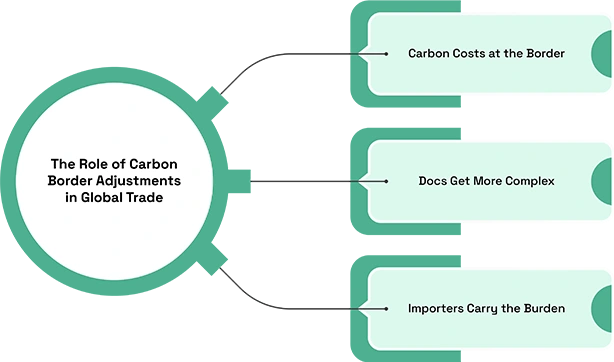
Carbon Border Adjustment Mechanisms (CBAMs) are becoming one of the most powerful tools in modern trade policy. Positioned as environmental systems, they effectively allow countries to impose carbon-based import fees on goods arriving from regions with looser climate rules. This strategy directly changes Import duties and tariffs and indirectly pressures exporters to use greener production methods. For businesses, CBAMs complicate Import export documentation, requiring more detailed carbon disclosure and accurate product classification under HS code and HTS guidelines. These carbon-linked checks extend across the supply chain from International freight services to last-mile delivery services, where carbon presence is tracked more accurately. Incoterms interpretations, specifically for DAP, DAPs, and Delivered Duty Paid service, further determine who supports these carbon-related compliance costs, placing increased responsibility on the Importer of Record and changing how cross-border agreements are made.
How Compliance Is Weaponized and Why It Matters
Compliance is becoming a geopolitical instrument because regulatory systems are increasingly personal. Governments can redefine Audit expectations for IOR services, change entry requirements for Exporter of Record definition approval, or scrutinize logistics data from real-time shipment tracking systems to create pressure on global companies. Once neutral tools, such as Import duties and tariffs, or the application of HTS and HS codes, can be used to block market entry or raise operational costs without clearly breaking trade agreements. This trend matters because it changes the balance of power in global trade.
Conclusion
The weaponization of compliance signals a new era of carbon-adjusted global trade where rules work as a major benefit. As countries intertwine climate policy with economic changes, businesses must review their logistics system, dependence on International freight services, and mastery of Import export documentation. Whether guiding carbon border adjustments, following with changing Incoterms, or strengthening IOR services and EOR services, organizations must prepare for a world where regulatory precision is as critical as product quality.
DID YOU KNOW?
Global industry accounts for 8-10% of global CO2 emissions, and deep decarbonization is necessary to achieve the goals set in the Paris Agreement.
FAQs:
- What does “weaponization of compliance” mean in global trade?
It refers to countries using regulatory systems such as carbon reporting, tariff adjustments, and HS/HTS classifications to gain political or economic leverage over trading partners without violating trade rules.
- How do Carbon Border Adjustment Mechanisms (CBAMs) impact importers?
CBAMs impose extra carbon-linked fees on imported goods, forcing importers to prove low-emission production, update documentation, and follow stricter HS/HTS classifications.
- Why are HS codes and HTS classifications becoming more critical?
Countries increasingly use minor variations or strict interpretations of HS/HTS codes to impose additional duties, delay shipments, or restrict access to preferential tariff systems like GSP.
- Which businesses are most affected by trade weaponization?
Companies dependent on cross-border supply chains, international freight services, IOR/EOR compliance, and carbon-heavy manufacturing processes face the greatest risk.
- How can companies prepare for carbon-adjusted global trade?
By improving Import export documentation accuracy, strengthening IOR/EOR compliance, adopting carbon tracking systems, and restructuring supply chains to reduce emissions and regulatory exposure.