Insight
Global companies functioning within the aviation, automobile, IT, and medical equipment sectors need efficient import-export management as a priority. IOR and EOR represent essential services for international trade operations since they work in separate operational areas. This article investigates the fundamental differences between IOR and EOR services and their appropriate application and scenarios for operational streamlining capabilities. The knowledge of these export-import services lets companies stay compliant with laws while preventing legal problems that maintain international delivery paths.
Emerging Trends in IOR and EOR Services
With the growth of global trade and digital transformation, IOR and EOR services are becoming more technology-driven. Many companies now use AI-based compliance tools, automated documentation systems, and real-time tracking platforms to reduce manual errors and speed up customs processes. Regulatory frameworks guided by organizations like the World Customs Organization are also evolving, pushing businesses to adopt smarter and more transparent trade practices. This shift is making IOR and EOR services faster, more accurate, and highly scalable for global operations.
Improving Global Trade Efficiency with IOR and EOR Services
Global trade becomes easier when import and export processes are managed correctly. IOR and EOR services help businesses prepare the required documents, follow customs rules, and handle duties and taxes. This helps goods move between countries without unnecessary problems. It also reduces the chance of delays & compliance issues. With reliable support, businesses can improve delivery performance, enter new markets more easily, & keep their global operations running smoothly.
What is an Importer of Record (IOR)?
The entity that handles the duty of care to ensure imports meet local laws and regulations is the Importer of Record (IOR). The Importer of Record (IOR) services are mandatory during goods importations, particularly within the aviation and medical equipment industries, to meet essential safety and regulatory standards.
Through the Importer of Record function, the entity declares customs to authorities and presents payment for customs duties while checking that imported items follow regional standards. The IOR enhances customs procedure efficiency by managing all necessary documentation and collaborating with customs departments for regulatory compliance.
What is EOR (Exporter of Record)?
A company serving as an Exporter of Record is responsible for executing legal exports by following all regional export requirements. An EOR takes charge of export operations by providing applicable documentation to foreign authorities and facilitating payments linked to export regulations.
Export businesses that deal with valuable and delicate products like aviation equipment and medical devices must utilize an EOR as a core export service. Through its legal expertise, the EOR manages export processes for businesses by providing complete legal handling to ensure goods’ safe and legal delivery to their intended location. An EOR enables businesses to produce or operate their products peacefully because professional export handling oversees operations.
Documents required for IOR and EOR services?
Both Importer of Record (IOR) and Exporter of Record (EOR) services require a set of important documents to ensure smooth customs clearance and compliance with international trade regulations. For IOR services, key documents include a commercial invoice with product and pricing details, a packing list describing the shipment contents, and a Bill of Lading or Air Waybill for transportation. Importers may also need an import license for restricted goods, the correct HS Code for product classification, customs declaration forms, a tax identification number (such as VAT or EIN), and a Certificate of Origin.
Key Differences Between IOR and EOR Services
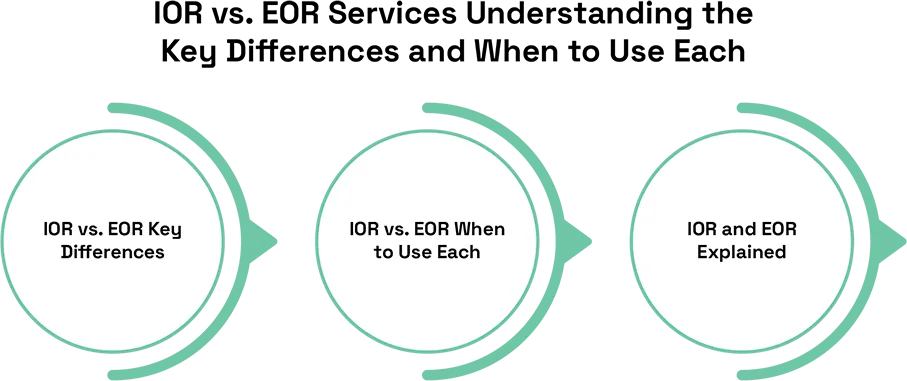
IOR and EOR services mainly differ in their roles. The Importer of Record (IOR) is responsible for handling imports, making sure all local laws are followed, and ensuring the correct documents for customs clearance. The Exporter of Record (EOR), on the other hand, manages exports and ensures that goods leave the country legally according to both local and international rules.
In simple terms, IOR helps bring goods into a country, while EOR makes sure goods are sent out properly. Both services focus on legal compliance, but they work at different stages of the supply chain.
Industries like aviation, medical, and IT often need both IOR and EOR services to move goods smoothly across borders. Depending on your business needs, you may require one or both services to make your global trade operations more efficient.
When to Use IOR and EOR Services
When companies need to ship goods into a country, they use IOR (Importer of Record) services. To make sure that the shipment follows with local rules, the IOR handles customs problems, import documents, taxes, and charges.
When companies exporting goods to another country, businesses need EOR (Exporter of Record) services. The EOR is in to handle export documents, licenses, and compliance rules, making sure that goods are exported legally. Using IOR and EOR services can help businesses avoid delays, reduce customs issues, and ship products more smoothly over global borders.
Benefits of IOR and EOR Services
IOR Benefits
Businesses can ensure product compliance with regulations while IOR services handle tax and customs payments correctly. IOR services prevent companies from facing customs delays while avoiding penalties. Airline and medical equipment industries benefit from IOR services, which enable swift and efficient imports with reduced chances of non-compliance and maintained shipment timetables.
EOR Benefits
EOR services ensure that exports are legally compliant, with all required documentation completed and necessary duties paid. This is especially important in industries like IT or medical equipment, where specialized documentation and export compliance are required. EOR services handle all the paperwork, ensuring that goods are legally and securely shipped to their destination, without delays or issues.
Conclusion
The services of IOR and EOR prove crucial for businesses that exchange international trade, particularly if their core products include premium and detailed equipment such as aviation and medical devices and IT infrastructure. IOR services guide business imports through complicated procedures, but EOR services help businesses manage their exports with legal and operational efficiency. Businesses achieve operational streamlining, regulatory compliance, and legal protection by clearly understanding service timing between IOR and EOR.
Did You Know,
Companies that work with IOR and EOR services decrease their compliance risks by 25% and obtain a 25% increase in logistics process efficiency.
Frequently Asked Questions
Why is compliance important in international trade?
Compliance helps businesses follow import and export rules, avoid delays, fines, and customs problems, and keep shipments moving smoothly.
Can small businesses benefit from IOR and EOR services?
Yes. Small businesses can use these services to handle complex import and export rules without needing a large in-house trade team. This helps them expand into new markets with greater confidence.
Can I use IOR and EOR services together?
Yes, you can use both services together for smoother global operations. IOR handles imports, while EOR manages exports.
Are IOR and EOR services useful for high-value equipment?
Yes. They help high-value equipment such as servers, medical devices, and aviation parts move across borders smoothly while meeting all customs and compliance requirements.
What methods should I use to determine whether my business meets international regulations standards?
Businesses which use IOR and EOR providers stay compliant with import and export regulations thus reducing legal problems and delays.