
Introduction: Understanding Neutral Hubs in Aerospace Trade
Global aerospace trade depends on the smooth and safe movement of high-value parts across different countries. But today, things are becoming more complicated. Due to increasing geopolitical tensions, sanctions, and strict trade rules, many direct shipping routes are no longer easy to use.
Because of this, “neutral hubs” have become very important. These are safe & stable locations where goods & items can pass through without facing major rules. They act as trusted transit issues that help keep global shipments moving smoothly.
Neutral hubs are usually countries with simple trade guidelines, fewer restrictions, & strong customs systems. They help to make sure that goods & items are moved without any delays or compliance issues. These hubs are particularly necessary for industries like IT, aviation, medical, & automotive, which depend heavily on fast & reliable global supply chains.
Why Aerospace Trade Routes Are Becoming Restricted
Aerospace trade routes are evolving more difficult due to several reasons. Governments are applying stricter rules like sanctions, export controls, & airspace restrictions. Because of this, direct shipping routes are no longer simple & usually involve more steps and checks.
At the same time, compliance needs have become stricter. Companies must use the correct HS code, follow the HTS Harmonized Tariff Schedule, & prepare proper papers based on Incoterms. These rules must be followed carefully to avoid issues during shipping.
For example, exporters need to deliver accurate customs details & follow programs like the generalized system of Preferences (GSP) when applicable. Even a small mistake in customs clearance documents can lead to delays, fines, or even rejection of shipments.
Due to these challenges, companies are now reviewing their international logistics strategies. They are looking for better & safer routes that help them stay compliant while maintaining their processes smooth & efficient.
The Role of Neutral Hubs in Aerospace Logistics
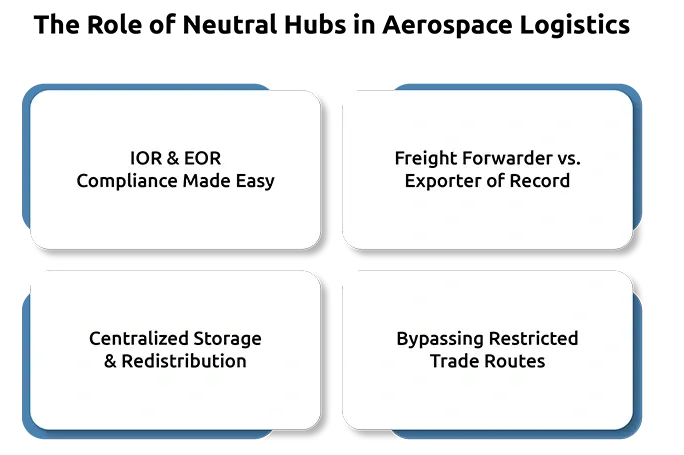
Neutral hubs help make complex trade routes easier to manage. They act as middle points where businesses can reroute shipments through areas with fewer restrictions. This makes cross-border shipping services smoother and more reliable.
For companies handling sensitive aerospace equipment, using Importer of Record services and Exporter of Record services at these hubs is very important. These services make sure all legal and compliance requirements are properly managed. This is especially helpful when businesses are not fully sure about the rules in restricted regions.
Many companies also depend on global freight forwarding and international freight services to handle these operations. Freight forwarders support with shipping, paperwork, & coordination. However, the legal responsibility of being an exporter of record usually belongs to a specialized provider with strong compliance knowledge. This allows us to ensure all rules are followed perfectly & reduces the risk of delays, fines, or other problems.
Neutral hubs also enhance goods and order management. They act as central points where goods can be stored, repackaged, or redistributed. This allows companies to handle their shipments more efficiently while always following all trade rules.
Key Benefits of Using Neutral Hubs
Neutral hubs offer many important benefits for aerospace and other high-tech industries. One of the biggest advantages is better compliance. These hubs have strong customs compliance solutions in place, which help companies to manage documentation and follow rules correctly. This makes the customs clearance process smoother and reduces the chances of errors.
Another key benefit is decreased risk. By avoiding limited trade routes, companies can reduce the possibilities of delays, fines, or shipment seizures. Neutral hubs also improve logistics efficiency. With access to reliable international logistics solutions, businesses can handle their shipments more effectively, save time, and reduce delays in transit.
Cost savings are another important factor. Using neutral hubs allows companies to plan better routes, which supports supply chain optimization and helps avoid unexpected costs. In addition, businesses gain more flexibility. They can fast adjust to changing rules & regulations without impacting their processes, including complicated systems like the automotive manufacturing supply chain or aviation logistics.
Moreover, modern tools like the best trade compliance software for import export laws make it more comfortable to remain updated with changing laws, manage documents, & provide accuracy in every shipment. Overall, neutral hubs allow businesses to operate more smoothly, safely, and efficiently in global trade.
Future Trends: The Growing Importance of Neutral Hubs
As international trade keeps changing, neutral hubs are becoming even more important. Businesses are now investing in various logistics networks so they don’t have to depend on just one route or area. This helps them stay flexible and avoid trouble.
Technology is also transforming logistics. Automated customs clearance, AI-driven supply chain optimization, & other digital tools are making it easier to manage difficult global shipments. These innovations allow businesses to move goods faster, more efficiently, and with fewer mistakes.
Industries like IT, aviation, medical, and automotive will increasingly depend on reliable Importer of Record services & strong global freight forwarding partners. Neutral hubs will continue to be essential points in making trade smooth and compliant, especially in regions with strict rules and complicated regulations.

Conclusion
Neutral hubs have emerged as a solution to the increasing challenges in aerospace trade. They give a safe, flexible, and efficient way for companies to keep their global processes handling smoothly.
For businesses involved in global trade, mainly in high-value industries like IT, aviation, medical, and automotive, using neutral hubs is no longer just an option; it’s a need. By connecting the right logistics solutions, strong adherence support, and careful planning, businesses can guide trade rules effectively and make supply chains that are reliable and resilient.
Did you know?
Aerospace supply chain disruptions have created a backlog of over 17,000 aircraft orders, causing major delivery delays worldwide.
FAQs
- What are neutral hubs in aerospace trade?
Neutral hubs are countries or regions with stable trade policies and fewer restrictions. They act as safe transit points where aerospace shipments can pass through smoothly without major compliance issues. - Why are aerospace trade routes becoming restricted?
Aerospace trade routes are restricted due to sanctions, export controls, airspace limitations, and stricter global trade regulations. These factors make direct shipping more complex and time-consuming. - How do neutral hubs help in global logistics?
Neutral hubs simplify complex routes by allowing businesses to reroute shipments through compliant regions. This helps reduce delays, improve customs clearance, and ensure smooth cross-border shipping. - What is the role of Importer of Record (IOR) services in neutral hubs?
Importer of Record services handle legal and compliance responsibilities for imports. In neutral hubs, they ensure that all documentation and regulations are properly managed to avoid risks and delays. - Can neutral hubs reduce supply chain risks?
Yes, neutral hubs help reduce risks by avoiding restricted routes, minimizing compliance errors, and ensuring smoother logistics operations across global supply chains.