Overview
The global aviation industry is in transition where national security and technological control are important aspect as important as innovation and efficiency. The expansion of exports is one of the most important developments in 2026 is bans on critical avionics—key electronic systems used in aircraft such as navigation, communication, and flight control systems. Globally, governments are increasingly restricting exporting these high-value components to preserve strategic advantages and safeguard critical technologies.
This shift marks the beginning of a new era of aviation protectionism. For businesses involved in import-export operations, particularly those supporting IT, aviation, medical, and automotive sectors, both complication and opportunity are brought about by these shifts. These limitations apply to industries other than aviation since avionics components frequently have technological similarities.
Major Aspect of A New Era of Aviation Protectionism
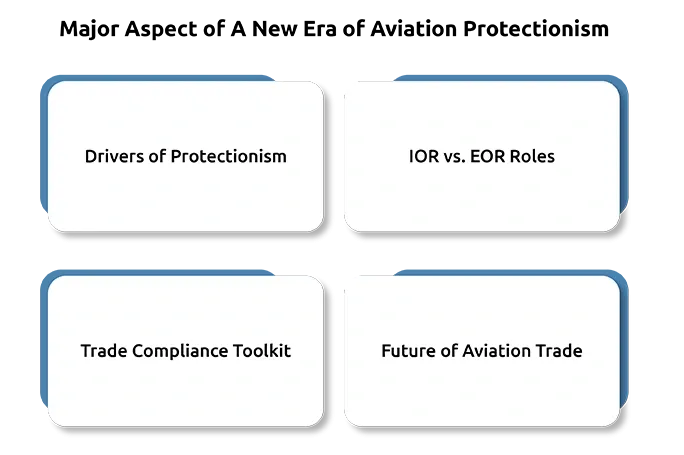
The urge to protect is what fuels aviation protectionism is intellectual property, national security interests, and technological leadership. Countries are more focusing on the tightening regulations on the export of advanced avionics to stop misuse or illegal access. This includes restrictions on systems that involve artificial intelligence, advanced sensors, and secure communication technologies.
Important factor is the growing fragmentation of global supply chains. Businesses cannot rely on a single global network for sourcing components. Instead, they must develop region-specific strategies to make sure continuity. This has increased the importance of supply chain optimization, as businesses seek to reduce dependency on restricted markets.
Compliance is a further significant component. Companies must carefully navigate evolving regulations to avoid penalties and shipment delays. The application of organized classification schemes such as HS code and HTS harmonized tariff schedule helps to make sure accurate documentation and smoother customs clearance processes. Plus, clearly defined trade terms through Incoterms like DAP and DAPs help businesses manage responsibilities and risks in cross-border transactions.
Importer of record service and exporter of record services play a significant role in making sure that shipments meet all regulatory requirements and follow all the rules. Businesses are also increasingly adopting the best trade compliance software for import export rules to handle complex documentation and regulatory checks efficiently.
Export Bans on Critical Avionics
Export bans on critical avionics are primarily focused on technologies that are regarded as dual-use or sensitive—that is, they can be used for both civilian and military purposes. These include encrypted communication devices, flight control software, and sophisticated radar systems.
Such bans are reshaping how companies approach international freight services and cross-border trade. Companies now need to carry out comprehensive risk assessments before engaging with suppliers or customers in certain regions. This has led to increased reliance on compliance frameworks and stricter internal controls.
The move to local manufacturing centers is another effect of these prohibitions. Companies are investing in localized production to reduce exposure to export restrictions. This approach not only helps mitigate risks but also supports faster delivery and improved inventory and order management.
For companies that import and export, understanding whether a customs broker can handle both import and export documentation has become increasingly important. Combined solutions that incorporate compliance, documentation, and transportation are now preferred to ensure seamless operations in a setting with strict regulations.

Advantages and Disadvantages
Advantages:
Among the main advantages of export Sensitive technology are protected by bans. By limiting access, nations can continue to have a competitive advantage and prevent the misuse of advanced avionics systems. Additionally, this supports domestic innovation, since businesses are investing more on research and development to lessen dependency on foreign technologies.
Additionally, these restrictions can lead to the development of stronger regional supply chains. Businesses are motivated to build partnerships within trusted markets, It can lessen the dangers brought on by global uncertainty and increase resilience.
Disadvantages:
On the opposite side, export bans can disrupt global trade flows and increase operational costs. Businesses may experience sourcing delays in critical components, leading to production slowdowns. The necessity of locating substitute providers or establishing new manufacturing facilities can also require significant investment.
Moreover, increased regulatory complexity can create challenges for compliance. Companies need to make sure that all documentation is correct and keep up with evolving regulations. Resources may be strained as a result, especially for smaller enterprises.
An additional drawback is the potential for the fragmentation of the market. As countries adopt different policies, the global aviation industry may become less interconnected, decreasing chances for cooperation and creativity.
Conclusion
Export bans on critical avionics signal a major shift toward aviation protectionism in 2026. Although these steps are intended to protect the addition to national interests and technological advancements, they also present new difficulties for international trade.
For those who are working in import-export industries across IT, aviation, medical, and automotive industries, the most important aspect is adjusting to this shifting environment. By leveraging international freight services, adopting advanced compliance tools, and focusing on supply chain optimization, companies can navigate these complexities effectively.
As the businesses continue to grow on a larger side, being informed and flexible will play an key role to maintaining competitiveness and make sure long-term achievement in a global market that is more divided and regulated.
DID YOU KNOW
“Global GDP has stayed just above 3% over the past couple of years and was expected to do so also over the next few years.”
FAQs
- What are export bans on critical avionics?
These are government restrictions on exporting sensitive aircraft electronic systems to protect national security and advanced technologies. - Why are countries imposing avionics export bans?
To safeguard strategic technologies, prevent misuse, and maintain a competitive advantage in the aviation sector. - How do export bans affect global supply chains?
They disrupt sourcing, increase costs, and force companies to shift toward regional suppliers and manufacturing hubs. - Which industries are impacted by avionics export restrictions?
Apart from aviation, sectors like IT, automotive, and medical equipment are also affected due to shared technologies. - How can businesses adapt to aviation protectionism?
By strengthening compliance practices, diversifying suppliers, and investing in efficient supply chain and documentation systems.