
Global aerospace supply chains are seeing one of their most difficult problems in years as geopolitical sanctions mostly target critical avionics components such as navigation systems, sensors, semiconductors, and flight-control electronics. These highly modern parts are frequently shipped from a minimum number of certified suppliers, making the industry mostly unprotected by export restrictions and approval problems. Sanctions connected to geopolitical problems and improving export controls on dual-use electronics have difficulty in international freight services, customs clearance, and regulatory agreements, leading organizations to look for global logistics plans.
Global Sanctions in Aviation
What Are Sanctions?
Sanctions are political & economic measures applied by governments to restrict trade & financial activities with specific countries, organizations, or individuals. These restrictions often aim to address security concerns, political conflicts, or violations of international law.
Why Aviation Is Highly Affected
Aviation is mainly difficult because it depends on cross-border collaboration. Aircraft are built using components from different regions, & airlines depend on global suppliers for maintenance & repairs. When sanctions target specific countries or entities, they disrupt not just direct trade but also the broader supply chain network.
Rising Aviation Costs & Compliance Complexity Under Global Sanctions
Sanctions affect aviation costs mainly through restricted access to certified avionics suppliers. Aircraft manufacturers mainly depend on globally combined production networks where components cross borders multiple times under established Incoterms such as DAP and DAPs. When export controls increase, these trade shipments weaken significantly. Tariffs & sanctions have increased approval requirements connected to HS code categorizations and the HTS Harmonized Tariff Schedule.
Even small documentation delays can stop shipments because avionics components require strict licensing approvals. Also, sanctions have forced airlines to operate older aircraft longer in the supply chain. The global aircraft backlog has surpassed 17,000 jets, nearly 12 years of production capacity, getting maintenance demand higher globally. Higher maintenance frequency increases dependence on importer of record service providers and exporter of record services to legally move restricted components across administrations. Organizations are also reevaluating whether a freight forwarder can be an exporter of record to simplify compliance & delivery.
Key Challenges in Aerospace Supply Chain Management After Sanctions
Limited Supplier Warehouse
Critical avionics components are certified for safety, meaning replacements cannot easily be sourced from various vendors. A disruption at one supplier can spread across the complete aerospace ecosystem.
Regulatory and Documentation Burden
Organizations must verify whether a customs broker can manage both import & export documentation while confirming approval with sanctions guidelines & export control terms.
Cost Changing
Tariffs on electronics & metals have developed component prices, while renting rates for aircraft & engines have increased by 20–30% compared to pre-2019 levels.
Visibility Gaps
Many aerospace supply chains still need real-time tracking across multi-tier suppliers, making risk projection difficult in global trade.
Financial Barriers & Payment Challenges
Restricted Banking Channels
Sanctions often limit access to global banking systems, making it difficult for companies to process payments. This can delay transactions & disrupt procurement cycles for useful aircraft components.
Increased Transaction Risks
Businesses may face more serious financial problems due to uncertain payment channels. In some cases, companies must depend on alternative financial arrangements, which can be costly & not secure.
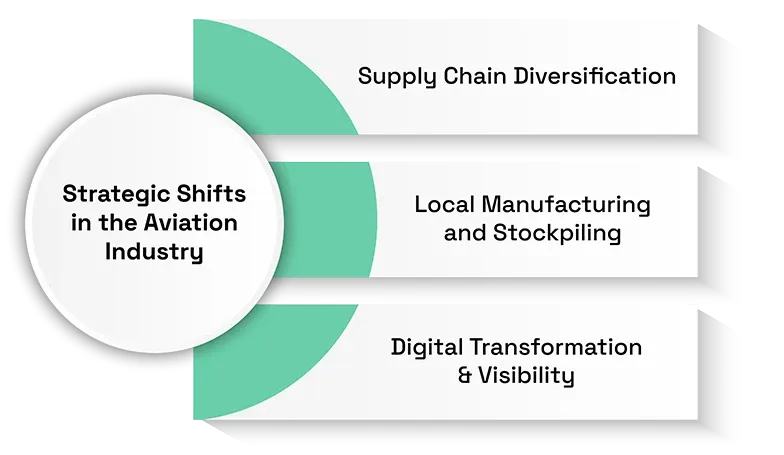
Strategic Shifts in the Aviation Industry
Supply Chain Diversification
To reduce dependency on restricted regions, aviation companies are diversifying their supplier base. By sourcing components from multiple countries, businesses can minimize the impact of sanctions & manage continuity.
Local Manufacturing and Stockpiling
Some organizations are investing in local production capabilities or maintaining larger inventories of critical parts. While this approach increases upfront costs, it provides greater resilience against supply disruptions.
Digital Transformation & Visibility
Technology is playing a main role in managing supply chain challenges. Advanced tracking systems & digital platforms help companies manage shipments, ensure compliance, & identify risks in real time. Improved visibility enables better decision-making & faster response to disruptions.
Role of IOR & EOR Services
Simplifying Compliance
Importer of Record & Exporter of Record services have become necessary in navigating the difficulties of global sanctions. These service providers manage regulatory requirements, documentation, & customs clearance on behalf of businesses.
Ensuring Smooth Operations
By using IOR & EOR expertise, aviation companies can avoid delays, minimize compliance risks, & manage easy operations even in highly regulated environments.
Industry Collaboration & Adaptation
Working with Regulatory Bodies
Airlines, manufacturers, & governments are improving & collaborating to address the challenges posed by sanctions. Industry associations are advocating for clearer regulations & streamlined processes to minimize disruptions.
Balancing Politics & Connectivity
Governments face the challenge of enforcing sanctions while managing international connectivity. Aviation plays a critical role in international trade & travel, making it useful to strike a balance between political objectives & economic stability.

Conclusion
Sanctions on critical avionics have changed aerospace logistics, exposing problems in the globally connected supply chain. Growing approval difficulty, longer lead times, & growing maintenance costs are quickly causing airlines & manufacturers to rethink transportation plans & operational methods. As geopolitical uncertainty continues, aerospace organizations that invest in digital supply chains, approval automation, & flexible logistics partnerships will be better situated to cover risk. In an environment where avionics availability directly affects aircraft operations, a flexible supply chain is no longer a complete advantage; it has become a working necessity.
Did you know?
Operators are shifting toward programmatic stock positioning, trading the gamble of ad-hoc sourcing for long-term certainty. It’s why 60% of new MRO contract value is now tied to these programmatic setups.
FAQ
1. How do global sanctions impact aircraft component supply chains?
Global sanctions disrupt aircraft component supply chains by restricting access to key suppliers, limiting cross-border trade, and increasing regulatory checks. This often leads to delays in sourcing certified parts, higher costs, and operational inefficiencies for airlines and manufacturers.
2. Why is the aviation industry highly affected by sanctions?
The aviation industry relies on a global network of manufacturers and suppliers. Since aircraft components are sourced from multiple countries, any restriction on trade or export controls can interrupt the entire supply chain, making aviation especially vulnerable to sanctions.
3. What challenges do airlines face due to sanctions on aircraft parts?
Airlines face multiple challenges, including delays in maintenance, a shortage of certified components, increased compliance requirements, and higher operational costs. In some cases, they are forced to use older aircraft longer due to the limited availability of new parts.
4. How do Importer of Record (IOR) and Exporter of Record (EOR) services help in sanctioned environments?
IOR and EOR services help businesses manage complex regulations by handling documentation, licensing, and customs compliance. They ensure that aircraft components are imported or exported legally, reducing the risk of penalties and shipment delays.
5. What strategies are companies using to overcome aviation sanctions?
Companies are adopting strategies such as diversifying suppliers, investing in local manufacturing, increasing inventory levels, and using digital tools for better supply chain visibility. Many also rely on compliance experts and logistics partners to navigate evolving regulations effectively.