Introduction
As global trade becomes increasingly digitized, businesses are redefining how they manage customs, logistics, and Import export documentation. The requirement for faster approvals, accurate tariff reporting, and automatic approval with trade rules has become more urgent, mainly when dealing with Free Trade Agreements, Import duties and tariffs, and Incoterms shipping processes. Modern global freight services now depend heavily on digital tools, including blockchain and AI-powered systems, to simplify cross-border shipments and confirm quick trade documentation verification. These innovations change how importers, exporters, and IOR services work, working directly to supply chain optimization and faster cargo movement across borders.
Key functions of blockchain in customs and compliance
Blockchain plays a vital role in creating secure trade that customs authorities and supply chain partners can trust. Instead of depending on manual paperwork, every step from HS code or HTS Harmonized Tariff Schedule classification to invoicing, country of origin validation, and tariff Importer of Record responsibilities, Exporter of Record definition requirements calculations is automatically logged in a shared digital register. This confirms that certificates of origin verification and cargo ownership records are always accurate and accessible to customers. Blockchain also strengthens workflows for Delivered Duty Paid service, DAP, and DAPs shipping terms, which depend heavily on clear cost systems and correct calculation of customs dependabilities. When combined with live shipment tracking, blockchain confirms that auditors and customs officers can instantly view the full shipment history from origin to last-mile delivery services.

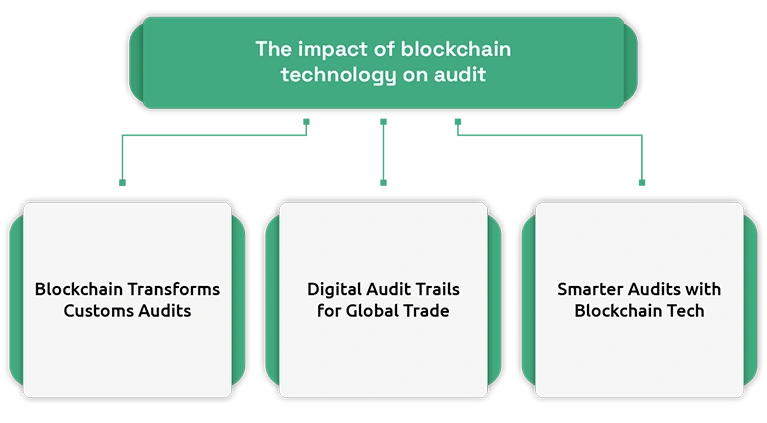
The impact of blockchain technology on audit
Auditing is one of the most difficult challenges in cross-border freight because customs authorities are required to verify documents, values, tariff codes, duties, taxes, and trade preferences such as those under the generalized system of preferences (GSP). Before digitization, this frequently required manual recovery of old paperwork and work among multiple brokers and agents. Using blockchain, every logistics is automatically authorized with time, source, and identity, creating an encrypted and verifiable audit trail. This digital audit chain confirms that auditors can review complete transaction data instantly, such as valuation, HS code selection, trade invoices, origin certificates, and logistics documentation. Customs officers can trust the data they see, hugely reducing disputes and penalties. It also improves supply chain optimization by removing issues related to missing, incomplete, or misclassified documentation, which historically caused cargo delays and storage fees.
What Are AI Agents in Customs Clearance?
AI agents are automated systems that analyze trade documents, categorize information, and help importers and customs brokers complete clearance quickly and more accurately. Also, AI can rate product descriptions and automatically determine the correct HS Code or HTS Harmonized Tariff Schedule categorization based on existing regulatory systems. This reduces the risk of incorrect declarations, which can increase Import duties and tariffs or lead to customs penalties.
Why audit trails are important
Digital audit trails are the foundation of modern agreements because customs brokers demand complete transparency, mainly in a world where millions of global logistics move across borders every day. When shipments lack proven documentation or product classification clarity, customs may stop clearance, valuation, or impose large fines. As businesses manage increasingly difficult supply chains, involving multiple carriers, brokers, and last-mile delivery services, accurate digital audit trails become even more necessary for working dependability. This improves dispute resolution, fast customs clearance, and supports long-term trade integrity, mainly for importers and exporters working under a high-volume logistics chain. For industries dealing with preferential trade authorities such as the generalized system of preferences (GSP) or long-term FTAs, audit trails also work as proof of compliance in case regulators review eligibility for tariff savings.
Conclusion
The intersection of blockchain and AI represents a huge advancement for international freight services, customs management, and the global logistics chain. Also, they remove dependence on physical paperwork, stop classification errors, accelerate tariff calculations, and confirm instant FTA approval where applicable. Importers, exporters, and IOR services gain a future-ready mechanism for digital transparency that reduces financial risk and improves supply chain optimization across borders.
DID YOU KNOW?
The latest report by the European Commission states that the tax commission is losing 137 billion euros due to the lack of clear visibility into transactions.
FAQs:
What role does blockchain play in customs compliance?
Blockchain creates a secure shared ledger where every trade action HS code assignment, invoicing, certificates of origin, and tariff calculations is recorded and time-stamped, making the process transparent and verifiable.
How do AI agents help in customs clearance?
AI agents read trade documents, extract key information, and assign correct HS or HTS codes automatically, reducing the likelihood of errors that lead to penalties or shipment delays.
How do digital audit trails speed up customs clearance?
Digital audit trails ensure that every transaction and document is already verified, easy to retrieve, and trusted by customs authorities, which reduces disputes and accelerates approvals.
Can blockchain reduce compliance disputes and penalties?
Yes. Since all shipments and decisions are traced back to validated digital records, customs authorities can verify every detail instantly, minimizing errors and compliance conflicts.
Why are digital systems important for high-volume global supply chains?
With millions of cargo movements daily, digital solutions eliminate paperwork, reduce processing time, support faster tariff validation, and ensure continual transparency across multiple brokers, carriers, and customs stakeholders.