Overview
In recent years, global trade has seen various problems due to geopolitical tensions, supply chain problems, and variations in technology usage in countries. After all these challenges, the electronics industry in Thailand has played a vital role in supporting trade recovery across Southeast Asia. Also, many exporters in Thailand depend on international trade terms such as the generalized system of preferences (GSP) to increase market access in some regions. Thailand’s effective trade processes using Incoterms, DAP, and DDP shipping also help simplify global logistics. Businesses exporting electronics must carefully manage documentation, such as HS code categorizations and the HTS Harmonized Tariff Schedule, to confirm approval with global trade requirements.
Thailand’s Exports Jump Most in Four Years on AI-Led Electronics Boom
Rising Global Demand for AI Components
Thailand’s electronics manufacturing sector has successfully capitalized on this demand by developing production capacity and increasing exports to major markets. Effective logistics and International freight services play an important role in shipping these electronic components across global trade. Exporters frequently work with shipping responsibilities using trade terms such as DAP, confirming that goods are delivered to the buyer’s location while having clear responsibilities between sellers and buyers.
Improving Local Supply Chains
Thailand’s electronics exports also support an interconnected production chain across Southeast Asia. To confirm smooth global trade logistics, organizations frequently depend on exporter of record services and Importer of record service providers in Thailand. Effective Customs clearance processes further confirm that products reach their destinations without unnecessary delays.
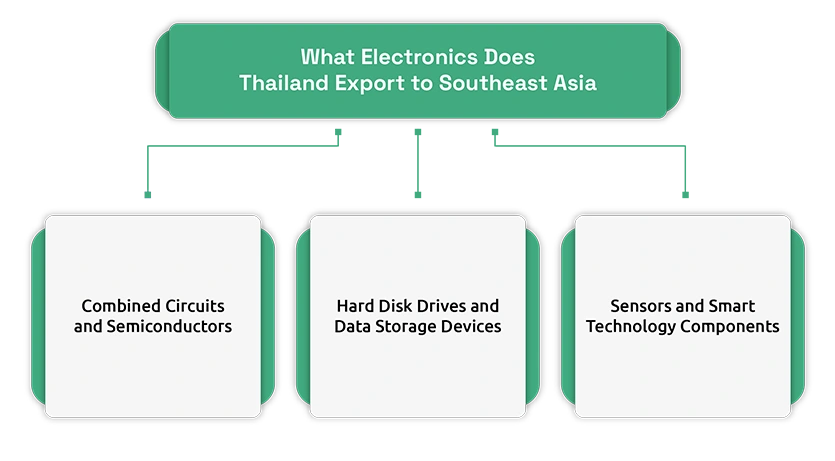
What Electronics Does Thailand Export to Southeast Asia?
Thailand exports a huge range of electronic products and components that support new technology industries globally. These exports contribute hugely to local manufacturing and technology development.
Key Electronics Export Categories
Combined Circuits and Semiconductors
Integrated circuits are among Thailand’s most valuable exports. These parts of powerful smartphones, computers, servers, and artificial intelligence systems are used across global technology industries.
Hard Disk Drives and Data Storage Devices
Thailand is one of the leading producers of hard disk drives used in data centers and organizational computing systems. These devices support the increasing global demand for data storage and cloud computing services.
Printed Circuit Boards
PCBs work as the base for most electronic devices, including communication equipment, industrial systems, and consumer electronics.
Sensors and Smart Technology Components
Managing these electronics exports requires correct product categorizations using HS code standards and the use of HTS Harmonized Tariff Schedule regulations in destination markets. Many organizations also accept advanced Inventory and order management systems to effectively manage global demand and maintain supply chain efficiency.
Thailand’s Electronics Exports Challenges for Southeast Asia’s Trade Recovery
Although Thailand’s electronics sector continues to grow quickly, many challenges could affect its long-term expansion and the region’s trade recovery.
Increasing Global Competition
Countries across Asia are working heavily in semiconductor manufacturing and electronics production. As competition grows in Thailand, it must continue improving productivity with new technologies to maintain its advantage in Southeast Asia.
Supply Chain Difficulty in Thailand
Electronics manufacturing depends on difficult global supply chains for developing raw materials, semiconductor devices, and special equipment shipments. To address possible disruptions, organizations increasingly focus on Supply chain optimization plans that improve efficiency and reduce working risks.
Regulatory and Approval Requirements
International electronics trade requires strict agreement with regulatory standards. Exporters must guide difficult documentation processes, including classification systems, tariff structures, and regulatory checks. Many organizations now depend on the best trade compliance software for import export rules to manage these processes effectively in Thailand. Businesses also frequently ask operational questions, such as whether a freight forwarder can be an exporter of record or if a customs broker can handle both import and export documentation when structuring their global shipping logistics.
Conclusion
Thailand’s growing electronics exports are playing a major role in supporting trade recovery across Southeast Asia. Growing global demand for electronics and AI technologies has hugely grown Thailand’s export performance in recent years. In Thailand, the production and export of combined circuits, storage devices, circuit boards, and smart sensors continues to improve as a major technology manufacturing hub. Effective international trade processes, such as systematic logistics and approval management, help confirm that electronics products are shipping smoothly through global trade.
DID YOU KNOW?
According to the Trade Policy and Strategy Office, Thailand’s exports rose by 24.4 percent in January 2026, reaching US$ 31.6 billion; this marks the 19th consecutive month of export growth.
FAQs:
1. Why are Thailand’s electronics exports increasing rapidly?
Thailand’s electronics exports are growing due to strong global demand for AI hardware, semiconductors, and data storage devices. Many global technology companies depend on Thailand’s manufacturing ecosystem, efficient logistics chain, and well-established export infrastructure.
2. What electronic products does Thailand export the most?
Thailand mainly exports integrated circuits, hard disk drives, printed circuit boards, sensors, and other semiconductor components. These products are widely used in computers, cloud data centers, and AI systems.
3. How does Thailand support global electronics supply chains?
Thailand supports global supply chains through advanced manufacturing facilities, strong logistics infrastructure, and reliable export documentation systems. Exporters also depend on efficient customs clearance, international freight services, and supply chain optimization strategies.
4. What challenges affect Thailand’s electronics export industry?
The industry faces challenges such as rising competition from other Asian semiconductor producers, supply chain disruptions, regulatory approval requirements, and changes in global technology.
5. How does AI demand influence Thailand’s electronics exports?
The growth of artificial intelligence technologies has increased demand for processors, semiconductors, sensors, and data storage devices. Thailand’s manufacturing capabilities allow the country to supply key components needed for AI infrastructure worldwide.