
Overview
In 2026, South Korea continues to improve its position as one of the world’s growing semiconductor exporters. The growing global demand for advanced chips used in artificial intelligence, cloud computing, and high-performance electronics has hugely grown the country’s trade performance globally. Semiconductor shipments are now one of the most important contributors to South Korea’s export-driven economy. As global technology organizations continue to grow their AI infrastructure, the demand for high-performance semiconductors has increased quickly, driving export growth for South Korea. In international trade terms, exporters must also follow global trade regulations and correct documentation. Concepts such as the Generalized System of Preferences (GSP), Incoterms, DAP, DDP shipping help define tariff systems and product categorizations with HS code, and the HTS harmonized tariff Schedule that supports smooth global trade.
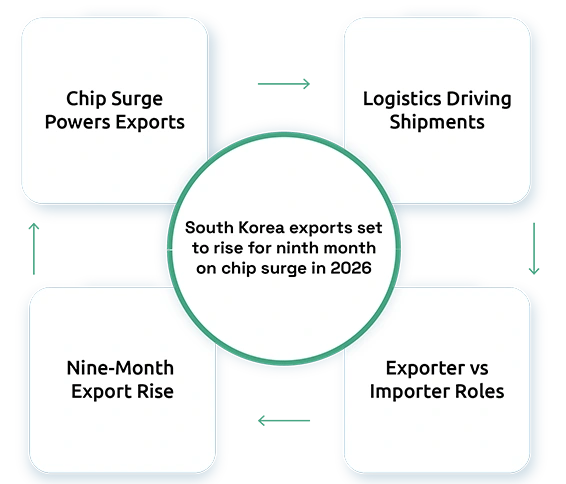
South Korea exports set to rise for ninth month on chip surge in 2026
Growing demand from global technology markets
The strongest demand for South Korean semiconductors is coming from major technology markets in the United States and China. Technology organizations in these regions are massively working in AI data centers and high-performance computing devices. The expansion of generative AI sources, machine learning applications, and cloud computing services has further increased the requirement for memory chips such as DRAM and high-bandwidth memory.
Trade operations supporting semiconductor exports
The growing export volume also requires strong working support in global trade. Businesses depend on logistics, International freight services, and experts exporter of record services to confirm semiconductor shipments reach global buyers effectively. In addition, companies frequently utilize an Importer of Record Service to manage regulatory responsibilities in destination markets. Effective documentation and Customs clearance procedures also play a critical role in simplifying the shipment of semiconductor products across global borders.
How AI Semiconductors Drive South Korea’s 55.6% Export Surge in 2026
Artificial intelligence technology is one of the most important factors behind South Korea’s semiconductor export growth in 2026. AI applications require extremely powerful processors and high-speed memory systems to analyze massive volumes of data.
Role of advanced memory chips in AI development
High-bandwidth memory plays a crucial role in AI computing because it allows faster data processing and efficient system performance. South Korean semiconductor organizations have invested heavily in developing these advanced technologies to meet the growing requirements of global AI markets.
Growing demand for AI infrastructure
Technology organizations around the world are developing AI infrastructure through huge data centers and advanced computing systems. These developments require massive quantities of semiconductors, which have driven South Korea’s chip exports up by 55.6% in early 2026. To support this growing trade activity, organizations increasingly depend on Supply chain optimization plans and Inventory and order management systems that help simplify global semiconductor supply.
What are the major reasons for South Korea’s Semiconductor Exports Growth in 2026
Many elements have contributed to the strong growth of South Korea’s semiconductor exports during 2026.
Expansion of global AI technologies
AI technologies are being accepted across various industries, such as healthcare, finance, manufacturing, and cloud computing. This growing adoption requires advanced semiconductors, developing demand for South Korean chips.
Growth of global digital device systems
The quick expansion of cloud services and data centers globally has increased the demand for high-performance chips. As organizations create new digital systems, semiconductor imports from South Korea continue to grow.
Increasing role of trade compliance and documentation
As semiconductor exports expand globally, trade approval becomes mainly important for shipments. Businesses frequently depend on the best trade compliance software for import export rules to manage regulatory requirements and documentation. Organizations also frequently ask questions such as whether a freight forwarder can be an exporter of record and whether a customs broker can handle both import and export documentation required in international trade terms.

Conclusion
South Korea’s semiconductor industry remains a major contributor to the country’s export growth in 2026. Increasing global demand for AI technologies and strong technological leadership from organizations such as Samsung Electronics and SK Hynix have greatly grown chip shipments globally through South Korea. As AI development grows and digital transformation continues worldwide, semiconductor exports from South Korea are expected to remain a major stage of global trade and economic growth in the coming years.
DID YOU KNOW?
According to the Korea Customs Service on the 11th, exports reached $21.5 billion between March 1 and 10, up 55.6% from the previous year.
FAQs:
1. Why are South Korea’s semiconductor exports increasing in 2026?
South Korea’s semiconductor exports are growing mainly due to the growing demand for AI technologies, cloud computing infrastructure, and high-performance chips. Global technology organizations require advanced memory chips such as DRAM and high-bandwidth memory to power data centers and artificial intelligence systems.
2. What role does AI play in South Korea’s semiconductor export growth?
Artificial intelligence applications require powerful processors and fast memory systems. This demand for AI computing hardware has mostly increased global orders for semiconductors produced by South Korean manufacturers.
3. Which countries are the largest buyers of South Korean semiconductors?
The United States and China remain the largest markets for South Korean semiconductor exports. Both countries are investing heavily in AI infrastructure, data centers, and high-performance computing systems.
4. What are the major semiconductor companies in South Korea?
Major semiconductor manufacturers in South Korea include Samsung Electronics and SK Hynix. These organizations produce advanced memory chips that are widely used in global technology devices and AI infrastructure.
5. How do global trade operations support semiconductor exports?
Global semiconductor shipments depend on effective logistics, international freight services, exporter of record services, and importer of record services. Proper documentation, customs clearance, and supply chain optimization help confirm smooth global trade.