Understanding Regional Trade Blocs in Equipment Shipping
The region’s trade blocs are made up of countries that are entering into agreements aiming at reducing trade barriers and increasing the cooperation levels in the region. Such agreements facilitate the clearance of goods, reduce tariffs, and align the trading policies internationally. This is largely directed to the improvement of a seamless and economical inter-member country trade.
The case of industries shipping aviation components, automobile parts, IT equipment, and healthcare devices creates stable trade conditions that promote the rapid delivery of goods and services across borders by air freight. They also assist importer and exporter in adhering to rules and reducing the time spent at customs. The system provides effective operations for an international freight forwarding service that handles high-value cargo on international routes.
What are the disadvantages of trade blocs?
Trade blocs can create trade barriers for non-member countries, lead to trade imbalances, and sometimes favor stronger economies within the bloc, making it difficult for smaller nations to compete equally.
Trade blocs may cause trade diversion, where countries shift imports to member nations even if they are not the most cost-effective suppliers. This can reduce overall efficiency in global trade. Smaller or developing member countries may also become overly dependent on larger economies within the bloc, limiting their own industrial growth.
Major Regional Trade Blocs Driving Equipment Trade
Different trade blocs play a big role in how equipment and technology move across countries. The European Union has a single market with common customs rules, making it easier and faster for businesses to ship goods with fewer delays. The United States-Mexico-Canada Agreement helps improve trade between the U.S., Mexico, and Canada, especially in industries like automotive, aviation, and healthcare.
In Asia, the Association of Southeast Asian Nations supports strong manufacturing and export partnerships, particularly in electronics and automotive sectors, which improves supply chains and air freight. In Africa, the African Continental Free Trade Area is boosting trade within the continent by improving transport, warehousing, and access to industrial equipment.

How Trade Blocs Shape Air Freight and Supply Chains
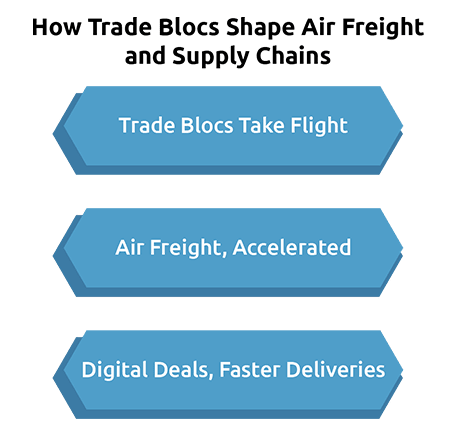
Trade blocs have a specific impact on the air freight business by reducing tariffs and improving customs procedures. This reduces the transit times that high-value shipments take, as well as simplifying the trade experience of both the importer of record and the exporter of record. The uniformity of the standards is also useful to freight forwarding logistics companies, as it reduces risks in the customs clearance process. Digital trade agreements also facilitate the use of electronic documentation and paperless transactions, reducing the number of delays and enhancing transparency.
Future Trends in Regional Trade Blocs and Equipment Shipping
The future generations of the trading blocks are also not only overcoming tariffs. Sustainability objectives, digitalization, and automation, however, are also being added. The air freight market has been transformed into a green one, and the logistics providers should make sure that they minimize their carbon footprint by using smarter delivery pathways and operating more energy-efficient warehouse devices. Online trade transactions encompass cybersecurity, online authentication, and other international data security measures for confidential shipments, including medical devices or sensitive equipment.
Businesses must adopt eco-friendly logistics practices and invest in sustainable supply chain solutions to stay competitive. Using digital tools and automation can improve efficiency, reduce errors, and speed up global trade operations. Strong cybersecurity measures are essential to protect sensitive shipment data and ensure safe international transactions. By adapting to these trends, companies can meet future trade requirements while improving performance and reliability.
Conclusion
Regional trade blocs have streamlined air freight operations, simplifying customs clearance processes and facilitating economic cooperation in global trade dynamics. Such blocks also provide industries with high-value and time-sensitive equipment. This solid trading environment benefits from avoiding delays, improving compliance, and increasing profitability.
It enhances cross-border cooperation by tying together the importer of record, exporter of record, freight forwarding, and warehouse into a single network. We are familiar with these international trade formats. At One Union Solutions, we manage all these logistics steps, including customs documentation and delivery to the port. Our freight forwarding service guarantees that your cargo will travel securely, effectively, and on time to any part of the world.
Did You Know?
Air cargo volumes for healthcare and IT equipment have grown by over 12% globally in two years. Advanced air freight systems and agile freight forwarder continue to drive that rise.
FAQ’s
1.What does a regional trade bloc in logistics mean?
A regional trade bloc refers to a group of nations that reduce tariffs and trade regulations. This assists the air freight transport in transporting high-value products between members at a reduced time and cost.
2.How do trade blocs improve supply chain management?
They streamline customs, allowing the importer of record and freight forwarder to complete shipments efficiently. Digital trade agreements support online documentation and real-time tracking.
3.What challenges do member nations face?
Uneven infrastructure across regions can delay shipments. Continuous investment in warehouse management and air cargo systems helps overcome this.
4.How are non-member countries affected?
They often pay higher tariffs and face slower customs processing. Joining blocs or aligning with their standards can improve access to major trade routes.
5.What trends will shape future trade?
Expect more digital trade agreements, greener logistics, and smarter freight auditing tools for air freight chargeable weight. These trends will redefine global shipping efficiency.