Overview
The medical device industry has become mainly visible to geopolitical risks, specifically amid ongoing trade tensions between the United States and China. Over the past many years, tariffs, export controls, and regulatory scrutiny have changed global manufacturing with incoterms such as DAP and DAPs. Medical devices depend on highly modern components and cross-border manufacturing chains; any disruption between two of the world’s largest economies directly affects pricing, production schedules, and healthcare devices. The developing trade guidelines introduced during the administration of Donald Trump marked a changing point in bilateral economic relations. China, as one of the largest manufacturing hubs for medical equipment components, became a central focus of U.S. tariff plans in the best trade compliance software for import export rules.
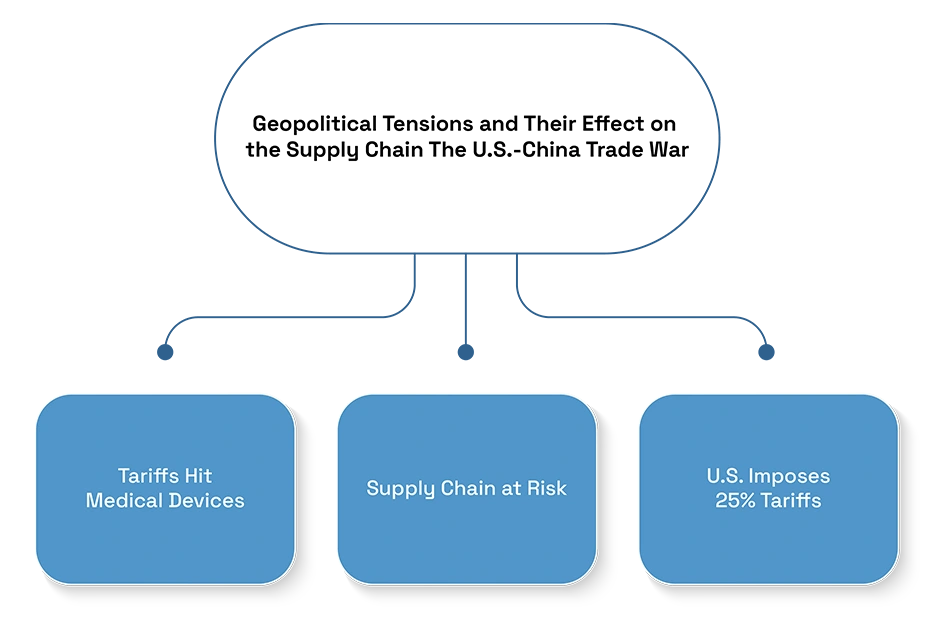
Geopolitical Tensions and Their Effect on the Supply Chain: The U.S.-China Trade War
The trade war mainly stops the supply chain for medical goods shortages and impacting patient care. Also, adding open and clear trade policies, improving diplomatic relations, and using effective risk management techniques are necessary for safeguarding the medical equipment supply chain from geopolitical uncertainties in customs clearance. Also, the U.S. implemented a 25% tariff on high-value Chinese medical goods, such as imaging equipment, diagnostic reagents for X-ray examinations, dental drills, and metal alloys such as aluminum and steel in medical device manufacturing. Also, China has imposed a 5-25% tariff on expensive U.S. medical devices. These tariffs mostly affect the cost and availability of medical products in both countries, which may affect healthcare services with the Importer of record service and the exporter of record services. Using replacement medical equipment to avoid tariffs raised problems about their quality, possibly resulting in misdiagnosis and ineffective treatment.
U.S. Tariffs: Implications and Strategies for Medical Device Manufacturers
Financial Implications of Tariffs
Tariffs on Chinese imports directly impacted devices and necessary components. Even when finished goods were released for medical reasons, the raw materials or intermediate goods used in manufacturing were frequently not included in inventory and order management. In some cases, manufacturers request exclusions, arguing that some components were not available outside China. Also, these exemptions were frequently temporary, increasing long-term uncertainty with regard to how a customs broker can handle both import and export documentation.
Major Responses by Manufacturers
Some companies have changed manufacturing closer to their main markets. Shipping production to North America or other regional hubs, organizations aim to reduce tariff problems and reduce geopolitical risk with international freight services. Manufacturers are conducting complete supplier inspections to identify problems. Multi-sourcing plans working with suppliers in different regions help reduce dependence on any single country. Automation and advanced manufacturing technologies are helping offset growing approval costs.
Challenges and Future Outlook for Medical Device Supply Chains
Regulatory Complexity
Trade tensions frequently lead to stronger export controls and regulatory scrutiny. As the U.S. and China compete in new technologies, such as semiconductors used in medical imaging devices, medical manufacturers must guide the development of approval systems. This regulatory difficulty increases the risk of shipment delays with customs clearance.
Long-Term Structural Changes
Despite short-term challenges, the medical device under a US–China trade tensions environment may ultimately lead to stronger, more flexible supply chains. Changing sourcing, local production hubs, and digital monitoring systems are becoming permanent features of the industry. This showing of demand provides stability, even as trade policies change.

Conclusion
The medical device industry stands at the crossing of healthcare and geopolitical strategy. USA and China trade tensions have increased costs and regulatory uncertainty in logistics. Can a freight forwarder be an exporter of record? Also, they have fast manufacturers to reevaluate issues and create more resilient supply chains. As trade policies develop, organizations that prioritize variations, technological investment, and major flexibility will be better positioned to guide uncertainty with the HS code and the HTS Harmonized Tariff Schedule. While geopolitical issues may continue, the necessary nature of medical devices confirms that innovation and adaptation will remain at the core of the industry’s long-term growth.
DID YOU KNOW?
According to 2024 data from GlobalData, the US medical technology industry leads the world in both volume and value of investment, attracting nearly $290 billion in capital in 2023 alone.
FAQs:
1. How did US–China trade tensions affect the medical device industry?
US–China trade tensions increased tariffs on medical equipment and components, raising production costs, causing supply chain disruptions, and creating regulatory uncertainty for manufacturers and healthcare providers.
2. What medical devices were impacted by U.S. tariffs on China?
Devices such as imaging equipment, diagnostic reagents, dental tools, and key raw materials like aluminum and steel components used in medical manufacturing were affected by tariff measures.
3. How can medical device manufacturers reduce tariff risks?
Manufacturers can use various suppliers, change production to regional hubs, improve trade approval processes, use proper HS code classification, and strengthen customs clearance strategies.
4. What role does trade compliance play in medical device supply chains?
Trade approval confirms proper documentation, accurate HTS Harmonized Tariff Schedule categorizations, exporter of record services, and importer of record service management to avoid penalties and shipment delays.
5. Will US–China trade tensions continue to impact medical devices in the future?
Yes, ongoing geopolitical competition, export controls on advanced technologies, and regulatory scrutiny are likely to influence global medical device supply chains for the long term.