Overview
In 2024 and early 2025, Singapore targets businesses and individuals who violate or circumvent other countries’ export controls on advanced semiconductor and AI technologies, as global scrutiny of supply chain optimizations. As a leading semiconductor manufacturing and technology hub, Singapore sits at the center of Asia’s advanced electronics supply chain. Growing restrictions introduced by major economies, specifically the United States, on high-performance AI chips and advanced semiconductor manufacturing equipment have changed global trade patterns with International freight services.
Authorities have stressed that the country will not allow efforts to use locally registered organizations or customs brokers to avoid foreign restrictions. In recent public statements across 2024–2025, officials approved Singapore’s responsibility for international trade terms and customs clearance.
Why Singapore Businesses Violate Export Controls on Semiconductor and AI Technologies Equipment’s
Rising Global Demand for AI Chips
Demand for advanced semiconductor and AI technologies equipment has grown due to the quick expansion of generative AI, hyperscale data centers, and defense-related computing with importer of record services and exporter of record services. Export controls imposed by the United States on certain high-performance chips shipped for specific markets have further strengthened the availability of the best trade compliance software for import export rules.
Regulatory Complexity and Rapid Policy Updates
Export control rules governing advanced semiconductor and AI technologies devices are highly technical and frequently updated with incoterms. Performance thresholds, chip architecture definitions, and end-use limitations have developed many times since late 2023. Organizations that fail to keep pace with regulatory changes risk non-compliance, and questions arise like can a freight forwarder be an exporter of record.
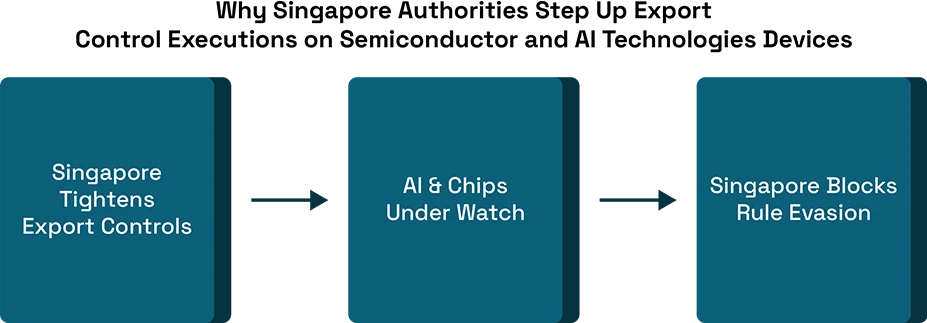
Why Singapore Authorities Step Up Export Control Executions on Semiconductor and AI Technologies Devices
Singapore’s economic method depends on trust and reliability. Any perception that the country simplified the rerouting of restricted semiconductor or AI hardware could undermine its reputation as a neutral and rules-based trade hub. In 2025, authorities repeated that Singapore-based organizations must not be used to circumvent export controls imposed by other authorities. Regulators have reportedly increased trade tracking and risk assessments in sectors involving advanced semiconductor manufacturing equipment and AI growth.
Key Features of the Advisory on Export Controls
Singapore’s advisory communications highlight several core requirements for organizations handling advanced semiconductor and AI technologies equipment. Businesses are expected to conduct strong due diligence on end users and intended applications to ensure compliance with export regulations. They must also continuously review evolving foreign export restrictions that impact semiconductor and AI products. Maintaining accurate and transparent transaction records is essential, along with implementing structured internal approval systems to ensure proper responsibility and oversight in all trade activities.
Singapore Export Controls on Semiconductor and AI Technologies
Singapore Export Controls on Advanced Semiconductor and AI Technologies devices cover strategic goods and dual-use items, including certain semiconductor equipment, high-performance AI processors, and advanced computing components with potential applications in defense, using the HS code Licensing requirements may apply depending on technical capability, destination, and declared end use. Organizations working in these sectors are expected to start strong risk management systems and confirm that advanced semiconductor and AI technologies equipment is not transferred in violation of applicable restrictions.

Conclusion
Singapore’s role in strict execution in 2024 and 2025 shows its responsibilities in stopping the misuse of its administrations for violating export controls on advanced semiconductor and AI technologies. Businesses and individuals, the message is clear: approval with Singapore export controls on advanced semiconductor and AI technologies devices is not optional in customs clearance. Strong governance systems, continuous tracking of regulatory developments, and strong risk management are necessary to work responsibly in today’s tightly controlled semiconductor trade globally.
DID YOU KNOW?
Singapore handles nearly $1 trillion in annual trade, making it one of the world’s most critical logistics and re-export hubs despite its small geographic size.
Its upcoming Tuas Mega Port will become the world’s largest fully automated port with a capacity of 65 million TEUs, transforming global maritime logistics efficiency.
FAQs:
1. What are Singapore’s export controls on advanced semiconductor and AI technologies?
Singapore regulates strategic and dual-use goods under its export control system on some semiconductor manufacturing equipment, high-performance AI processors, and advanced computing components. Licensing requirements depend on technical specifications, destination country, and declared end use.
2. Why is Singapore increasing enforcement on AI chip exports in 2024–2025?
Singapore is improving its execution to stop businesses and individuals from using locally registered organizations to avoid foreign export restrictions, specifically those imposed by the United States on new AI chips and semiconductor equipment.
3. Do companies in Singapore need a license to export AI chips?
Yes. A license may be required if AI chips or semiconductor equipment fall under controlled dual-use or strategic goods categories, depending on technical specifications, destination, and end-user checks.
4. What happens if a business violates export control laws in Singapore?
Violations can result in huge penalties, including fines, imprisonment, seizure of goods, and reputational damage. Organizations may also face increased regulatory scrutiny and loss of trade benefits.
5. How can businesses confirm approval with Singapore export controls?
Businesses should maintain internal compliance systems, conduct end-user due diligence, and regularly review applicable export control regulations before shipping controlled technologies.