Understanding the Shift in India’s Export Strategy
Times are changing in the world of trade, and resilience is becoming at least as important as growth. In India, the shift in the tariffs, particularly the US tariffs, has compelled the country to re-strategize its export-based strategy. To maintain the momentum, India has spread to 50 additional markets. This transformation also introduces opportunities for exporter of highly specialized manufactured goods such as precision aircraft parts, high-tech automotive components, information technology and data centre technologies, including 3-phase power systems and high-tech medical devices. It has not only acted as a reaction to tariffs but is a long-term plan to enhance India’s presence in the international market.
The Impact of US Tariffs on Indian Exports
Growing trade relations between the US and India have posed new problems for exporter. Incidents of rising tariffs will significantly increase the price of goods, making companies reevaluate their strategies under alternative incoterms. Indian exporter increasingly focus on classifying products appropriately using HS codes per the HTS Harmonised Tariff Schedules to comply with the regulations. Companies are also looking at unexplored markets to reduce their reliance on long-term trade partners. State-of-the-art AI analytics and accurate customs forms will help avoid any added expenses in these new destinations, and the importer of record services will facilitate shipment entry.
Diversification of Export Markets: Exploring New Opportunities in 50 Nations
Relying heavily on one market is risky when tariffs fluctuate. India is expanding its exports to 50 countries to spread that risk and create stability. Exporter will need to adapt to diverse DAP shipping practices, handle delivery duty paid expectations, and comply with various customs broker regulations internationally.
In the case of industries that deal with equipment, it causes more consistent trade, be it higher-quality aviation parts, energy-efficient automobile parts, secure server infrastructure, or controlled healthcare technologies.
Key Sectors Targeted in India’s Revised Export Strategy
The new export plan highlights sectors with strong global demand sensitive to regulation. This includes specialized machinery, transportation equipment, IT servers with ior export controls, and critical healthcare devices outside pharmaceuticals. Navigating DAP Incoterms in numerous markets is vital, supported by digital systems linked to importer of record numbers. India’s manufacturing capabilities and technical strengths position it well in fast-growing economies where infrastructure and tech upgrades are accelerating.
Bilateral Agreements and Trade Partnerships as a Response to Tariff Challenges
To offset tariff hurdles, India is putting more focus on bilateral trade agreements. These deals create clearer roles for importers and exporter and define the exporter of record responsibilities in high-value trade.
Simplifying Incoterms will also go a long way in removing the congestion in ports and avoiding demurrage expenses. The European Union and Japan consistently negotiate to reduce tariff barriers that help them comply smoothly with customs.
The partnerships strengthen trust, and goods like automobile parts, aviation products, and IT hardware are transported freely under a fair and transparent trade regime. Other strategic players are Australia and South Korea, which provide strategic trade infrastructures and innovation in compliance.
The Role of Government Policies and Support in Facilitating this Transition
India’s government is playing an active role by backing diversification with strong policies. Support includes helping exporter comply with the generalized system of preferences, offering subsidies to ease tariff pressures, and running training programs on tariff definitions, ECCN code handling, and foreign importer of record procedures.
Such practical assistance is indispensable to exporter of sensitive goods, such as automobile technology or server-grade computer hardware. Here, compliance might be the difference between proper clearance & time-consuming detention. Governments play an important role in helping exporter to adapt to the complexity of compliance requirements in new markets to guarantee an efficient & legally compliant supply chain.
Market Insights: Why India’s Diversification Strategy Works
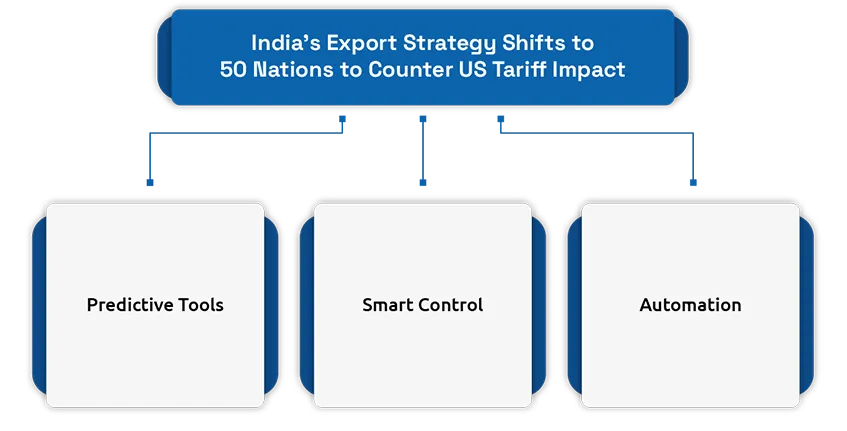
India’s export expansion to 50 new markets is strongly supported by improved compliance standards and advanced logistics capabilities. Recent trade data indicates significant growth in high-value sectors such as aerospace components, medical equipment, IT servers, and automotive parts—industries that rely heavily on accurate HS code classification, global trade compliance, and streamlined import clearance processes. Exporters are increasingly adopting AI-powered demand forecasting tools, digital customs documentation, and real-time shipment visibility to reduce delays and avoid tariff-related disruptions. Integrating smarter supply chain technologies with efficient freight forwarding services, customs clearance, and in-transit warehousing services strengthens India’s position in emerging markets and supports a more resilient, tariff-proof export ecosystem.
Strengthening India’s Export Readiness with Advanced Supply Chain & Compliance Solutions
As exporters explore 50 new global markets, the demand for robust logistics and compliance frameworks has intensified. Many industries—especially automotive, aviation, IT hardware, and medical devices—now depend on reliable warehouse management services, MRO supply chain planning, and accurate interpretation of Incoterms 2025 to maintain smooth cross-border operations. Leveraging specialised partners like importer of record experts and third-party logistics providers ensures shipments stay compliant with destination-country regulations, reducing risks associated with tariff and non-tariff barriers. With growing emphasis on sustainable trade and green logistics, exporters adopting multimodal transport, bonded warehousing, and AI-driven forecasting gain a competitive edge in international markets. This strategic evolution not only supports India’s diversified export structure but also strengthens long-term global supply chain visibility.
The Future Outlook: Long-term Effects of the New Export Policy on the Economy of India
India is creating a more balanced and solid export base, less sensitive to quick policy shifts, by considering markets beyond conventional destinations. The advantages are more stable revenues, good consideration of exchange profits, and better standing in emerging markets. The better-informed the exporter of record role, the clearer the outlook of the importer of record duties, and coordinated logistics channelling will enable India to be a credible international trade destination. Investing in compliance knowledge and intelligent logistics technology will help Indian exporter remain competitive globally.
This shift also encourages long-term trade partnerships and reduces dependence on a limited set of buyers. By strengthening regulatory alignment, improving documentation accuracy, and adopting digital trade tools, exporters can respond faster to market changes. Together, these steps support smoother cross-border operations and reinforce India’s position as a reliable global trading partner.
Conclusion
India’s response to diversifying its exports to 50 countries may see this as a reaction against tariffs, but it is, in fact, a bold step of long-term, sustainable growth. With better compliance solutions, the proper understanding of exporter of record roles, and established international connections, exporter can have enduring success. Tech-savvy sectors can expect to find additional stability and opportunities assisted by forward-thinking policies, improved compliance capabilities, and the power of AI-powered logistics intelligence. One of the ways we approach support at One Union Solutions is by assisting clients to make their way through this changing global trading environment, maximizing compliance, resilience, and growth.
FAQ’s
Q1: What happens if import duties are not paid on time?
Customs may delay or hold the shipment.
Penalties or extra charges may also apply.
Q2: Can goods be shipped without an Importer of Record?
No, an Importer of Record is required for customs clearance.
Shipments cannot legally enter without one.
Q3: How do tariff changes impact exporters?
They can increase or reduce total landed costs.
Exporters may need to adjust pricing.
Q4: Why is trade compliance important?
It helps avoid fines and shipment delays.
It also builds trust with authorities and partners.
Q5: How does automation help in export operations?
It reduces paperwork errors and saves time.
Automation improves accuracy and compliance.