Overview
The global semiconductor industry has grown as the most important part of technology and geopolitical competition in the 21st century. The so-called “Global Chip War” between the United States, China, and Taiwan shows a broader problem for economic leadership, national security usage, and dominance in artificial intelligence and advanced computing. Semiconductors chip everything from smartphones and electric vehicles to advanced data centers, making control over their production mainly necessary in the supply chain optimization. Over the past three years, tensions have grown as Washington added extensive export restrictions and has looked at limiting Beijing’s access to advanced chipmaking technologies with international shipping terms.
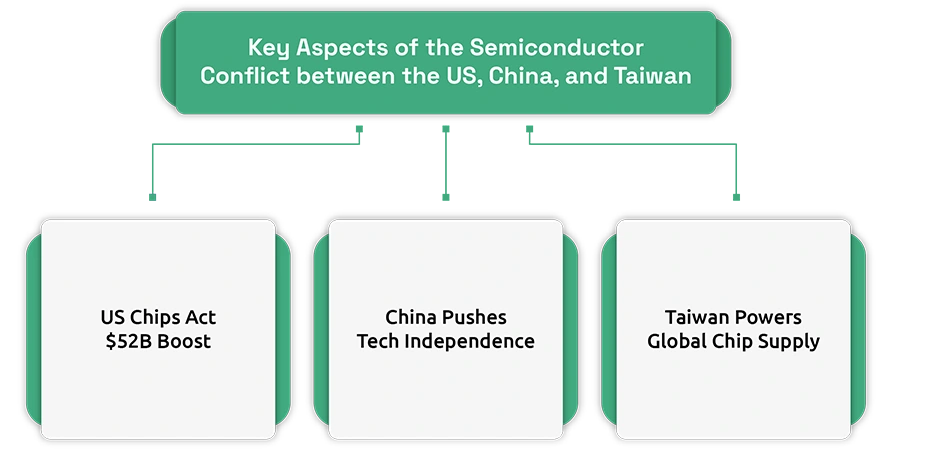
Key Aspects of the Semiconductor Conflict between the US, China, and Taiwan
The United States has combined industrial policy with national security to maintain its technological leadership in inventory and order management. The CHIPS and Science Act allocated over $52 billion in subsidies and research funding to increase local semiconductor manufacturing and innovation, with the best trade compliance software for import export rules. In 2024 and early 2025, additional rules were introduced to stop indirect access through third countries, improving Washington’s responsibilities to limit China’s high-end chip capabilities.
China’s Technology Self-Dependence Growth
China has responded with huge state-supported investment programs to build a semiconductor ecosystem. In 2024, Chinese organizations revealed advanced processors manufactured locally, showing industry observers a Generalized System of Preferences (GSP) program. While these chips still trail global leaders in efficiency and scale, they show Beijing’s determination to reduce dependence on Western technology. China has also imposed export controls on critical raw materials such as gallium and germanium, showing its arrangement to use supplies mainly in logistics.
Taiwan’s Role in Global Chip Production
Taiwan remains an important part of the semiconductor industry with International freight services. Taiwan Semiconductor Manufacturing Company produces the majority of the world’s most modern chips, supplying companies like Apple Inc and Advanced Micro Devices with Importer of record services and exporter of record services. Cross-border tensions between China and Taiwan continue to raise global problems about supply disruptions. In response, TSMC has grown their global investments, including huge systems in the United States and Japan, to change production and reduce geopolitical risks.
Decoding the US-China Chip War for Semiconductor Dominance
The semiconductor problems are about more than trade; it is a contest over future technologies. Advanced chips are necessary for artificial intelligence, quantum computing, military surveillance systems, and autonomous devices. The US government guidelines for export controls are necessary for national security, as unrestricted access could improve China’s technology. China explains these measures as containment efforts designed to slow its rise as a technological superpower with the best trade compliance software for import export rules. This separation in perspective grows, changing policy responses with DAP and DDP Shipping.
Indication of US-China Rivalry for the Semiconductor Chip Supply Chains
The semiconductor ecosystem was mainly globalized, with research, design, manufacturing, and assembly growing across multiple continents. The chip war is growing in fragmentation, as nations prioritize dependence and security over pure cost efficiency with the HS code and HTS harmonized tariff Schedule. Organizations are showing systematic manufacturing existence to reduce geopolitical tensions, investing in various production hubs across North America, Europe, and Southeast Asia.
Growing Costs and Industry Restructuring
Building advanced production plants can cost more than $20 billion, and reproducing capacity across regions raises overall industry expenses. While government policies offset some costs, higher production expenses may ultimately change global electronics pricing. TSMC’s 3nm and 2nm process technologies in 2025 continue to set the performance standard, maintaining its leadership in cutting-edge chip production.

Conclusion
The Global Chip War between the United States, China, and Taiwan shows a huge change in how technology, economics, and national security are used for customs clearance. The US is reinforcing local production while restricting advanced exports, China is growing in dependence, and Taiwan remains indispensable to advanced semiconductor manufacturing. As of 2025, this three-way rivalry shows no sign of stress reduction. Instead, it continues to change global partnerships, industrial policy, and technology innovation.
DID YOU KNOW?
Last year, it announced an investment of 11.5 billion baht (approximately US$350 million) to build the country’s first SiC chip factory by 2027, primarily to fuel growth in electric vehicles and data centers.
FAQs:
1. What is the Global Chip War between the US, China, and Taiwan?
The Global Chip War refers to the strategic competition between the United States and China over advanced semiconductor technology, with Taiwan playing a central manufacturing role. It involves export controls, subsidies, and supply chain restructuring.
2. Why is Taiwan so important in semiconductor manufacturing?
Taiwan is home to Taiwan Semiconductor Manufacturing Company (TSMC), the world’s leading producer of advanced chips. It manufactures cutting-edge processors for companies such as Apple Inc. and Advanced Micro Devices, making it essential to global electronics and AI systems.
3. What is the CHIPS and Science Act?
The CHIPS and Science Act is a US law that provides over $52 billion in funding to boost domestic semiconductor manufacturing, research, and innovation to reduce dependence on foreign supply chains.
4. Why did the US impose export controls on China’s semiconductor sector?
The US government introduced restrictions to limit China’s access to advanced chipmaking equipment and high-performance AI processors, citing national security concerns and the use of advanced computing technologies.
5. How is China responding to US semiconductor restrictions?
China is investing heavily in domestic chip production, expanding state-backed semiconductor programs, and improving control over key raw materials such as gallium and germanium to reduce dependence on Western technologies.