In international trade, the Importer of Record (IOR) plays a very important role. They are responsible for following customs rules and paying all required taxes and duties. IOR acts as a key player in global trade, making transactions smoother and ensuring that all legal requirements are met.
One of their most important responsibilities is risk management. IOR carefully checks every step of the import process to identify and fix possible problems—such as shipping delays, incorrect paperwork, or compliance issues. By reviewing documents, verifying suppliers, and setting up strong compliance practices, they protect businesses from financial losses, legal troubles, and damage to reputation.
The success of these risk management efforts depends greatly on the IOR’s knowledge and attention to detail. Their ability to handle different regulations and apply effective solutions strengthens international trade operations. In this way, IOR does much more than just oversee imports—they play a key role in keeping global trade safe, stable, and sustainable.

Understanding the Core: IOR’s Integral Position in Risk Mitigation
An Importer of Record (IOR) is the legally responsible entity or individual for ensuring that imported goods comply with the laws and regulations of the destination country. This includes handling documentation, customs clearance, payment of duties and taxes, and ensuring the correct classification of goods using the Harmonized System (HS) Code.
Within the complex global trade environment, risk mitigation measures place a premium on the Importer of Record (IOR). IOR are essential for managing the intricacies of cross-border transactions since they operate as the link between foreign suppliers and regional regulatory regimes.
IOR acts as a gatekeepers in risk management, ensuring that international trade follows all legal rules while reducing risks that could disrupt the smooth movement of goods. They protect businesses from financial, legal, and reputational harm by preparing accurate paperwork, carefully checking suppliers, and efficiently handling customs procedures.
Their main responsibility is to spot and manage risks at every step of the import process. By enforcing strict compliance practices and using their expertise in dealing with complex regulations, IOR strengthens the resilience and sustainability of global trade.
In simple terms, the role of IOR in reducing risks shows just how essential they are in keeping international trade stable and reliable, even in today’s fast-changing global environment.
Minimizing Risks: IOR’s Role in Global Trade Risk Management
In the fast-paced world of global trade, the Importer of Record (IOR) plays a crucial role in managing risks and ensuring the smooth movement of goods across borders. Acting as a link between international suppliers and local regulators, IOR are responsible for navigating complex compliance requirements and reducing risks tied to cross-border transactions.
One of their key responsibilities is to ensure compliance with diverse regulatory frameworks. By preparing accurate paperwork, conducting thorough supplier checks, and managing customs procedures with precision, IOR helps businesses avoid financial losses, legal penalties, and reputational damage.
Proactive Measures: IOR’s Approach to Minimizing Trade Risks
IOR adopts a forward-looking strategy to reduce risks in international commerce. Their work ensures regulatory compliance while minimizing financial, legal, and reputational risks that businesses face when trading across borders.
Through careful documentation, supplier due diligence, and effective customs management, IOR reduces vulnerabilities at every step of the importation process. By setting up strict compliance procedures and applying their expertise in regulatory navigation, they create stronger and more sustainable trade operations.
Real-time Risk Assessment: IOR’s Contribution to Dynamic Risk Management
In today’s fast-moving global trade environment, an Importer of Record (IOR) plays a key role in real-time risk assessment and dynamic risk management. They act as a bridge between international suppliers and local regulators, constantly monitoring and addressing risks to keep goods moving smoothly across borders. At every stage of the import process, IOR actively identifies potential issues—whether related to compliance, logistics, or market shifts—and takes steps to reduce them. By staying up to date with changing regulations and market conditions, they can anticipate problems before they escalate. IOR also uses data analytics and advanced technology to track risks in real time. This allows them to respond quickly to new challenges or opportunities, keeping supply chains resilient and flexible.
Through their proactive role in risk management, IOR help ensure the reliability and stability of international trade, even in the face of uncertainty and constant change.
III. Assessing Trade Risks: A Guide for Businesses
Navigating Uncertainty: A Business Guide to Assessing Trade Risks
Essential details about the function of Importer of Record (IOR) in international trade risk management can be found in “Navigating Uncertainty: A Business Guide to Assessing Trade Risks.” IOR are essential in evaluating and reducing risks in cross-border transactions because they operate as a bridge between foreign suppliers and regional regulatory frameworks. IOR are responsible for handling complex customs processes, ensuring suppliers comply with various regulatory frameworks, and maintaining compliance. They support the robustness and sustainability of international trade networks by proactively detecting and mitigating risks at every level of the importation process.
Identifying Potential Risks: IOR’s Guide to Comprehensive Risk Assessment
An extensive reference for Importer of Record (IOR) negotiating the complexity of risk management in international commerce is “Identifying Potential Risks: IOR’s Guide to Comprehensive Risk Assessment”. Assessing and reducing the risks connected to cross-border transactions is a crucial task for IOR.
This manual stresses the significance of approaching risk assessment with rigor and method. Risk officers (IOR) are responsible for spotting possible threats in several areas, such as financial, geopolitical, logistical, and regulatory compliance. IOR may prevent any disruptions by preemptively identifying vulnerabilities and putting mitigation plans in place. This is achieved by completing thorough risk assessments.
Data-Driven Insights: Leveraging IOR for Informed Risk Decision-Making
It provides a thorough method for using Importer of Record (IOR) in international trade risk management. IOR are essential for enabling well-informed decision-making since they offer data-driven insights on various cross-border transactional issues.
With their position between foreign suppliers and local regulatory frameworks, IOR are useful sources of data and information in this regard. To assist risk decision-making processes, they collect and evaluate data on market trends, financial transactions, logistics effectiveness, and regulatory compliance.
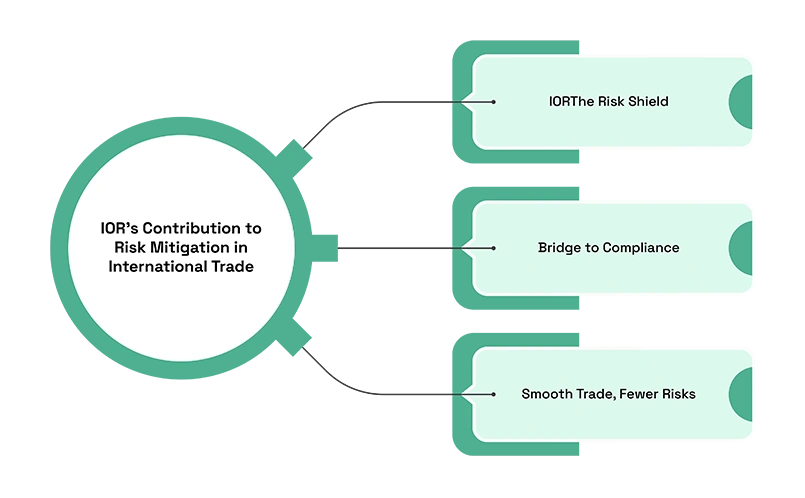
IOR’s Contribution to Risk Mitigation in International Trade
Mitigating Trade Risks: The Indispensable Role of IOR
Importer of Record (IOR) plays a crucial role in reducing risks in international trade. Acting as a bridge between global suppliers and local regulators, they help businesses navigate complex compliance rules and minimize risks tied to cross-border transactions.
IOR manages different types of risks—including financial risks, logistical challenges, regulatory issues, and even geopolitical uncertainties. They do this through accurate documentation, careful supplier checks, and efficient handling of customs processes, ensuring that trade flows smoothly and legally.
With their expertise, IOR can anticipate potential issues and respond quickly to new challenges. By keeping up with regulatory updates and shifting market conditions, they help businesses adapt without delays or costly mistakes.
Navigating Compliance Challenges: How IOR Mitigates Risks in International Trade
The article “Navigating Compliance Challenges: How IOR Mitigates Risks in International Trade” discusses the crucial role the Importer of Record (IOR) plays in resolving compliance issues and reducing the risks associated with international commerce. IOR are vital go-betweens who bridge the gap between foreign suppliers and local regulatory frameworks to guarantee compliance with various compliance standards.
By carefully monitoring documents, thoroughly investigating suppliers, and guaranteeing adherence to intricate customs processes, IOR proactively handles compliance obstacles. IOR protect international commercial transactions by utilizing its proficiency in managing regulatory environments to reduce risks related to non-compliance with regulations, delays in customs clearance, and possible fines. Furthermore, by putting in place strict compliance procedures and keeping up with legislative changes, IOR are essential in reducing financial, legal, and reputational risks. IOR helps companies manage compliance difficulties and preserve the integrity and effectiveness of global trade operations employing ongoing monitoring and assessment.
The skillful management of compliance issues by IOR highlights their vital role in risk reduction and facilitating the smooth movement of commodities across borders in the ever-changing context of global trade.
Legal Landscape: IOR’s Insights into Regulatory Risks and Compliance
Importer of Record (IOR) plays a critical role in navigating the intricate legal landscape of international commerce. “Legal Landscape: IOR’s Insights into Regulatory Risks and Compliance” explores this relationship. IOR serves as a helpful bridge between local regulatory frameworks and overseas suppliers, offering crucial insights into regulatory risks and compliance, hence reducing the likelihood of legal disputes. Because they keep up with the constantly changing legal landscape, IOR are essential in identifying and mitigating regulatory risks. Thanks to their experience, they provide businesses with vital information on how rules are developing and how to comply with various legal requirements across various countries. By being proactive, you may reduce the risk of legal non-compliance, possible fines, and interruptions to international trade activities.
Strategic Approaches: Incorporating IOR in Risk Management
Strategic Shielding: Incorporating IOR in Global Trade Risk Management
It is similar to offering strategic protection against future interruptions when the Importer of Record (IOR) is incorporated into global trade risk management plans. Businesses may proactively manage regulatory compliance, reduce financial risk, and guarantee efficient customs-clearing procedures by collaborating with IOR. This proactive strategy improves resilience and continuity by protecting their operations from unpredictabilities in the global commerce scene.
Integrating IOR into Corporate Strategy: A Framework for Risk Management
An effective framework for risk management in international trade operations is established when the Importer of Record (IOR) is integrated into the business strategy. Businesses may improve regulatory compliance, maximize supply chain efficiency, and reduce cross-border transaction risks by coordinating IOR collaborations with more expansive strategic goals. By promoting stability and adaptability in a fast-paced global economy, this all-encompassing approach fortifies the organization’s entire risk management strategy.
Collaborative Risk Mitigation: IOR’s Role in Strategic Trade Partnerships
IOR is essential to cooperative risk reduction initiatives in strategic trade alliances. Businesses use their knowledge to jointly identify and manage risks by cultivating cooperative connections with IOR. Through the exchange of best practices, resources, and expertise, this strategy improves the efficacy of risk management and, in the end, strengthens the resilience and success of strategic trade relationships.
Consideration for Businesses
Strategic Integration: Considering IOR for Enhanced Risk Management
Businesses can gain a strategic edge in managing the intricacies of international commerce by integrating Importer of Record (IOR) into their global trade risk management plans. By guaranteeing regulatory compliance and promoting efficient customs clearance procedures, IOR plays a crucial role as a partners in reducing the risks connected with cross-border transactions.
To prevent unplanned interruptions and improve operational resilience, businesses should carefully include IOR in their risk management frameworks. Companies may efficiently solve regulatory compliance difficulties, eliminate financial risks, and maximize supply chain efficiency by utilizing the skills and experience of IOR.
Evaluating the Suitability of IOR for Risk Mitigation in Global Operations
Businesses need to take into account several variables when assessing whether Importer of Record (IOR) is suitable for mitigating risk in their worldwide operations. These include the volume and frequency of foreign trade transactions, the complexity of regulatory regimes in target markets, and the amount of knowledge needed to manage a variety of compliance needs.
IOR may be quite helpful in mitigating the risks connected to international commerce, but companies should determine if their capabilities match their unique operating requirements and goals. The feasibility of IOR for risk reduction in global operations may be ascertained by carefully vetting possible IOR partners, analyzing their compliance management history, and gauging their flexibility in responding to changing regulatory environments.
VII. Conclusion
Navigating Global Trade Safely: Key Takeaways on IOR and Risk Management
Importer of Record (IOR) are a valuable resource for optimizing operational effectiveness and reducing risks when they are integrated into global trade risk management systems. The strategic integration of IOR to improve supply chain performance, improve compliance, and reduce financial risks related to international commerce are important lessons learned.
Conclusion
A safe and sustainable future depends on accepting Importer of Record (IOR) as important partners in international trade operations. In an increasingly linked global economy, businesses may drive development and success by employing the resources and experience of IOR to manage regulatory challenges, minimize risks, and take advantage of possibilities for international commerce.
FAQs
What is an Importer of Record (IOR) in international trade?
An Importer of Record (IOR) is the legally responsible entity that ensures imported goods comply with the destination country’s laws. This includes handling customs documentation, paying duties and taxes, and ensuring regulatory compliance.
Why is the IOR important for risk management in global trade?
IOR plays a critical role in risk management by identifying and reducing compliance, financial, and logistical risks. Their expertise helps businesses avoid delays, penalties, and legal issues during cross-border transactions.
How does an IOR help reduce compliance and regulatory risks?
IOR ensures accurate documentation, proper product classification, and adherence to changing customs regulations. They continuously monitor regulatory updates to keep shipments compliant and moving smoothly.
What types of risks does an IOR manage in international trade?
An IOR manages several risks, including customs non-compliance, financial penalties, shipment delays, supplier issues, and reputational damage caused by regulatory violations.
How should businesses choose the right IOR partner?
Businesses should evaluate an IOR’s experience, compliance track record, global coverage, and ability to adapt to regulatory changes. Conducting thorough due diligence helps ensure effective risk mitigation and smooth international operations.