International trade regulation is based on quotas, tariffs, & subsidies. Such policies establish the modes of movement of goods, applicable duties, and how prices remain competitive across nations. It directly influences all the logistics networks, such as air forwarding and cargo freight management. Knowledge of the functioning of each of these factors is beneficial in reducing costs and compliance in the global freight forwarding systems.
Defining Tariffs and Their Global Role
Tariff refers to a duty that is charged on imported goods. It controls a country’s prices, trade flows, and economy. For sensitive equipment transported under global freight rules, tariffs dictate shipping costs and determine total import charges at clearance. Logistics operations rely on customs duty management systems integrated with the HS code and hts HS Harmonized Tariff Schedule.
Accurate documentation under the hts code ensures the right customs value is applied, avoiding penalties and clearance delays. Many shipments under trade agreements & tariffs benefit from the generalized system of preferences, which lowers or removes tariffs for specific goods traded between selected countries.
Quotas and Their Impact on Global Logistics
In contrast to tariffs, quotas restrict the amount of goods that can be exported to a country. They also seek to equalize supply, domesticate prices, and regulate volumes of trade. In freight forwarding, quotas can directly influence the movement schedule and port-to-port capacity planning for carriers handling specialized project cargo.
For high-value shipments, quotas act as trade control barriers, requiring early documentation through import-export registration and DGFT IEC(Directorate General of Foreign Trade Importer-Exporter Code). By fulfilling all these requirements, timely freight transport is guaranteed by air or sea without any compliance risk.
The Role of Subsidies in Trade Facilitation
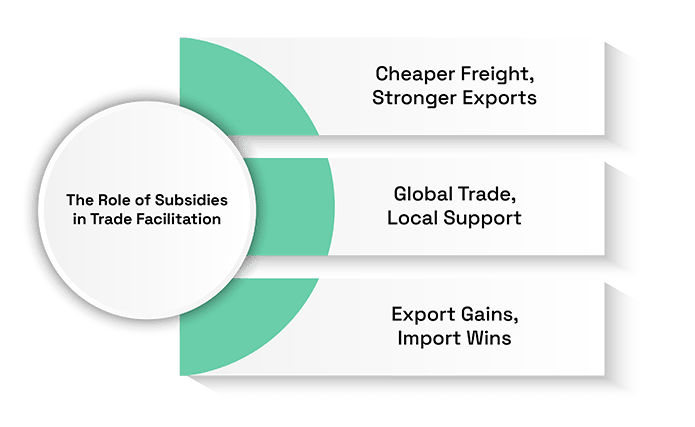
Subsidies are the government subsidies provided to help with the country’s manufacturing, production, or export activity. They help offset global competition and encourage economic stability by reducing production costs. When linked to logistics and supply chain operations, subsidies make international freight forwarding more affordable and accessible.
They can influence freight rates, air forwarding costs, and cargo insurance pricing across strategic regions. While subsidies often aim to boost exports, they also indirectly affect importers by modifying international trade terms and end-to-end export handling savings.
Linking Trade Policies to Air Freight and Logistics
A combination of quotas, tariffs, and subsidies determines the changes in the routes, schedules, and cost of operations in a freight forwarder. London Heathrow, Frankfurt, and Atlanta are examples of airports that serve as hubs for handling customs clearance support, tariff appraisal, and cargo certification.
The agreement with the terms of Incoterms, such as DDP (delivery duty paid) and DAP (delivered at place), provides any clarity in transactions by logistics teams. The meaning of DDP and the meaning of DAP shipping will facilitate the port-to-port clearance and ensure a quicker customs clearance. It will make shipment customs paid before delivery to enhance predictability and compliance.
The cross-border logistics professionals depend on trade compliance knowledge and customs duty management tools to track the air cargo movement worldwide. All these processes ensure the transparency and cost-effectiveness of solutions to international trade.
Importer and Exporter of Record: Ensuring Legal Compliance
Cross-border delivery needs a registered exporter of record (EOR) and importer of record (IOR). The IOR does inbound regulatory checks, and the exporter does outbound documentation. They totally agree with Incoterms DDP and international export rules in their functions.
They oversee customs clearance, tax assessments, and verification of hts code entries. Without their active management, delays can occur in customs brokerage clearance. Maintaining up-to-date registration of import export licenses is essential for any global trade activity.
Role of Incoterms in Managing Pricing and Responsibility
Incoterms are international rules that outline responsibilities between parties during transportation. Under ddp shipping, delivery with duty included guarantees that all costs, including customs duties, are prepaid. DDP incoterms define financial responsibility, while DDU (delivery duty unpaid) transfers this responsibility to the receiver.
Understanding ddp shipping terms and every associated condition supports clear shipping documentation and prevents disputes. The correct application of Incoterms can also facilitate an easy handover of freight, clear import duty clearance, and the correct determination of ddp price when making an invoice.
Logistics, Warehousing, and Supply Chain Coordination
Warehousing and supply chain management systems form the core of regulated trade logistics. A modern warehouse management system (WMS) organizes inbound goods, assigns HS code classifications, and tracks shipments through every stage. Efficient SCM logistics integration optimizes air forwarding timelines and helps adjust customs paperwork under trade compliance frameworks.
Building a Transparent Trade Ecosystem
The difference between quotas, tariffs, and subsidies is an easy concept to understand, and it can simplify the way shipments are handled across borders. These business tools influence the pricing of freight worldwide, customs duty, and supply cost-effectiveness. By matching them with the correct compliance system, shipping can run smoothly under international incoterms.
At One Union Solutions, we design logistics strategies that ensure every shipment meets legal, financial, and customs standards for transparent, compliant, and efficient air freight transport.
Did You Know: Real Trade Insights
The World Bank and OECD trade statistics released in the year 2025 showed the world exporting high-precision equipment worth over USD $3.4 trillion, which is an increase of 7.8% over 2024. More than 61 million metric tons of goods were carried on air cargo networks throughout the world. Airports that invested in increased freight management increased efficiency by 12% annually.
FAQ’s
What is the key distinction between the tariff and the quota?
A tariff is a customs duty imposed on imported goods, whereas a quota restricts the quantity that is to be imported. The two tools regulate the flow of trade in a different manner than tariffs influence the price, whereas quotas limit volumes.
What are the impacts of subsidies on international freight prices?
The subsidies can be used to lessen the cost of manufacturing or transporting their products by decreasing the production or export costs. They are cheaper when it comes to the international shipping of special equipment, which is applied to logistics.
What is the importance of such incoterms as DDP and DAP in international trade?
Incoterms establish the transportation, taxes, and insurance responsibility. DDP shipping means the duty is paid, whereas DAP incoterms mean that the products are delivered at the destination, but a ready to be cleared by customs.
What is the part of the importer of record in the air freight business?
The importer of record takes care of proper customs documentation, classification of tariff under the HS code, and legal standards of a certain country. The step will ensure that there is a smooth movement of goods across the borders without any form of regulatory problems.
What are the effects of trade policies on the operations of the global airports?
Trade agreements, tariff changes, and quotas are some of the policies that influence the speed at which cargo passes through. customs. Efficient customs clearance support and digital tariff management system of the airports remain more competitive and minimize waiting time during the handling process.