Overview
Global aviation is going into a new era where geopolitical sanctions mainly changed how aircraft are leased, maintained, financed, and operated in the global trade. Over the past few years, restrictions imposed on some countries have disrupted conventional aviation business methods, causing airlines, lessors, and maintenance providers to look for approval, logistics, and supply chain plans. The global aircraft leasing market was valued at about USD 183 billion in 2024 and is projected to grow to nearly USD 397 billion by 2034, driven by airlines changing toward a reduced asset-ownership operating method. Also, the aircraft maintenance, repair, and overhaul (MRO) sector continues growing, supported by rising air traffic and aircraft fleets getting extended service requirements.
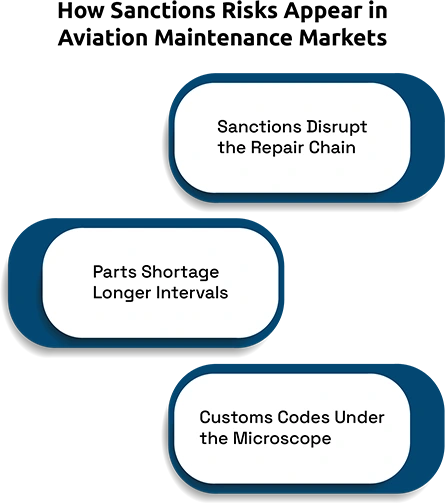
How Sanctions Risks Appear in Aviation Maintenance Markets
Supply Chain Problems and Approval Problem
Sanctions directly affect aviation maintenance because aircraft depend on globally sourced components, special maintenance tooling, and a certified repair chain. When restrictions stop entry to parts or technical support, airlines must reroute through difficult logistics while confirming correct HS code categorizations and HTS Harmonized Tariff Schedule. Maintenance providers now depend heavily on systematic customs clearance procedures and advanced inventory and order management systems for tracking components. Approval teams increasingly use the best trade compliance software for import export rules to avoid violations.
Working Effect on MRO Providers
Global passenger traffic is growing to 4.9 billion passengers in 2024, pushing aircraft usage higher and creating more than 310 million maintenance hours yearly. When sanctions limit spare-part availability, airlines extend maintenance intervals carefully or change work to neutral officials using complete International freight services and systematic Importer of Record Service solutions.
Role of Trade Structures
Maintenance contracts frequently depend on Incoterms such as DAP or DAPs arrangements, where delivery responsibility and risk management must work with sanction rules. In many cases, companies ask: Can a customs broker handle both import and export documentation? Increasingly, combined approval providers manage both sides to reduce problems.
How Sanctions Changed the Aviation Leasing Market
Asset Seizures and Economic Risk
The most visible disruption occurred after Western sanctions left around 400 leased aircraft stranded in restricted administrative areas, showing insurance problems worth billions of dollars. Leasing organizations were forced to reassess political risk methods, insurance systems, and repossession strategies. Some lessors recovered partial compensation through deals exceeding $1 billion, highlighting how geopolitical risk now directly affects lease pricing and economic decisions.
Change Toward Approval of Aircraft Leasing
Leasing contracts increasingly require detailed trade compliance checks, including verification of exporter of record services and confirmation of whether a freight forwarder can be an exporter of record under applicable regulations. These checks confirm aircraft changes remain compliant throughout their supply chain.

How Do Trade Wars and Tariffs Change Aircraft Leasing?
Cost Structures and Trade Compliance
Trade wars introduce tariffs affecting aircraft components, engines, and maintenance tooling. Accurate categorizations using HS code systems become necessary to avoid penalties. Using Programs such as the Generalized System of Preferences (GSP) may reduce duties in certain routes, changing where aircraft are maintained or changed globally. Tariffs also increase dependence on systematic logistics planning and compliant cross-border asset transfers.
Supply Chain Optimization and Leasing Strategy
Aircraft delivery delays and a backlog of nearly 17,000 unfilled aircraft orders mean airlines depend more on leased aircraft and a growing maintenance chain. Lessors respond by prioritizing flexible leases, short-term arrangements, and geographically varied shipments.
Conclusion
Sanctions have changed global aviation beyond political headlines; they now change working realities in aircraft leasing and maintenance markets. From stricter customs procedures to redesigned lease contracts, aviation customers must combine trade approval into everyday decision-making for trade. As fleets expand and air travel demand grows, companies that combine strong approval systems, optimized supply chains, and dependable Importer of record Service or exporter solutions will gain a competitive advantage. In a sanction environment, aviation success increasingly depends not only on aircraft performance but also on regulatory understanding and a flexible global logistics chain.
DID YOU KNOW?
The global aircraft leasing market was valued at US$187.1 billion in 2024. It is expected to grow from US$270.1 billion in 2025 to US$354.5 billion by 2030 and to US$565.1 billion by 2034, growing at a CAGR of 11.8% during the forecast period.
FAQs:
1. How do sanctions affect aircraft leasing companies?
Sanctions increase political and economic risks for leasing companies by restricting aircraft repossession, payments, insurance coverage, and cross-border trade, and improve approval checks and risk assessments.
2. Why are aviation maintenance markets impacted by sanctions?
Aircraft maintenance depends on globally sourced spare parts and certified repair networks. Sanctions disrupt component access, approvals, and logistics routes, causing working delays and higher approval requirements.
3. What role does trade approval play in aircraft leasing today?
Trade compliance confirms that leasing transactions follow export controls, customs regulations, and sanction rules. Companies now verify exporter and importer responsibilities to avoid regulatory violations.
4. How do trade wars and tariffs increase aircraft leasing costs?
Tariffs on aircraft components and engines increase maintenance and working fees, which can increase lease rates and change maintenance work to more cost-efficient regions.
5. Why are airlines depending more on leased aircraft?
Delivery delays, growing passenger demand, and large aircraft order backlogs push airlines toward leasing as a flexible and lower-capital alternative to direct ownership.