Overview
Maritime transportation is really important for commerce. It carries most of the trade by volume. This includes things like materials and big machines to consumer goods and technology products. The Suez Canal and the Red Sea are really important for transportation. The Suez Canal and the Strait of Hormuz and the Malacca Strait play a role in helping goods get to where they need to go. The Suez Canal and these other places make sure goods can move freely between markets around the world. If something goes wrong in these areas it can affect when things are made, when things are available and when things are delivered over the world. Maritime transportation and these key routes are crucial, for commerce and trade.
Global trade is getting really complicated these days. Businesses have to think about how they get their goods from one place to another because of lots of problems and tensions and regional conflicts. Businesses really have to think about this because it’s a big deal for them to get their goods from one place to another safely. They have to worry about security and ships taking routes and ports being too busy and things taking longer to get where they need to go. Industries like automotive, IT, aviation and medical equipment are especially at risk. This is because they rely on moving value and time-sensitive shipments, on schedule. As global trade becomes more linked businesses must ensure their supply chains can handle issues. To stay competitive businesses need global trade and supply chains.
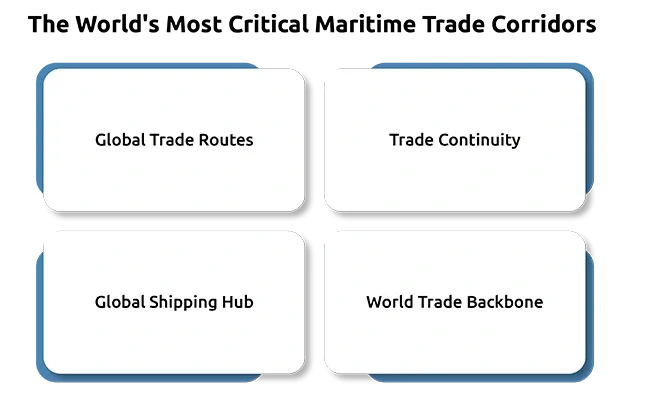
The World’s Most Critical Maritime Trade Corridors
Global trade depends on special routes on the water that connect places where the manufacturing of materials is made. The Red Sea and the Suez Canal are really important because they connect Asia and Europe. These routes help get all sorts of things from one place to another like containerized cargo, industrial machinery, automotive components, medical equipment, and technology products. If something goes wrong on this route it can cause problems for businesses, around the world making things late and costing more money. The Suez Canal is really important for trade. Global trade and the Suez Canal are like two things that go together. The Suez Canal helps trade to keep things moving. Without the Suez Canal global trade would have a lot of problems.
The Strait of Hormuz the Bab el-Mandeb Strait and the Malacca Strait are super important for trade. These waterways are like highways for ships and lots of industries depend on them to get goods. Without these routes many businesses would struggle to keep working.
Regional Conflicts Are Reshaping Global Shipping Patterns
Regional conflicts are really affecting import export. They are changing the routes that ships take and making shipping companies think about how they want to move ,from one place to another. When there are problems between countries near trade routes shipping companies will often take their ships a different way to avoid areas that are not safe. This means the trips take longer and it costs more to operate the ships. Changing the routes can also cause problems at ports because more ships are going there now. This can lead to a lot of congestion and ships having to wait for a time to unload their cargo. It also means that the schedules are not as reliable as they used to be. They have to worry about the equipment that are being shipped. Regional conflicts and global shipping are closely connected, and regional conflicts are having a big impact on global shipping operations.
When it takes longer to move things from one place to another it becomes constrained, businesses across the automotive, IT, aviation, and medical sectors having a hard time keeping up with their plans to make keeping enough products in stock and getting things to customers on time.
Industry Spotlight: How Key Sectors Are Being Affected
Regional conflicts are affecting the shipping routes. This is a problem for many industries that need things from other countries. In the automotive sector, its hard to get the parts they need for the manufacturing purposes. This is making it tough for automotive companies that get parts from countries. The IT and Data Centre industry is experiencing slower deliveries of servers, networking equipment, and semiconductor-related products, which can delay infrastructure expansion and technology deployment projects.
The aviation sector has a lot of trouble moving aircraft parts and maintenance equipment around. This makes it really hard for businesses are in these industries. The medical equipment industry is having a time too. When shipping routes get messed up it can take a time to get important medical devices and diagnostic equipment to where they are needed. The aviation sector and the medical equipment industry are facing these problems. This shows that it is very important for companies to know what is going on with their supplies plan transportation that works and have a plan in place to deal with problems that might come up. This is especially true for businesses, like the aviation sector and the medical equipment industry that have to follow a lot of rules and need to get things done quickly.

How One Union Solutions Supports Global Trade Continuity
Global trade is getting harder because of fights in certain areas and changes in rules, and these are causing problems with import export. Businesses need someone they can trust to help them keep getting import export done. One Union Solutions is a company that helps organizations with importing and exporting . One Union Solutions supports organizations with comprehensive import-export solutions tailored to the IT, aviation, medical, and automotive industries. They also help with things, like being the Importer of Record and the Exporter of Record. This means they make sure that important machines and technology can move easily across borders.
One Union Solutions has a lot of knowledge about trade compliance. They are also very good at customs clearance coordination and managing logistics around the world. This means One Union Solutions helps businesses deal with uncertain things in the market.
Conclusion
Regional conflicts and geopolitical tensions are changing the way the world does business. This is a problem for companies that import and export from other countries. When things do not go as planned these companies need to be able to deal with problems. One way to do this is to work with different suppliers so if one has a problem the others can still deliver. Using AI to track things can also help. It is a good idea to have a backup plan for import export.
Companies that put money into supply chains that can handle problems and work closely with global trade partners will be able to deal with future issues. They will be able to keep the promises they make to customers and keep growing over a time. This is important because the world market is getting more complicated all the time. Businesses need to have supply chains to do well.
DID YOU KNOW
“Regional conflicts disrupt maritime trade by threatening key chokepoints, forcing vessels to take longer alternate routes (like circumventing the Cape of Good Hope). ”
FAQS
1. How are disruptions in choke points like the Red Sea and Suez Canal affecting global supply chains?
Some groups are attacking ships in the Bab el-Mandeb Strait and the Red Sea. This has made a lot of ships stop using the Suez Canal. Now ships have to go all the way around the Cape of Good Hope, in South Africa to get from Asia to Europe which, is a long way.
2. What is the financial impact of regional conflicts on international shipping?
The cost of shipping tanks and containers goes up a lot. This happens a lot when there are problems in a region. Also the people who insure ships have to charge money to cover the risks of war. Sometimes they double or triple the cost of insurance overnight.
3. What other ways can things be transported because of all the problems between countries?
One of these ways is called the Middle Corridor. The Middle Corridor is like a path with roads and trains and ports that connect China to Europe by going through Central Asia and the Caspian Sea.
4. How do problems and fighting, in the Strait of Hormuz affect the markets?
The Strait of Hormuz is very important for the worlds supply. About a fifth of the worlds import export comes through it. When there are problems it makes markets very unstable. This makes prices go up fast and causes inflation.
5. Where can I monitor real-time shipping disruptions and route changes?
To keep track of trade routes and problems many people in the industry use the UNCTAD Newsroom. They post reports, on trade and developments there.