In the developing era, a single customs classification error can cost an organization millions in fines & delays. International trade professionals are changing to artificial intelligence to reduce increasingly difficult international regulations. With more & more updates across legal, tax, accounting, & government sectors already growing AI solutions, the question isn’t whether AI will change trade compliance, it’s how quickly your organization can adapt.
How AI in global trade compliance is changing operations
Automated classification & duty optimization
AI-driven classification systems now deliver SSAE18-certified accuracy in HS code assignments, mainly minimizing manual classification mistakes. These systems verify product descriptions, technical updates, & regulatory requirements to verify best classifications across many markets simultaneously.
Real-time duty calculations across global markets enable trade teams to identify cost-use opportunities instantly. AI algorithms can develop preferential trade agreement eligibility, duty drawback programs, & special customs procedures to minimize total landed costs while managing full compliance.
Document processing and workflow management
Modern AI solutions automate customs documentation generation & validation, remove manual data entry & minimizing processing errors. Workflow routing ensures approvals & compliance reviews follow established protocols while adapting to exception managing needs.
Developing capabilities with existing ERP systems like SAP S/4HANA, Oracle, & NetSuite create data flows between trade management & broader business operations. The Thomson Reuters Partnership Program reflects this ecosystem approach, enabling connections with specialized applications.
These developments transform trade compliance from an isolated function into an integrated business process. Real-time data sharing enables better decision-making, improves cash flow management, & provides visibility into trade operations across the whole organization.
Predictive analytics for risk mitigation
AI-driven early warning systems manage regulatory changes across global markets, updating trade teams to compliance before they affect operations. Machine learning algorithms analyze historical patterns to identify high-risk transactions, unusual activity patterns, & compliance gaps.
Compliance risk rating enables prioritized resource allocation, focusing attention on the highest-impact areas while managing oversight across all trade activities. Automated audit preparation compiles evidence, generates compliance reports, & maintains the documentation trail required for regulatory reviews.
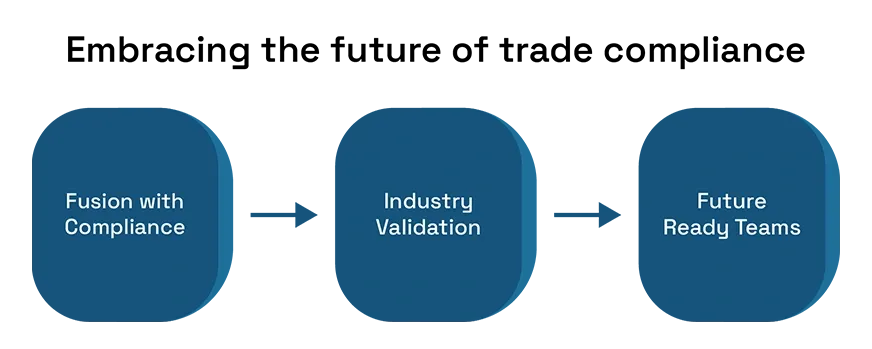
Embracing the future of trade compliance
The fusion of AI technology & global trade management represents a complete need rather than just an efficiency opportunity. As 87% of professionals expect AI to be central to their workflow within five years, trade teams adopting complete solutions position themselves to expand in an mainly difficult regulatory environment.
Success in this change requires strategic development of AI in global trade compliance through classification tools, automated workflow systems, integrated trade management platforms, predictive analytics capabilities, & partnerships with proven industry leaders. IDC MarketScape Leader recognition for Thomson Reuters in tax management applications validates this complete approach to trade compliance modernization.
The future belongs to organizations that adopt AI not as a replacement for human expertise, but as a tool that enhances professional capabilities & enables strategic focus on high-value trade optimization activities.
The important challenges facing global trade teams today
Regulatory complexity & constant change
Global trade professionals operate in an environment where regulations shift constantly across 100+ countries. Each region manages its own compliance requirements, documentation standards, & penalty structures. A single HS code misclassification can trigger customs audits, financial fines, & supply chain risk that flow through whole operations.
The challenge boosts when considering real-time regulatory updates. Trade agreements change, tariff schedules develop, & new compliance requirements develop with little advance notice. Past manual managing systems cannot keep pace with this regulatory velocity, leaving trade teams reactive rather than proactive in their compliance strategies.
Manual process inefficiencies
Despite technological advances in other business areas, many trade operations still rely heavily on manual processes. Document processing, customs declarations, and duty calculations consume significant resources while introducing human error risks. According to Gartner’s 2025 Market Guide for Global Trade Management, GTM solutions are ‘typically offered & used independently to support siloed processes in a practical manner’ rather than strategic development, highlighting how organizations remain trapped in routine compliance activities instead of using technology for strategic trade use.
These manual workflows create risks in customs clearance, delay shipment processing, & limit visibility into global trade operations. Resource allocation challenges compound the problem, as compliance management needs specialized expertise that many organizations struggle to manage across all relevant areas.
Audit preparedness and risk management
Customs authorities worldwide are increasing audit frequency & inspection. Trade teams must manage complete documentation, demonstrate compliance processes, & provide evidence of due diligence across all global transactions. The financial exposure from compliance failures extends beyond immediate penalties to include supply chain risk, reputation damage, & increased regulatory oversight.
With 80% of trade professionals now using AI tools at least weekly for compliance tasks, the gap between AI-enabled & traditional trade operations continues to widen. Organizations depending on manual processes find themselves increasingly disadvantaged in audit situations & strategic trade use opportunities.

Conclusion
Artificial intelligence is rapidly changing the way businesses cover difficult international trade regulations. From automated HS code classification & duty optimization to predictive risk analytics & intelligent workflow automation, AI enables organizations to enhance compliance accuracy, minimize operational waste, & strengthen decision-making across global trade operations. As regulatory environments continue to enhance across many countries, past manual compliance methods are becoming increasingly unsustainable for updated global enterprises.
Did you know?
Chinese tech companies have been required to provide the government with details about the algorithms behind features such as endless video scrolling in apps like RedNote and the domestic version of TikTok, Douyin.
FAQ
1. How is AI used in global trade compliance?
AI is used to automate trade compliance processes such as customs classification, duty calculations, regulatory monitoring, document verification, and risk analysis to improve accuracy and efficiency.
2. Can AI help reduce customs and trade compliance errors?
Yes. AI-powered systems minimize manual data entry and automate classification and validation processes, helping businesses reduce errors, avoid penalties, and improve compliance accuracy.
3. How does AI support regulatory monitoring in international trade?
AI continuously tracks changes in global trade regulations, tariffs, sanctions, and compliance requirements, allowing businesses to respond quickly to evolving legal and customs standards.
4.What are the benefits of AI-driven predictive analytics in trade operations?
Predictive analytics helps businesses identify high-risk transactions, detect unusual trading patterns, anticipate compliance issues, and improve overall risk management strategies.
5. Why are businesses increasingly adopting AI for trade management?
Businesses are adopting AI to streamline workflows, improve customs clearance speed, reduce operational costs, strengthen compliance oversight, and gain better visibility across global supply chains.