The Increasing Demand for UAVs and Drones
The world market has experienced a great demand for Unmanned Aerial Vehicles – UAVs and drones in the past few years, especially because of the current technological advancements and their application across different industries. UAVs are changing the world of trade, moving it to the next level in defence and logistics. The export market also holds much potential concerning the business expansion of companies interested in going global, as the UAV technology is still evolving. In a highly growing market characterized by international trade, customs clearance, & supply chain management, it is important to navigate these complexities to succeed.
The drone and the UAV market is expected to rise massively, with many applications of drones in areas like surveillance in defence, monitoring, and efficient delivery systems in logistics. The total drone market is projected to increase at a CAGR of 13.8 per cent between 2024 and 2032, resulting in an evaluation of $100 billion by the decade’s end. With the countries still investing in foreign trade and aviation technologies, the businesses will have to consider optimising logistics and compliance to fulfil this demand.
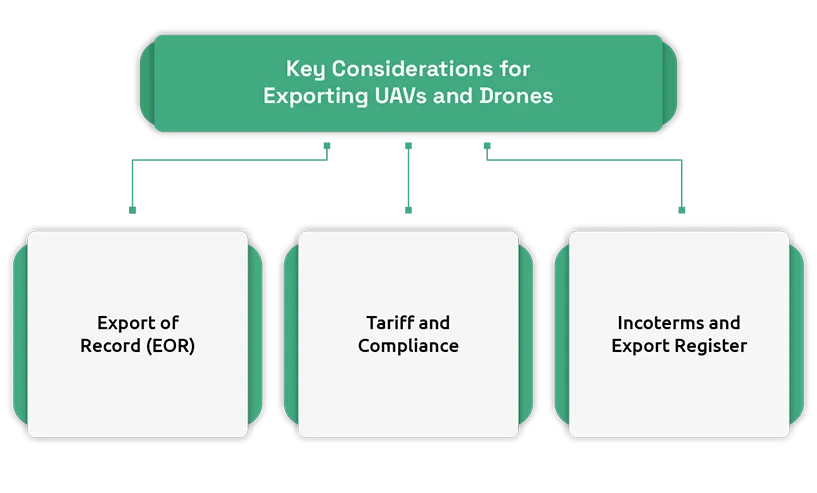
Key Considerations for Exporting UAVs and Drones
HS Code Classification
The Harmonised System code, or HS code, is necessary to export UAVs during customs clearance. The coding system categorises the products under tariff, which should be properly categorised to eliminate delay, penalty, or false tariff calculations. Knowledge of HS codes for your goods will help you be in line with local and global regulations.
Export of Record (EOR)
The Exporter of Record – EOR ensures that all shipments are within the law as required by local and international laws, and that an export license and appropriate documentation have been obtained. The EOR eliminates and enforces the customs requirements for clearing drones to export UAVs to overseas markets.
Tariff and Compliance
When exporting UAVs, tariff levels and compliance with international regulations are necessary. Most nations have certain tariffs on aviation-related products, and being up to date with tariff changes could prevent unnecessary expenses. It is also essential to comprehend incoterms, like DAP, and CIF (Cost, Insurance, and Freight), to make all parties know their obligations.
Incoterms and Export Register
Under Incoterms, buyers and sellers are outlined in line with shipping, insurance, and duties. The terms are very important to international shipping, and they facilitate the attainment of clarity between the exporter and importer. The document that is used to ensure that all export operations meet international and local standards is the export register.
UAV Export Supply Chain Management
Effective supply chain management is one of the most important factors in ensuring timely & economical deliveries. The companies have to collaborate with logistics companies that know how to deal well with UAVs in handling, warehousing, and eventual delivery. Applying such powerful tools as an air cargo rates calculator would allow businesses to estimate their expenses, whereas employing automated guided vehicles (AGVs) would enhance warehousing processes, making them more efficient overall.
In addition, real-time tracking systems help monitor shipments and reduce the risk of loss or damage. Proper packaging and secure storage are also essential for protecting sensitive UAV components. Streamlined coordination between suppliers, warehouses, and carriers minimizes delays. Together, these practices help businesses achieve faster, safer, and more cost-effective UAV deliveries.
The Exporter’s Responsibilities: Understanding the Exporter of Record
The Exporter of Record is handy in ensuring that the goods meet local and international standards. These are managing the export documents, procuring required licenses, and complying with export license rules. Regarding the export of UAVs, the exporter will have to jump through different regulations that may impede the shipment of certain technologies on national security grounds. The presence of a trusted provider of exporter of record service will guarantee that any regulatory provisions are fulfilled and that the movement of shipments is executed without the risk of delays and customs fines.
Trends & Market Insights Global
The global UAV market is experiencing massive growth, especially in logistics. As per recent reports, North America is the largest market for UAVs, & the U.S. has made considerable investments in drones’ military and commercial usage. Nevertheless, the Asia-Pacific region will likely be the most rapidly expanding as countries such as China and India spend more on drone technologies and apply them in various fields.
The globalisation of regulations as the drone industry continues to flourish, is now offering more standards, simplifying the process for exporters in dealing with markets across borders. Increasing use of air transport in delivering highly in-demand UAVs and UAV parts is changing the market dynamics in e-commerce and logistics.
Conclusion
The UAV sector is experiencing rapid growth in global demand, which means that companies should be trained to handle the challenges of global trade, customs clearance, and supply chain. Ensuring that tariffs are followed, proper HS code is used, and incoterms are understood can make business operations approach the optimum state, opening the global markets to their benefit. At One Union Solutions, we aim to empower businesses with help in dealing with the difficulties of exporting UAVs to help them capitalize on the raised demand in the international drone market.
Did You Know,
The global drone market is set to grow from $42 billion in 2025 to nearly $90 billion by 2030. The increased use of UAVs in logistics and defense is driving this exponential growth.
FAQs
What is an Exporter of Record (EOR), and why is it required for UAV exports?
An Exporter of Record ensures UAV exports comply with all local and international laws. This includes obtaining required licenses and preparing accurate export documentation.
What is the HS code for UAVs?
UAVs are classified under specific HS codes based on their design and intended use. Correct classification ensures proper tariffs and smooth customs clearance.
What are Incoterms, and how do they affect UAV exports?
Incoterms define the responsibilities of buyers and sellers for shipping, insurance, and tariffs. Understanding these terms helps avoid disputes and ensures smooth UAV exports.
How can supply chain management improve the efficiency of UAV exports?
Effective supply chain management reduces storage risks, prevents losses, and minimizes delays. Technologies like automation and tracking systems further streamline UAV transportation.
What are the key export compliance considerations for UAVs?
Key considerations include accurate documentation, correct tariff payments, proper Incoterm selection, and compliance with export control regulations governing UAVs.