Overview of increasing global trade volumes
International trade volumes have been increasing easily over the past decades, driven by globalization, the development of e-commerce, & the growing interconnection of supply chains across regions. As businesses source raw materials & finished goods from many countries, the number of cross-border shipments has risen, mainly, placing greater pressure on customs authorities to process higher transaction volumes easily. This growth is further accelerated by digital trade, just-in-time management models, & the development of improving markets participating more actively in global commerce. Global trade ecosystems are becoming more difficult, & need faster, more accurate, & technology-driven systems to manage documentation, compliance checks, & risk assessment at major.
Challenges in Traditional Customs Regulations
Past customs regulations face some important challenges in the updated era, extending from the complete volume of global trade to increasingly advanced illegal plans. These issues often stem from a reliance on manual processes that struggle to keep pace with digital commerce & high-speed supply chains.
Operational & Tactical Challenges
The rapid growth in global trade volumes, mainly the rise in low-value e-commerce shipments, has stressed past manual verification systems, making it increasingly difficult for customs authorities to manage border control easily. This challenge is further magnified by improved hiding plans used in many operations, where goods are transported in disassembled forms or misdeclared as generic industrial materials to evade regulatory inspection & safety checks. At the same time, intellectual property risks have become harder to detect, as fake products are now highly updated & often nearly uniform from genuine items, while enforcement agencies mainly lack the specialized expertise needed to assess difficult patent & design breaks. The growing risk of many cargo presents a serious concern, as conventional systems struggle to identify dangerous shipments in real time, leading to the collection of unsafe materials at ports that can result in fires, explosions, or severe environmental issues.
Structural & Technical problems
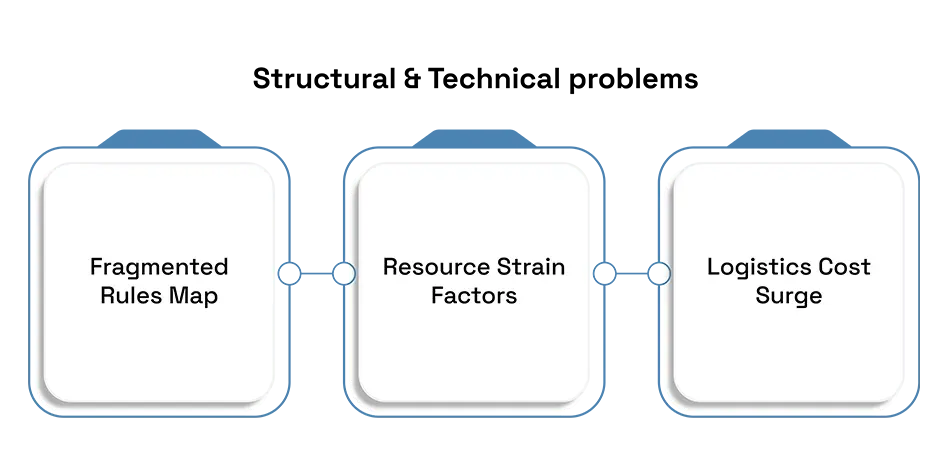
Past network stays a main problem for customs departments, as many still depend on manual document verification processes & past IT systems, resulting in delays, data issues, & higher logistics costs. This issue may depend on regulatory difficulties, where a split landscape of changing national rules increases the probability of compliance errors for international traders operating across many states. Resource constraints such as staff shortages, unstable electricity supply, & poor internet connectivity often force agencies to depend on manual workarounds, even in environments where digital systems have been introduced. Inconsistent inter-agency cooperation between customs authorities, local governments, & other regulatory bodies reduces application mechanisms, minimizing whole usability & creating gaps in trade compliance control.
Rising Threats
As customs operations mainly transform toward digital systems, they face developing exposure to cybersecurity risks & online fraud, and a need for advanced defensive mechanisms that traditional enforcement frameworks were not originally developed to manage. This digital transformation, while improving efficiency, also enhances the attack surface for harmful actors seeking to use system issues. The development of global illegal networks & organized fraud groups has increased the difficulty.
Future of AI in Customs Regulation
The future of AI in customs enforcement centers on the change from basic digital automation to autonomous, multi-agent AI systems. By using real-time data, computer vision, & predictive analytics, customs agencies globally are majoring in fraud detection, working legal trade, & strongly targeting fraud.
Customs systems are rapidly evolving with a shift toward agentic AI, where processing moves beyond rigid rule-based programming to intelligent systems that can dynamically interpret trade laws and policy changes. Without depending on engineers to manually translate tariff updates into system code, policy experts can now arrange risk parameters in real time, mainly minimizing management delays & enhancing usability. Autonomous risk management powered by AI enables the parallel analysis of structured data, such as declarations, & unstructured data like invoices & transportation manifests, allowing systems to mainly refine risk profiles based on historical compliance patterns.

Conclusion
The development of global trade & customs enforcement reflects a changeable shift from manual, divided processes to intelligent, technology-driven systems capable of managing unprecedented difficulties & measures. As trade volumes continue to develop & supply chains become more linked, past enforcement mechanisms are mainly strained by operational limitations, regulatory fragmentation, resource constraints, & using digital frauds.
Did you know?
Partnered with OpenAI to implement a generative AI platform for synthesizing research data. They piloted the tool with 900 advisors and planned a broader rollout.
FAQ
1. How is AI used in customs fraud detection?
AI is used to analyze large volumes of trade data, detect anomalies in invoices and declarations, identify suspicious shipment patterns, and flag potential fraud cases in real time.
2. What is AI-based risk scoring in customs operations?
AI-based risk scoring is a system that evaluates shipments, traders, and transactions based on multiple risk factors such as trade history, product type, origin, and compliance records to determine inspection priority.
3. How does AI improve customs clearance speed?
AI automates document verification, screening, and risk assessment, allowing low-risk shipments to pass through faster while focusing manual inspections only on high-risk cargo.
4. What types of data does AI analyze in customs systems?
AI analyzes both structured data (declarations, HS codes, shipment records) and unstructured data (invoices, shipping documents, manifests, and supporting trade paperwork).
5. What are the main benefits of AI in customs enforcement?
The key benefits include improved fraud detection, faster clearance times, reduced manual workload, better risk targeting, and enhanced border security and compliance accuracy.