
Introduction
China continues to grow the global trade landscape, remaining one of the world’s largest exporters and a major importer of raw goods, technology, and advanced services. China, with its strong manufacturing base, huge logistics chain, and increasing focus on sustainable trade methods, remains central in the global supply chain. In 2025-26, the nation’s import-export organizations are getting new guidelines issued, such as international export regulations, customs clearance, and changing global demand across industries such as electronics, automotive, aviation, and healthcare equipment.
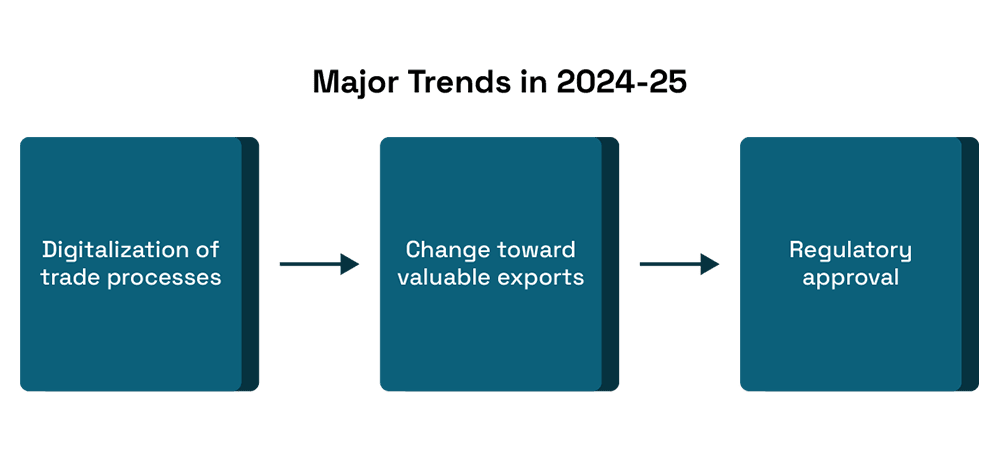
Major Trends in 2025-26
Many trends are changing China’s trade at the moment. Trade work is becoming more digital, which makes import-export registration, customs clearance, & shipping processes faster & easier. China is also exporting more high-value products such as electronics, electric vehicle parts, and green energy equipment, instead of depending only on traditional factory goods. Clearer use of HS Codes, tariff schedules, and Incoterms is helping businesses avoid mistakes and move goods more smoothly across borders. Many companies are also using importer of record and exporter of record services to handle legal rules & reduce risks in other countries. At the same time, Delivered Duty Paid (DDP) shipping is growing in demand because it gives buyers clear total costs and makes international delivery simpler.

Trade Dynamics with Major Partners
China’s trade continues to be influenced by both existing and growing partners. The United States, European Union, and ASEAN remain in control, but trade with Africa, the Middle East, and Latin America is expanding rapidly. To manage these difficult ties with countries, businesses are depending on freight forwarding services, customs clearance support, and global supply chain services that ensure on-time cargo movement. Exporters are also accepting Incoterms such as DAP (Delivered at Place) and DDP (Delivered Duty Paid) to strengthen competitiveness. Also, importers are increasingly dependent on importer of record services and comprehensive export register systems that reduce regulatory delays.
Strengthening China’s Supply Chain Through Smarter Warehousing and Global Trade Compliance
China’s trade ecosystem is also benefiting from upgraded warehousing solutions, stronger in-transit inventory controls, and advanced global trade compliance systems. As international buyers demand faster delivery and more predictable supply chains, companies are adopting warehouse management services, bonded warehouse facilities, and third-party logistics providers (3PLs) to streamline the storage and movement of goods. These enhancements are especially important for sectors such as automotive, aviation, and telecom, where accurate documentation, MRO supply chain support, and strict adherence to Incoterms 2025 are critical. With better visibility enabled by global supply chain analytics and compliance platforms, Chinese exporters can reduce tariff risks, improve cost efficiency, and deliver seamless cross-border shipping experiences for global eCommerce and B2B markets.
China’s Import-Export Partners in 2025-26
China’s major partners, such as:
- United States & EU: Focused on high-value goods such as semiconductors, EV vehicles, and medical devices.
- ASEAN: A hub for both intermediate goods and final goods, supported by local logistics and global trade facilitation agreements.
- Africa & Middle East: Increasing imports of medical resources and exports of infrastructure equipment, where customs clearance support and Delivery Duty Paid services simplify operations.
- Latin America: Automotive and raw material imports are balanced with exports of electronics and healthcare goods, aided by strong freight forwarding services.
China Import-Export Trade Data Insights Between 2025-26
China’s import-export activity in 2025-26 is being transformed by rapid digital trade adoption, smart logistics, and stronger global compliance standards. Export growth across electronics, EV components, and medical technology is supported by AI-powered demand forecasting tools, automated customs systems, and improved freight forwarding services that speed up international shipments. On the import side, businesses increasingly rely on Importer of Record (IOR), customs clearance services, and DDP shipping models to handle stricter global HS Code and HTS classification requirements. This shift is also reshaping supply chains, with companies choosing advanced warehousing services, in-transit inventory management, and multimodal transport to maintain resilience and avoid customs delays. These improvements are enabling China to stay competitive despite trade regulations and growing international scrutiny.
Conclusions
China’s import-export trends in 2025-26 highlight a change toward smarter, compliant, and technology trade. With major ties growing across the globe, the nation supports its position as a vital hub in global trade. The role of logistics service providers, customs clearance support, and special services such as importer and exporter of record service is expanding, confirming smoother approval with international export regulations. For businesses engaging in China’s import-export business, accepting Incoterms, using DDP shipping solutions, and providing comprehensive import-export support will be key to staying competitive. In the coming years, China’s role in global supply chain services will only strengthen, creating chances for growth across multiple industries.
DID YOU KNOW?
According to the Indian Embassy in Beijing, in 2025-26, total imports from China were worth $113.46 billion, while India’s exports to China were only $14.25 billion, creating a deficit of $99.21 billion.
FAQs
Q1: What are the major trends shaping China’s import-export trade in 2025-26?
A1: Key trends include digitalization of trade processes, growth in high-tech and green exports, stricter compliance with HS codes and Incoterms, rising demand for IOR/EOR services, and expansion of flexible delivery models like DDP shipping.
Q2: Who are China’s main trading partners in 2025-26?
A2: China’s main partners include the United States, the European Union, ASEAN nations, as well as emerging trade ties with Africa, the Middle East, and Latin America.
Q3: Which industries are driving China’s export growth in 2025-26?
A3: Electronics, automotive, EVs, semiconductors, and medical devices are key sectors driving export growth, while imports remain strong in raw materials and advanced technologies.
Q4: Why are importer of record (IOR) and exporter of record (EOR) services important in China’s trade?
A4: IOR and EOR services help businesses navigate complex compliance requirements, ensure proper documentation, reduce customs delays, and manage risks in foreign markets.
Q5: How do Incoterms like DAP and DDP affect China’s import-export trade?
A5: Incoterms such as DAP (Delivered at Place) and DDP (Delivered Duty Paid) give buyers and sellers more flexibility, provide cost clarity, and streamline cross-border logistics for smoother trade operations.