Overview
Global trade in early 2026 has shown unexpected shipments, specifically with China reporting a huge growth in exports, and trade remains. During the first two months of 2026, China’s export performance crossed growth expectations, reaching the highest trade growth on record. The growth shows strong global demand for Chinese manufacturing goods. Businesses involved in import and export systems across IT, aviation, medical equipment, and automotive industries are closely tracking this development because it is changing trade dynamics and supply patterns. China’s ability to have export growth despite global economic uncertainty shows the improvement of its manufacturing ecosystem, with an exporter of record services.
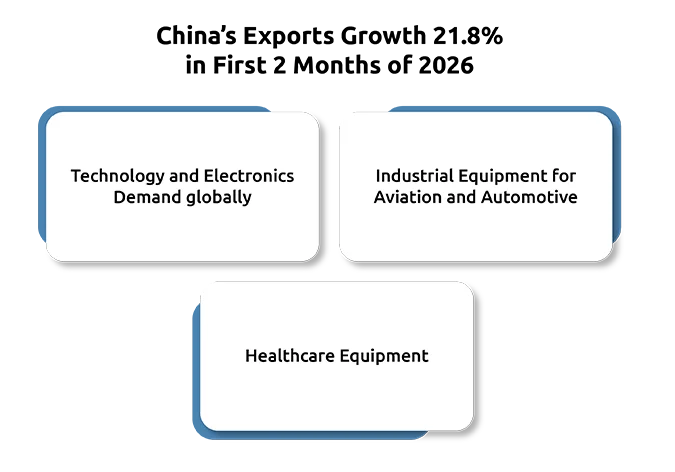
Technology and Electronics Demand globally
Demand for software products remains one of the strongest growth areas for exports using International freight services. Organizations working in IT infrastructure, semiconductor equipment, and cloud computing hardware continue to depend on Chinese manufacturing capacity in other countries. Increased investment in artificial intelligence infrastructure, data centers, and digital services globally has seen huge demand for electronic components and hardware systems.
Industrial Equipment for Aviation and Automotive
Another important contributor to export growth is the shipment of special industrial equipment used in aviation and automotive production. Aircraft components, correct manufacturing equipment, and automotive electronics are being sourced from Chinese suppliers. This trend shows the global requirement for dependable manufacturing capacity and cost‑effective production capabilities.
Healthcare Equipment
Medical device manufacturing has also supported China’s export growth in 2026. Hospitals and healthcare providers globally continue to grow their medical systems, which has increased demand for medical equipment, surgical devices, and globally, with HS code, HTS harmonized tariff Schedule categorizations. Chinese manufacturers have grown production systems to meet this growing global requirement.
Will China’s rising exports impact shipping and logistics markets?
Yes, rising exports usually increase demand for container shipping, freight forwarding, port operations, customs clearance, and warehousing services. Higher shipment volumes can lead to tighter container availability, port congestion, and fluctuating freight rates on major trade lanes. Increased exports may also create stronger demand for trucking, rail transport, and last-mile delivery services connected to ports and inland distribution hubs. Logistics companies often benefit from higher cargo volumes, but they may also face operational pressure such as capacity shortages and longer transit times. As Chinese exports continue to expand in 2026, global supply chains may need better planning, faster inventory turnover, and more flexible transport solutions to manage growing trade activity efficiently.
How China Exports Grow Despite Trump Tariffs
Trade tariff tensions between China and the United States, specifically tariffs introduced during the administration of Donald Trump, created huge problems for Chinese exporters. Also, Chinese organizations have accepted their plans to sustain export growth in Inventory and order management. Chinese exporters have grown their presence in developing markets across Asia, the Middle East, Latin America, and African countries. China has also changed toward producing manufacturing goods rather than depending completely on low‑cost manufacturing. Advanced electronics, special machinery, aerospace components, and electric vehicle technologies represent areas where Chinese organizations have increased investment in the country. Also, manufacturing networks have been reorganized across multiple countries with core production in China.
Major Reasons for China’s Trade Growth in Early 2026
Many broader economic factors explain why China’s trade grows to record levels during the first two months of 2026.
Strong Global Industrial Demand
Global industries are increasing investment in digital infrastructure, logistics systems, and healthcare technology. This growth requires large sizes of electronic components, industrial machinery, and special manufacturing equipment goods, where Chinese exporters have strong production capacity with the generalized system of preferences (GSP) scheme.
Manufacturing Efficiency and Scale in the country
China’s manufacturing sector benefits from huge economies of scale and advanced industrial collection. Huge factories, a combined supply chain, and experienced technical experts allow producers to maintain high output levels while controlling costs.
Export‑Focused Industrial Policy
Government support for major industries such as advanced manufacturing, renewable energy technology, and electronics continues to improve export performance in global trade. China’s guidelines that increase innovation and industrial development help increase the competitiveness of Chinese manufacturers in global trade.

Conclusion
China’s export performance during the first two months of 2026 shows the flexibility and adaptability of its manufacturing sector, with the best trade compliance software for import export rules. A 21.8% increase in exports and the highest recorded trade growth show strong global demand for technology products, industrial equipment, and healthcare devices. Organizations working in import and export sectors, specifically within IT, aviation, medical, and automotive industries, are seeing important changes in global supply chains. These trends will help organizations export plans, supply dependability, and respond effectively to the developing global trade.
DID YOU KNOW?
China’s total merchandise trade reached 7.73 trillion yuan ($1.12 trillion) in the first two months of 2026, with year-on-year growth returning to double digits at 18.3 percent.
FAQs:
1. Why did China’s exports grow sharply in early 2026?
China’s exports grew due to strong global demand for electronics, industrial machinery, medical devices, and digital infrastructure equipment. Increased investment in artificial intelligence, cloud computing, and manufacturing technology will also grow exports.
2. How much did China’s exports grow in the first two months of 2026?
China’s exports increased by 21.8% in January and February 2026, which helped the country reach the highest trade surplus on record during that period.
3. How did China maintain export growth despite US tariffs?
Chinese exporters varied their markets across Asia, the Middle East, Latin America, and Africa, while also changing toward higher-value products such as advanced electronics, EV technology, and aerospace components.
4. Which industries contributed most to China’s export growth in 2026?
Major industries include electronics and technology equipment, industrial machinery, automotive components, aviation equipment, and medical devices.
5. What does China’s export growth mean for global supply chains?
The surge in Chinese exports shows that global supply chains still depend heavily on China’s manufacturing efficiency and ability to produce advanced industrial products.