Introduction
Mexico has long been a critical hub for the automotive industry, supplying millions of vehicles to the United States every year. Its nearly established logistics chain, and free trade agreements have made it a preferred manufacturing and export base for global carmakers. Also, changing trade policies, new tariffs, and changing supply chain strategies are prompting manufacturers to revise their export methods. These adjustments are not only about production capacity but also involve agreement with international export regulations, customs clearance support, and stronger global trade facilitation.
How Digital Trade Solutions Are Reshaping Automotive Exports
Digital trade solutions are helping automotive production manage complex cross-border vehicle shipments more effectively. Advanced platforms improve shipment visibility, document accuracy, & communication between production, customs teams, and logistics partners. By using digital tools for compliance monitoring & export coordination, carmakers can reduce delays, improve decision-making, & adapt faster to changing global trade requirements.
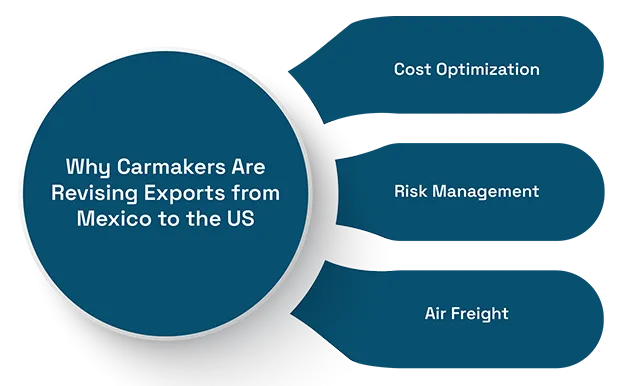
Why Carmakers Are Revising Exports from Mexico to the US
The main reason behind these revisions lies in cost optimization and risk management. Stricter U.S. tariff structures under the HTS harmonized tariff system, changes in Incoterms rules, and adjustments in the generalized system of preferences are altering the economics of exports. Carmakers are also reevaluating Delivery Duty Paid service methods, since organizations must pay customs duties, taxes, and global logistics fees. Also, disruptions in the global supply chain have accelerated the need for more flexible freight forwarding services and international shipping solutions to ensure on-time shipments.
Impact on the Automotive Industry and IOR, Exporter of Record Services
The change has a direct effect on vehicles imported into the U.S. For many organizations, using an Importer of Record service has become necessary to manage regulatory approval, tariffs, and customs documentation. These services simplify cross-border trade by confirming that vehicles are exactly categorized under the correct harmonized system code and meet U.S. safety guidelines.
On the other side, Exporter Of Record services in Mexico are equally crucial, managing export customs brokerage and documentation to confirm smooth exit processes. The combination of IOR and EOR services provides manufacturers with comprehensive import-export support, reduces delays, and improves visibility across global supply chain services. Using these functions, carmakers can focus on production while using customs brokerage and trade logistics and agreement expertise from special providers.
Reasons for Revisions of Exports of Vehicles from Mexico to the US
Several factors are driving these strategic changes across global trade and logistics. Shifts in tariff and trade policies—such as adjustments in U.S. tariffs, updated Harmonized Tariff Schedule (HTS) classifications, and renegotiated trade agreements—are directly affecting overall costs. At the same time, stricter regulatory guidelines, including stronger international export controls and customs requirements, are increasing the need for robust customs clearance support. Ongoing supply chain disruptions, such as semiconductor shortages, rising logistics expenses, and congestion at major ports, are making traditional export methods less reliable. In response, organizations are also re-evaluating Incoterms and delivery models, particularly Delivered Duty Paid (DDP) logistics, to better balance risk and cost. Additionally, sustainability pressures are pushing carmakers to adjust export strategies to align with green logistics initiatives and reduce their carbon footprint.
Carmaker Responses for Exports of Vehicles from Mexico to the US
Global manufacturers are implementing various plans to manage these challenges. Some are depending on international shipping solutions with advanced tracking to increase visibility. Others are partnering with special freight forwarding service providers to improve cross-border trade logistics and agreements.
Many are investing in stronger partnerships with customs brokerage firms that provide end-to-end export customs brokerage and customs clearance support. Carmakers are also diversifying their supply chain systems, splitting shipments between DAP and DDP shipping methods to reduce risk exposure. Also, increased use of global supply chain services confirms that production schedules remain in line with U.S. market demand.
Conclusions
The revision of vehicle exports from Mexico to the U.S. highlights the many parts of global trade. Carmakers are no longer just focusing on production efficiency but are increasingly prioritizing global trade facilitation, agreements, and resilient logistics plans. With the help of importer of record services, exporter of record services, and special partners in customs brokerage and international shipping solutions, manufacturers can guide tariff changes, HS codes, and international export regulations more effectively.
DID YOU KNOW?
Under the US-Mexico-Canada Agreement (USMCA), vehicles must meet a 75% Regional Value Content (RVC) requirement to qualify for preferential trade treatment. This rule encourages automakers to source more vehicle components from North America and strengthen regional automotive supply chains.
FAQs:
Why are carmakers revising exports from Mexico to the US?
Carmakers are adjusting due to tariff changes, stricter Incoterms, customs regulations, and supply chain disruptions that impact export costs and timelines.
How do tariffs and HTS harmonized tariff codes affect exports?
Updated HTS codes and tariffs change the duty rates for imported vehicles, making cost optimization and compliance essential for carmakers.
How do changing trade policies impact automotive exports from Mexico?
Changing trade policies can affect vehicle export costs, customs procedures, and supply chain planning. Carmakers need to monitor tariff updates, regional trade requirements, & compliance requirements to maintain smooth vehicle shipments between Mexico and the U.S.
Why are Exporter of Record (EOR) services important in Mexico?
EOR services handle export customs brokerage, documentation, and regulatory compliance, ensuring vehicles legally exit Mexico without delays.
How are carmakers responding to supply chain disruptions?
Manufacturers are diversifying logistics strategies, using a mix of DAP and DDP shipping models, partnering with freight forwarders, and investing in visibility tools.