
Understanding Export Insights & Import Trends of Canada Trade
Canada’s trade balance in 2025 reflects the country’s strong integration into global supply chain services. As one of the world’s leading trading nations, Canada depends massively on advanced manufacturing and technology-driven exports. Imports remain equally critical, supporting industries such as automotive, medical devices, aviation, and IT hardware. International export regulations and customs clearance support have become more important than ever, as Canada continues to expand its role in global trade facilitation. Businesses entering the import-export business must confirm proper import-export registration and agreement with Incoterms, HS codes, for smoother cross-border movement.
Navigating Canada’s Digital Trade Balance
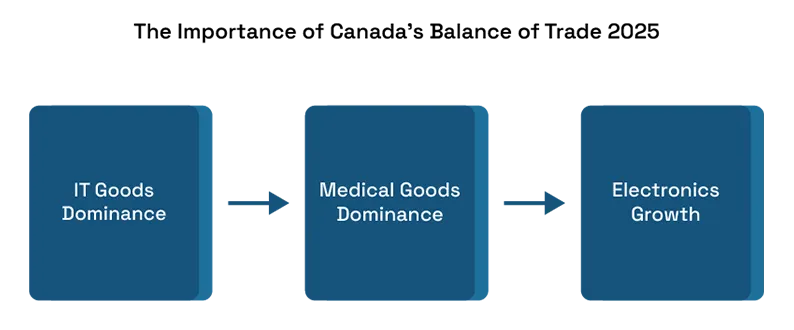
Canada’s trade balance now depends on mastering the new CARM digital portal rather than just moving freight. While IT and medical device hardware still lead exports, the focus has shifted to total digital compliance and automated tax bonds. Using an Importer of Record (IOR) is now the standard way to handle these security requirements and avoid immediate border rejections. By choosing DDP shipping, companies ensure their items clear customs instantly, bypassing the slow paperwork delays of the past. This modern approach keeps your projects on schedule while providing a clear, real-time view of your entire trade operation.

What Are Canada’s Greatest Exports and Imports?
Canada’s export and import landscape in 2025 is defined by high-value sectors and rapidly evolving supply chain needs. Medical devices, advanced automotive components, and IT services continue to lead export growth, supported by freight forwarding services, Exporter of Record (EOR) support, and efficient customs clearance systems. On the import side, Canada relies heavily on machinery, electronics, semiconductor equipment, and automotive parts sourced from global markets under DDP shipping and in-transit warehousing services. With increasing demand for global trade compliance, HS code classification, and seamless last-mile logistics, businesses depend on optimized warehouse solutions and strong freight forwarding networks to maintain uninterrupted market access.
Canada’s Export & Import Trends by Industry
Automotive Industry: Imports of vehicles and spare parts remain high, with DAP and DDP shipping solutions simplifying deliveries for global manufacturers. Exporter of record services also supports Canadian organizations expanding to global trade.
IT & Electronics industry: Canada imports semiconductors and advanced electronics while exporting IT services and software solutions. Freight forwarding service providers play a crucial role in this sector by providing global trade facilitation.
Medical device & Aviation industry: Imports of medical devices and aviation equipment are increasing, driven by customs clearance support and comprehensive import-export services. These industries frequently require DAPs (Delivered at Place) and specialized delivery solutions to confirm secure logistics.
Canada Export & Import by Country
The United States remains Canada’s top trading partner, accounting for more than 70% of exports, including IT and automotive goods. The EU and Asia-Pacific countries are also growing markets, importing Canadian Medical device and IT services. Imports from China, Germany, and Mexico supply major goods such as machinery, electronics, and devices. Global supply chain services and export customs brokerage allow Canadian businesses to maintain smooth trade relationships with these markets. Also, DDP logistics and importer of record services have allowed organizations to expand their import-export business with minimal delays.
The CARM Shift: Canada’s New Digital Border Standard
What is the biggest factor currently affecting Canada’s trade growth?
The CARM portal has completely changed how products enter Canada. It’s no longer just about fast shipping; you must now manage digital security bonds and direct declarations. Most businesses use an Importer of Record (IOR) to handle this, as any error in the system causes immediate border rejections. This setup ensures that high-tech equipment and medical device supplies stay compliant with real-time tax shifts, keeping your supply chain moving without the old manual paperwork delays.
Conclusions
Canada’s trade balance in 2025 shows the importance of both exports and imports in maintaining economic stability. From manufacturing to IT services, Canadian exports are expanding into new trades, while imports of medical devices, vehicles, and electronics are increasing. To continue this momentum, businesses must depend on comprehensive import-export support, including freight forwarding services, DDP shipping methods, and customs clearance support. As Canada strengthens its role in global trade, the combination of Incoterms, HS codes, and global trade facilitation will confirm competitiveness in the growing global economy.
DID YOU KNOW?
In December 2025, exports of aircraft and other transportation equipment and parts were up 20.5%, reaching a record high of $3.5 billion.
FAQs:
What is the biggest change for Canada’s trade balance right now?
Success now depends on mastering the CARM digital portal. While IT and medical devices hardware lead exports, businesses must now handle digital security bonds to ensure their shipments aren’t rejected at the border.
Who are Canada’s major trading partners?
The United States remains the largest partner, but trade with the EU and Asia-Pacific is growing fast, especially for specialized medical devices and aviation tech.
Why did Canada’s aircraft exports surge specifically in December 2025?
Aircraft exports increased due to year-end shipping, bulk business jet shipments, & strong U.S. demand in aerospace supply chains.
What impact does the CARM system have on high-value exports like aerospace and medical device goods?
CARM increases digital compliance requirements like tax bonds, HS code accuracy, and electronic declarations to avoid delays or rejection.
How is Canada’s import structure changing with technology-driven industries?
Canada is importing more semiconductors, electronics, & industrial machinery to support its growing tech & production sectors.