Overview
Bangladesh’s export to the United States is going through a challenging stage. A recent trade show suggests that Bangladesh’s exports to the US may decrease by nearly 14 percent in 2026, largely due to proposed tariff changes and trade approval requirements. As the US remains Bangladesh’s biggest export location, any tariff-related issues could have a huge impact across manufacturing, logistics, and global supply chains. Organizations are required for import-export work, international freight services, and customs clearance. This development shows the growing importance of approval, pricing plan, and supply chain optimization, specifically in industries such as IT devices, aviation tools, medical devices, and automotive parts.
What’s the reason Bangladesh’s Exports to the US decreased by 14 percent?
Growing Tariff Risk and Policy Changes
The expected decline is closely connected to changes in tariff systems and trade preferences. Bangladesh has historically benefited from preferential access to the US market under trade arrangements similar to the generalized system of preferences (GSP). Also, growing US trade priorities and approval standards are increasing cost pressures on exporters.
Cost Changing Across the Supply Chain
Higher duties under updated HTS Harmonized Tariff Schedule categorizations mean exporters see stronger margins. When combined with growing freight costs, insurance, and inventory holding expenses, US buyers may look for alternative sourcing markets. From a working position, exporters must now reevaluate Incoterms, international shipping terms, and landed cost calculations to remain efficient.
What’s the Major Reason Behind the Tariff Hike on Bangladesh’s Exports?
Approval and Categorizations Challenges
One of the major reasons behind higher tariffs is the stronger execution of HS code accuracy and good classification. Miscategorizations have led to under-reported duties in the past. Increased scrutiny by US Customs authorities is now resulting in higher reevaluated tariffs and execution actions.
The Shift to Mandatory Supply Chain Tracking
Today, US Customs requires more than just transparency; they demand verified proof of origin under strict new labor and sustainability laws. Even a small error in tracing your raw materials can lead to total shipment Losing stock and big penalties . Using an Importer of Record (IOR) is now a strategic move to manage this risk. They provide the legal oversight for your products that standard exporters frequently need. This hands-on compliance ensures your electronics or medical equipment meets the latest US Rules for checking , Stopping high-cost border issues that slow down sales
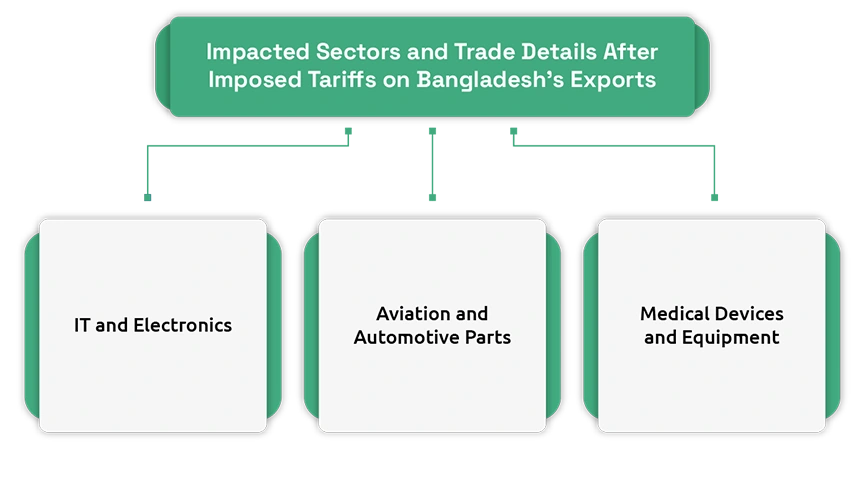
Impacted Sectors and Trade Details After Imposed Tariffs on Bangladesh’s Exports
IT and Electronics
Higher tariffs on electronic assemblies and subcomponents may impact Bangladesh’s growing IT hardware exports, mainly when routed through a difficult international freight services chain.
Aviation and Automotive Parts
Correct parts used in aviation and automotive manufacturing are highly sensitive to delays in shipments. Increased tariffs combined with customs issues can stop just-in-time delivery methods and inventory planning for the supply chain.
Medical Devices and Equipment
Medical exports see stronger approval requirements, with correct customs clearance, product labeling, and documentation non-negotiable in global trade.
Logistics and Delivery Pressures
As tariffs grow, exporters are selecting DAP and DAPs delivery methods to remain attractive to US buyers. Also, this changes the cost and risk responsibility back to the exporter, making inventory and order management more difficult for the supply chain. Some exporters are changing to premium delivery service options to reduce logistics risk and have delivery responsibilities, mainly for urgent shipments.
Major Adjustments for Exporters in Bangladesh’s
Using Trade Expertise
Working closely with an expert customs broker can help exporters guide the developing HTS Harmonized Tariff Schedule, avoid miscategorizations, and reduce unexpected duty showing.
Improving Supply Chain Optimization
Exporters that invest in modern routing, alternative suppliers, and modern approval tools will be better positioned to absorb tariff issues. Combined logistics planning and correct trade documentation are no longer optional; they are competitive necessities.
Conclusion
The expected 14% drop in Bangladesh’s exports to the US in 2026 shows a change in global trade. Tariffs, agreement execution, and supply chain clarity are changing how exporters work with the US market. For businesses working across IT, aviation, medical, and automotive industries, success will depend on proactive planning, using international shipping terms, improving customs processes, and using flexible supply chain plans. While tariffs add challenges, exporters that quickly and mostly can still protect market access and long-term growth in global trade.
DID YOU KNOW?
Bangladesh’s exports to the US market could fall by up to 14 percent, or nearly $1.25billion, over the next year due to the recently imposed 20 percent reciprocal tariff, according to study by the Research and Policy Integration for Development.
FAQs:
Why are Bangladesh’s exports to the US expected to drop by 14% this year?
The drop is a direct result of the new 19% Reciprocal Tariff and Strict paperwork check. Exporters who fail to update their HTS classifications are seeing their goods stuck at the border, leading to higher costs and lost contracts.
What is the biggest challenge for IT and Medical exporters in 2026?
It’s no longer just about the tax; it’s about legal entry. Without a dedicated Importer of Record (IOR), high-value tech and medical shipments are identified as high risk, causing weeks of delays that kill business growth.
Does the suspension of GSP mean the end of tax breaks for Bangladesh?
Not exactly. While the old GSP is gone, the new 2026 Trade Resilience Framework offers a path to lower rates. The catch is that you now need a certified supply chain audit to prove your goods meet the new sustainability standards required for these perks.
What’s the fastest way to clear high-value tech and medical cargo right now?
Stop relying on basic freight forwarding and start using Importer of Record (IOR). In today’s strict market, having a dedicated partner to handle the legal entry and HTS paperwork on the ground is the only way to avoid the 20-day customs “black hole” at US ports.
How can I protect my business from the new 20% tariff hikes?
Switch to DDP shipping. It lets you calculate and pay all taxes upfront so you can completely avoid extra charges or border delays . It’s the simplest way to keep your costs predictable.