Introduction
Artificial intelligence is increasing demand for specialised computing equipment, including high-performance servers, graphics processing units (GPUs), networking systems and data centre hardware. Businesses are increasing computing power to support AI applications, cloud services and large-scale data processing. The movement of AI hardware thus turns into an important factor for the global logistics and air freight business.
AI hardware shipments are not the same as typical commercial shipments. They may involve high value components, tight delivery schedules, specialized packaging and detailed customs documentation. Delays can affect data center installation, equipment improvement and broader technology projects. At the same time, air cargo capacity is also shared with other industries that need fast international transport.
Knowing why AI hardware is putting new pressure on global air-cargo capacity helps companies plan shipments, manage freight costs and prepare for import requirements before the equipment leaves the country of origin.
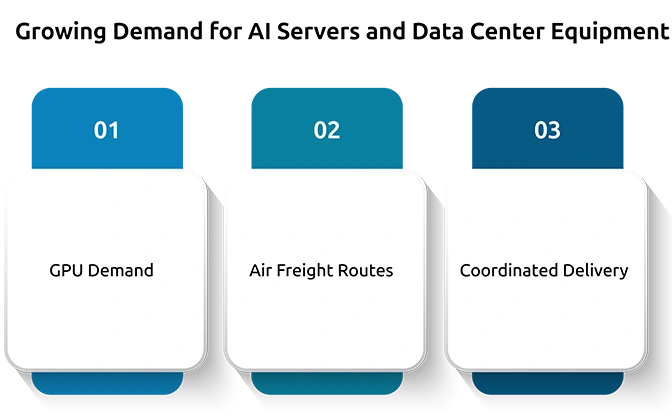
Growing Demand for AI Servers and Data Center Equipment
Demand for servers, GPUs, storage systems, switches & other networking equipment is being driven by growth in AI infrastructure. These products support the computing power required to train AI models, operate cloud platforms and process large volumes of data.
Many equipment manufacturers and technology companies operate international supply chains. Components may be manufactured or assembled in one country, consolidated in another location and shipped to a data centre in a different market. When several projects require equipment within similar delivery windows, demand for air freight can increase along particular trade routes.
AI hardware also has project-specific delivery requirements. A data centre may need servers, power-related components and networking equipment to arrive within a coordinated installation schedule. If one critical shipment arrives late, installation or testing may have to be rescheduled.
This demand does not mean every AI shipment travels by air. However, if speed of delivery, value of equipment or project deadlines are essential , businesses may choose air cargo over slower transport alternatives.
Customs paperwork could slow down cargo movement
Booking air freight capacity is not the only thing involved in the international shipping of AI hardware. The delivery time of a shipment can be affected by customs requirements and product controls.
Depending on the product and destination, import preparation may involve a commercial invoice, packing list, air waybill, correct product descriptions, customs classification, declared values or origin details. Technical specifications may be needed to identify the equipment and determine whether particular regulatory or trade-control requirements apply.
AI hardware could also be subject to further export-control review for high-end servers and networking device, and advanced computing chips. Requirements depend on the technical characteristics, the classification, the destination, the end user and the intended use of the product. “Companies should check the relevant rules before they ship any computing equipment and not assume that they are all similar.”
The importer, exporter and receiving party should also be identified correctly in the shipping and customs records. Where an importer of record (IOR) arrangement is required, it should be confirmed before shipment, including the responsible entity and the documents needed for the destination. A freight forwarder arranging transport does not automatically become the importer of record.
Preparing these details in advance can reduce avoidable document corrections and help prevent customs issues from adding to an already tight delivery schedule.

Practical Methods for AI Hardware Air Freight Planning
A company that can view transportation as an aspect of equipment procurement and project planning can better handle pressure on capacity. The first step is to forecast shipment requirements using confirmed equipment lists, expected manufacturing dates and installation milestones.
Booking early is specifically important for shipments of extraordinary dimensions, special handling needs or fixed delivery dates. Shippers shall report final weights and measurements as soon as possible and shall notify the logistics provider of any changes to packaging or cargo readiness.
It is also useful to compare air freight with sea freight or other suitable modes of transport. Air cargo is well suited for equipment that is urgent , valuable or schedule sensitive, but slower modes may be appropriate for planned replenishment or non-urgent components. The decision should account for the full delivery timeline, not just the time spent in transit.
Finally, businesses should coordinate the manufacturer, freight forwarder, customs broker, importer and receiving site before dispatch. Clear responsibilities, complete documentation or a confirmed delivery plan can help avoid shipping delays turning into installation delays.
One Union Solutions to Aid Equipment Movement
Rely on the destination, global technology equipment shipments may require coordination of transport planning, customs paperwork or import requirements. One Union Solutions provides trade-compliance services and global equipment shipping for businesses, including importer of record and exporter of record arrangements where applicable and subject to review.
For AI servers, GPUs and networking equipment, businesses should confirm the product details, destination requirements, end-user information and shipment documents before dispatch. Service availability and the suitability of any import arrangement depend on the specific shipment and destination.
Conclusion
AI hardware is adding pressure to global air cargo capacity because technology companies need to move increasingly important computing equipment across international supply chains. Demand for suitable space, high cargo values, specialised handling requirements and tight installation schedules can make transport planning more demanding.
Air freight capacity is only one part of the delivery process. The final timeline can be impacted by customs documentation, product classification, applicable trade controls and readiness of the receiving site. “The sooner businesses plan, verify cargo details, compare transport options and coordinate import requirements, the better placed they will be to deal with these variables.
Did You Know?
In 2025, U.S. data-centre spending was expected to exceed $500 billion, reflecting the scale of investment in AI infrastructure and the equipment needed to support it.
FAQs
1. Why is AI hardware increasing demand for air cargo?
AI systems projects require servers, GPUs, storage systems, and networking equipment. If these products need to be shipped fast for installation or replacement , companies may choose to opt for air freight, thus creating demand for enough cargo space on relevant routes.
2. Which AI hardware products are commonly shipped by air?
Its products include GPUs, AI servers, networking switches, storage, server components and other related technology hardware. The mode of transport shall be determined on the basis of the size, value, urgency and handling requirements of the shipment.
3. Does rising demand for AI hardware always drive to higher rates in air freight?
No. Rates are based on route-specific capacity, chargeable weight, shipment dimensions, seasonality, fuel-related charges and other market conditions. Demand can push prices up but the effect is not the same for all routes and for all periods.
4. What documents are needed to import AI hardware?
Common documents involves a commercial invoice, packing list and air waybill. Rely on the product and destination, customs classification, origin information, technical specifications, permits or other regulatory evidence may also be required.
5. How can companies reduce delays when shipping AI equipment globally?
Organizations can pre book transport, confirm package dimensions & weights , prepare correct invoices or product details , check for any export and import controls that apply & handles the importer, logistics provider & receiving site before dispatch.