On January 1, 2026, the European Union’s Carbon Border Adjustment Mechanism (CBAM) entered its final phase. This means that companies importing CBAM-covered goods now need to pay greater attention to emissions data than they did during the previous transition period.
Importers must ascertain the source of their emissions data, whether it corresponds with the goods being imported, and whether the data can be backed up by relevant documentation.
When the importer needs to prepare its CBAM declaration, a missing figure or an out-of-date calculation could cause issues. For this reason, early assessment of emissions data can facilitate compliance.
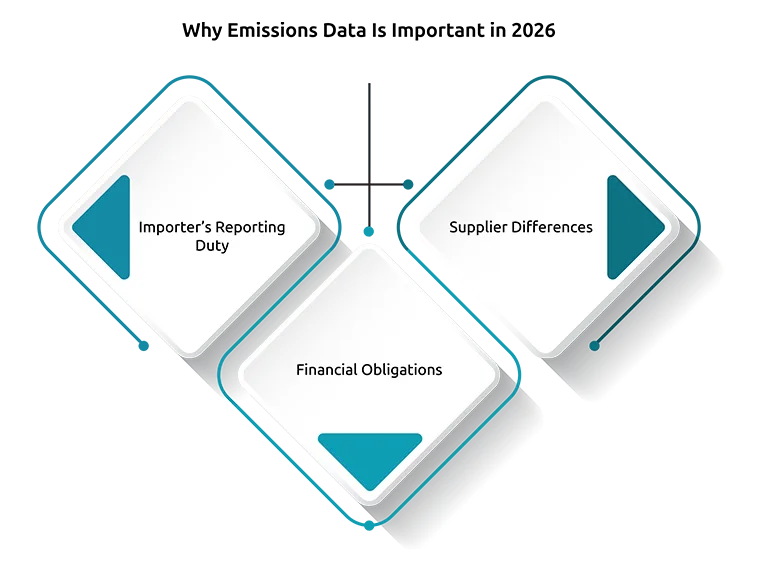
Why Emissions Data Is Important in 2026
CBAM connects certain imports entering the EU with their embedded carbon emissions. Importers must report the relevant emissions and, where applicable, meet the financial obligations associated with those emissions.
The information used for this process needs to relate to the actual goods being imported. It should also connect the shipment with the producer, production facility and applicable emissions calculation.
For companies that purchase from several overseas suppliers, this can become difficult to manage. Two suppliers may manufacture similar products but have different production processes and emissions figures.
Good record-keeping can help an importer identify these differences before preparing its declaration.
The Difference Between Actual Data and Default Values
Importers may use actual emissions information or applicable default values when preparing their CBAM information, depending on the rules for the goods concerned.
A more detailed picture of the emissions related to production can be obtained from actual data. However, suppliers outside the EU may need to cooperate in order to receive this information.
The importer may need details about the production facility, production process, quantity of goods and emissions associated with manufacturing.
When allowed, default settings can be helpful, but companies still need to know which approach is appropriate for their imports. It can lead to preventable problems to use an out-of-date reference value or an obsolete calculation without verifying the current needs.

What Importers Should Recheck in 2026
A CBAM data review should start with the basic information behind each shipment.
Check the Customs Classification
The first step is to confirm that the imported goods fall within the current CBAM scope.
The customs classification should match the actual product being imported. Product descriptions, quantities and country-of-origin information should also be consistent across the relevant records.
A classification error can affect whether a shipment is subject to CBAM requirements and how the import is reported.
Check the Production Facility
Knowing the supplier’s name may not be enough.
When installation-level information is required by the relevant CBAM procedure, importers should locate the production facility linked to the items.
This is particularly important for businesses purchasing the same type of product from different manufacturers or locations.
Emissions information should not be transferred from one production facility to another simply because the products appear similar.
Review How Emissions Were Calculated
Importers should ask how the emissions figure provided by a supplier was calculated.
The calculation should follow the applicable CBAM methodology. Businesses should be cautious about using figures copied from older reports, spreadsheets or previous shipments without checking whether they remain appropriate.
Where actual emissions are used, the relevant supporting information should also be retained.
Review Verification Requirements
Where verification is required for actual emissions data, importers should confirm that the relevant information has gone through the required verification process.
The European Commission has established rules for the verification of embedded emissions. Importers should therefore avoid assuming that any emissions figure supplied by a producer can automatically be treated as verified data.
Checking this early can prevent delays when the information is needed for CBAM reporting.
Do Not Rely on Old CBAM Data
One of the biggest mistakes an importer can make is assuming that information used during the transition period can simply be carried forward.
The definitive CBAM regime has different compliance requirements, and the European Commission continues to publish guidance and updates.
Companies should therefore review older spreadsheets, supplier declarations and calculation templates before using them for 2026 imports.
The same applies to default values and calculation methods. Businesses should make sure the information they use corresponds to the applicable rules for the reporting period.
Why Supplier Cooperation Matters
An importer cannot always calculate embedded emissions independently.
Information may need to come from the facility where the goods were manufactured. This means the quality of an importer’s CBAM process can depend partly on how quickly and accurately its suppliers provide information.
Companies can make this easier by setting clear requirements for suppliers.
For example, procurement teams can request the required emissions information as part of the supplier onboarding or purchasing process rather than waiting until the annual CBAM declaration is approaching.
This creates a more consistent flow of information between the supplier, importer and compliance team.
Start Preparing Before the Declaration Deadline
The first CBAM declaration covering 2026 imports is due by 30 September 2027.
Although this gives businesses time, waiting until the deadline approaches can create unnecessary pressure.
An importer may have hundreds of shipments, several suppliers and multiple production facilities to review. Finding missing emissions information at the last minute can make the process much more difficult.
Reviewing the data throughout the year gives companies more time to correct errors and contact suppliers when information is missing.
Conclusion
2026 is a crucial year for importers to examine their emissions statistics due to the transition to the final CBAM system.
Companies should verify that their product categories are accurate, that emissions data correspond to the appropriate manufacturing facilities, and that the data is backed up by the necessary paperwork.
The approach should include communication with suppliers. Correcting missing or inadequate information can be time-consuming, particularly if it must be acquired from industrial facilities located abroad.
Importers can analyze their data all year long and maintain connections between their supplier, emissions, and customs records instead of waiting until the CBAM disclosure deadline.
An efficient procedure can lessen the chance of depending on inaccurate or out-of-date emissions data and make it simpler to prepare the necessary information when the time comes.
DID YOU KNOW?
The European Commission’s CBAM Registry allows non-EU installation operators to share their emissions data directly with EU importers. This can help importers access the relevant installation and emissions information when preparing their CBAM reporting. The Commission also states that actual emissions data used for CBAM reporting must be verified by an accredited independent verifier.
FAQs
What is CBAM?
CBAM is an EU mechanism that addresses the carbon emissions associated with certain goods imported into the European Union.
Why should importers review their emissions data in 2026?
The definitive CBAM regime began in 2026. Importers therefore need to make sure their emissions information, calculations and supporting records are suitable for the current requirements.
Can importers use default values?
Default values may be used where permitted under the applicable CBAM rules. Importers should check the current requirements rather than relying on older values or calculations.
Where does CBAM emissions data come from?
Depending on the applicable reporting method, information may come from the producer or production facility outside the EU. Importers may need to collect information about production and embedded emissions.
When is the first CBAM declaration for 2026 imports due?
The first CBAM declaration covering imports made during 2026 is due by 30 September 2027, subject to the applicable CBAM rules.