Overview
Global trade is changing rapidly as sustainability becomes a center of focus for businesses and industries. The most significant advancements in the last several years is the Carbon Border Adjustment Mechanism (CBAM), a policy designed to impose carbon costs on imported goods based on their impact on the environment. This mechanism aims to create a level playing field between domestic producers subject to strict climate regulations and foreign manufacturers operating under less stringent rules.
For businesses involved in import-export operations—particularly in IT, aviation, medical, and automotive sectors—Cost management and calculation are guided by CBAM. It has managed to introduce a new layer of financial and regulatory considerations, making it important for companies to adapt their strategies to remain competitive in global markets.
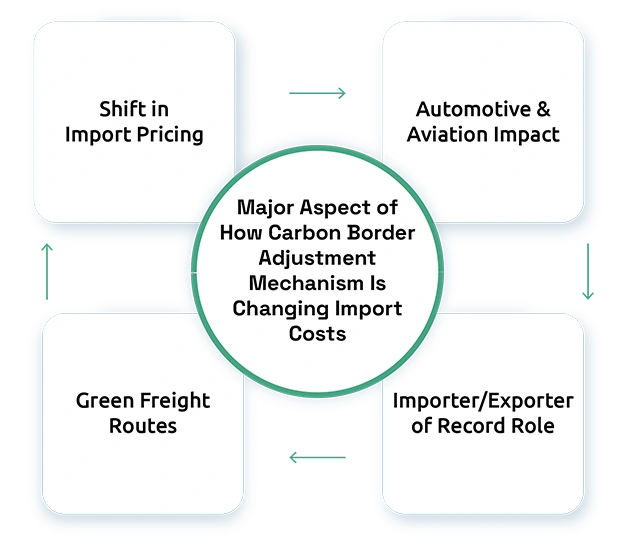
Major Aspect of How Carbon Border Adjustment Mechanism Is Changing Import Costs
An important aspect of CBAM is impact on import pricing structures which is direct. Companies importing carbon-intensive goods must now follow the new guidelines for additional charges linked to emissions generated during production. This helps to focus the shift from purely cost-based sourcing to more environmentally conscious decision-making.
Supply chain optimization is becoming crucial these days. Companies regularly monitor suppliers depending on their production techniques, carbon footprint, and compliance with international environmental standards. This is helping the procurement strategies across industries, especially in sectors like automotive and aviation where material sourcing plays a major role.
The role of international freight services is also evolving, as transportation emissions are gaining more attention. Safer and faster routing, consolidation, and minimal transit times are becoming an major factors in minimizing overall carbon costs. At the same time, services like importer of record service and exporter of record services help businesses navigate the complex regulatory landscape associated with CBAM.
Classification systems such as HS code and HTS harmonized tariff schedule remain essential for determining applicable duties and carbon-related charges. Alongside this, Incoterms like DAP and DAPs continue to define responsibilities between buyers and sellers, ensuring clarity in cost allocation. Rules grow more complex, industries are also interested in investing the best trade compliance software for import export rules to manage documentation and reporting requirements effectively. This is closely tied to improved inventory and order management, which helps companies maintain transparency and control over their supply chains.
What Has Changed in 2026 and Why It Is Relevant to Global Logistics
In 2026, CBAM has made a significant move from a transitional phase toward more structured implementation, increasing its influence on international trade. Companies are now required to provide detailed emissions data for imported goods, making precise reporting and verification even more crucial. An important change is focus on transparency. Businesses must check, track and then disclose carbon emissions throughout the supply chain, from raw material sourcing to final delivery. This has led to greater collaboration between suppliers, manufacturers, and logistics providers. Digital transformation has major role in this shift. Companies are leveraging advanced tools to monitor emissions, manage compliance, and streamline processes such as customs clearance. Automation is increasing accuracy and efficiency while lowering administrative burdens.
These developments are propelling the adoption of more sustainable and compliant supply chain procedures for sectors like IT and medical equipment, when precision and reliability are essential. Similarly, the automobile and aviation industries are examining their buying practices in an effort to lower carbon exposure and related expenses.
Changing Import Costs and Carbon Border Impacts
CBAM is fundamentally altering how import costs are calculated and how they are introduced. Beyond traditional duties and taxes, businesses must now keep an eye in carbon pricing, which can vary depending on the product, origin, and production process.
Profitability and pricing strategies are giving a direct hit. Companies may need to adjust product pricing, renegotiate supplier contracts, or explore alternative sourcing options to remain competitive.
Another important consideration is risk management. Non-compliance with CBAM requirements can result in penalties, delays, and reputational damage. This highlights the importance of integrated solutions that address both logistics and regulatory compliance. Plus, there has always been a need for end-to-end service providers which are now reflected in queries such as “can a freight forwarder be an exporter of record” and “can a customs broker handle both import and export documents.”
CBAM on other side is forcing businesses to adopt more sustainable practices while also reshaping global trade dynamics. Companies that proactively adapt to these changes are better positioned to manage costs and maintain a competitive edge.

Conclusion
The Carbon Border Adjustment Mechanism changing its way of import costs are structured, making a introduction of new challenges and opportunities for businesses globally. CBAM is promoting a change toward more transparent and sustainable supply chains by making an connection towards the trade policy with environmental goals. For import-export companies operating across IT, aviation, medical, and automotive industries, adapting to this new landscape is essential. Using international freight services and implementing cutting-edge compliance tools, and focusing on supply chain optimization, businesses can navigate the complexities of CBAM effectively.
Having the correct and important information will be crucial as the trade will continue to change in 2026 and beyond plus in order to make sure the compliance, keep costs under control, and develop reliable, future-ready procedures.
DID YOU KNOW
“CBAM will apply in its definitive regime from 2026, with a transitional phase of 2023 to 2026. This gradual introduction is aligned with the phase-out of free allowances under the EU Emissions Trading System (ETS) to support the decarbonisation of EU industry. “
FAQs
- What is the Carbon Border Adjustment Mechanism (CBAM)?
It is a policy that adds carbon-related costs to imported goods based on their emissions. - How does CBAM affect import costs?
It increases costs by including carbon pricing along with traditional duties and taxes. - Which industries are most impacted by CBAM?
Industries like aviation, automotive, IT, and manufacturing are highly affected due to carbon-intensive processes. - Why is CBAM important in 2026?
Its stricter implementation requires detailed emissions reporting and compliance from importers. - How can businesses adapt to CBAM changes?
By optimizing supply chains, improving compliance processes, and choosing low-carbon suppliers.