Introduction
In today’s developing world, shipment control has become increasingly important for companies. Businesses have to handle foreign shipments, changing rules, rising costs, & customer demands for timely delivery. The entire supply chain could face issues due to even minor mistakes. Standard logistics software helps companies with handling shipments and transportation, but when unexpected issues occur, it usually requires human help.
Businesses are handling these difficulties more effectively due to new technologies. AI agents may handle duties automatically, analyze data, & help companies in making better decisions.
What Is Traditional Logistics Software?
Traditional logistics used to be a logistics operation system where information & workflows are mainly carried out manually or in an unstructured manner. Typically, orders are received through non-structured channels such as phone calls, faxes, & emails, and deployment & transportation requests are processed accordingly. The status of transportation mainly depends on confirmation calls from the person in charge or handwritten documents. Inventory status is managed through manual verification by warehouse staff or simple ERP input.
This method has been used in the industry for a long time, but it has limitations such as difficulty in sharing real-time information, tracking difficult causes of errors, & low visibility across the whole supply chain.
What Are AI Agents in Logistics?
AI agents in logistics are updated software programs that can think, learn, & work on their own. They help organizations manage transportation, warehouses, inventory, & deliveries with less manual work. Unlike traditional logistics software, AI agents do more than follow fixed rules. They handle all data, make correct decisions, & take action when situations change.
AI agents collect information from different systems, like warehouse software, transport management systems, GPS tracking, customer orders, & customs records. They deliver all this information together in one place. This gives businesses a clear view of their supply chain & helps them make better decisions. One of the biggest advantages of AI agents is that they learn from experience. They study past shipments, delivery times, customer demand, & common delays. They become better at predicting problems & selecting the best solution.
AI agents also manage many routine tasks automatically. They can track shipments, update inventory, prepare shipping documents, schedule deliveries, & send customer updates. This minimizes manual work, saves time, & lowers the risk of human error. As global supply chains become more difficult, AI agents help businesses work faster & more easily. They enhance delivery performance, minimize costs, increase accuracy, & allow logistics teams to focus on more important tasks. This makes AI agents a valuable tool for updated logistics operations.
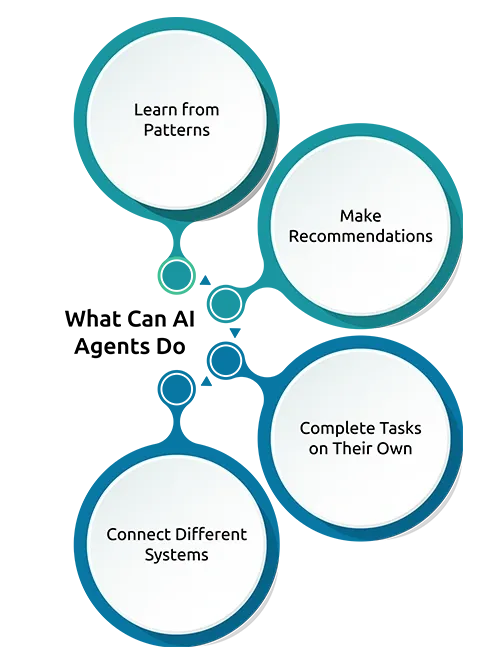
What Can AI Agents Do?
Analyze Data
AI agents collect information from different sources, such as shipment tracking, warehouses, traffic, & customs systems. They quickly study this data & help businesses make better decisions.
Learn from Patterns
AI agents learn from past shipments & daily operations. They can spot common delays, busy seasons, & delivery trends. This helps them make smarter decisions in the future.
Make Recommendations
AI agents can suggest the best shipping route, select the correct carrier, predict inventory needs, & warn about possible delays. These suggestions help businesses save time & minimize costs.
Complete Tasks on Their Own
AI agents can perform many tasks without human help. They can book shipments, update delivery status, reorder stock, prepare documents, & assign transport based on current conditions.
Connect Different Systems
AI agents can work with different logistics systems, such as warehouse software, transport management systems, ERP software, & customs platforms. They move information between these systems automatically, minimizing manual work & enhancing accuracy.
This allows businesses to handle their whole logistics process more easily & respond faster to changes.
What’s the Difference between AI Agents vs Traditional Logistics Software
Traditional logistics software & AI agents both help organizations handle shipments, but they work in many different ways. Traditional software follows fixed rules that are set by customers. It is useful for everyday tasks like managing shipments, tracking orders, handling inventory, & managing shipments. If any sudden issue happens, such as a delivery delay or a customs problem, employees mainly need to solve it manually.
AI agents are different because they can understand what is happening & respond quickly. They collect real-time information from warehouses, delivery vehicles, GPS tracking, customer orders, & other systems. Using this information, they can find problems early, suggest better solutions, & in some cases take action without waiting for instructions. This helps businesses save time & avoid delays.
Another difference is how they improve over time. Traditional logistics software works the same way every day unless someone changes its settings. AI agents learn from previous shipments, delivery times, customer demand, & common problems. This helps them make better decisions & enhance performance as they continue to work.
Traditional software is mainly developed to automate simple & repetitive tasks. AI agents can also manage these tasks, but they can do much more. They can choose better delivery routes, predict inventory shortages, update shipment information, prepare shipping documents, & send alerts when there is a risk of delay. This minimizes manual work & helps logistics teams work more easily.
Conclusion
AI agents help organizations handle difficulties more easily. They use real-time information to make quick decisions, automate routine work, minimize manual effort, & enhance shipment tracking. They can also help businesses respond more quickly when problems occur, making logistics operations easier & more usable.
AI agents do not replace traditional logistics software. They work together with it to enhance daily tasks. Traditional software handles regular tasks, while AI agents help make better decisions & handle changes quickly. Using both together helps businesses work faster, minimize issues, & build a stronger supply chain for the future.
Did you know?
Barcelona-based startup Opereit believes artificial intelligence can close that gap. The company has raised $2.5 million in pre-seed funding less than two months after launching.
FAQ
Can AI agents work with existing logistics software?
Yes. AI agents are designed to work alongside existing logistics software such as ERP, WMS, and TMS. They improve these systems by analyzing data, automating tasks, and providing real-time insights without replacing the software already in use.
How do AI agents improve supply chain visibility?
AI agents collect data from different sources, including warehouses, transport systems, GPS tracking, and customs platforms. They combine this information into one view, allowing businesses to track shipments, monitor inventory, and identify potential delays in real time.
Are AI agents suitable for small and medium-sized businesses?
Yes. Small and medium-sized businesses can also benefit from AI agents. They help reduce manual work, improve delivery planning, increase operational efficiency, and support business growth without requiring large logistics teams.
What types of logistics tasks can AI agents automate?
AI agents can automate many daily tasks, including shipment tracking, inventory updates, route planning, document preparation, delivery scheduling, order processing, and customer notifications. This helps save time and reduces the risk of human error.
What should businesses consider before adopting AI agents?
Before adopting AI agents, businesses should review their existing logistics systems, data quality, integration requirements, budget, and employee training needs. A well-planned implementation helps ensure that AI agents deliver the best results and improve overall logistics performance.