Introduction
Redundancy in the supply chain relates to having backup plans in case the main supply route is stopped. These could be more services, backup suppliers, extra stock, & different routes for transportation. Because these backups need support to maintain them, companies may view them as an extra cost. Redundancy, however, can protect companies against global issues, tariff changes, supplier problems, and transport delays.
So, is redundancy in the supply chain an unnecessary cost or a type of insurance? Cost, business impact, risk, and criticality all impact response. When disruptions possibly cause major loss, companies may use strategic redundancy for important suppliers, goods, routes, or systems.
What Is Supply Chain Redundancy?
Redundancy in the supply chain refers to having backup plans if the main supply chain fails. Rather than depending on the same supplier, warehouse, carrier, or route, a company keeps options. Several suppliers, extra suppliers, safety stock, multiple warehouses, other routes for delivery, different logistics providers, local diversification, and backup capacity for production are examples of this. These options help create supply chain alternatives and improve supply chain flexibility when an unexpected problem occurs. For example, if one supplier cannot deliver, a backup supplier can provide the needed goods. If one warehouse or transport route is affected, inventory can move through another location or route. This makes supply chain backup an important part of supply chain risk protection and supply chain continuity. However, redundancy does not mean duplicating everything; businesses should create backup options where they are most needed.
Why Redundancy Can Be Smart Insurance
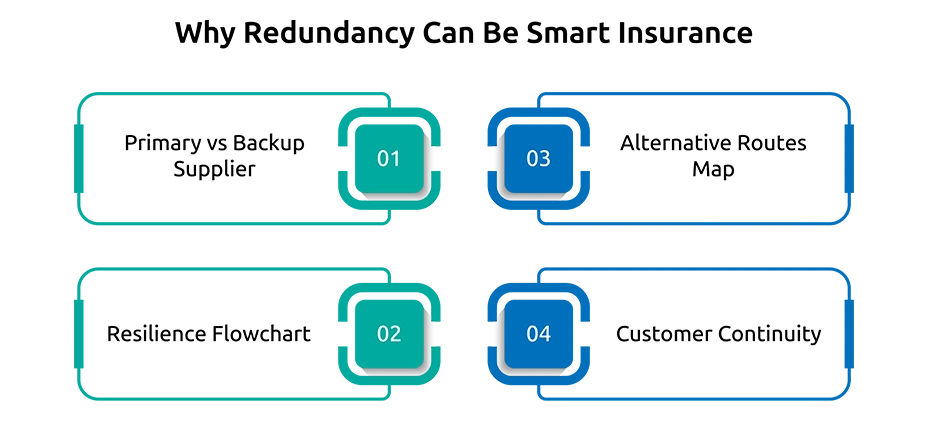
Redundancy in the supply chain provides companies with options for when something go wrong. When the main supplier delays or stops production, a second provider can help. This improves supply chain resilience & reduces the chance of delays. Alternative routes and carriers can keep goods moving when the normal route is unavailable. Both company and operational safety are provided by this.
Overstocks, lost orders, delivery delays, customer issues, and sales losses can all be reduced with backup stocks and suppliers. This helps maintain customer service continuity. By reducing the effects of delays on customers, sales, and company name, effective supply chain risk control can also improve revenue protection.
Redundancy vs Resilience: What Is the Difference?
The main difference between resilience & redundancy is capacity to work with disruption vs having backup plans. Supply chain redundancy gives a business alternatives, such as another supplier, route, or facility, when the main option is not available. A resilient supply chain goes further. It is capable of detecting problems, receiving their impact, moving quickly, recovery, and changing to new situations. Because of this, flexibility of supply chains and disruption recovery are important parts of resilience.
To put it simple, resilience is capacity to continue and come back, while redundancy offers a backup. Redundancy becomes a part of larger plans that also involves supply chain continuity planning.
When Does Supply Chain Redundancy Become Wasteful?
When companies provide more backup options than they clearly require, supply chain redundancy can become wasteful. For every product, companies don’t need extra suppliers, warehouses, routes, or inventory. Too much unnecessary redundancy can increase the cost of redundancy and create supply chain inefficiency. Large inventory buffers can also become a problem. Too much excess safety stock ties up cash and increases storage costs. If products are not needed, this can lead to redundant inventory and inventory waste.
Redundancy may also have little value when the risk is very low. Paying for backup capacity makes less sense when a disruption is unlikely and would have only a small impact. Companies should first identify their most important and vulnerable supply chain points. By doing this, supply chain cost control is improved and redundancy is used where it adds important value.

When Is Supply Chain Redundancy Worth the Cost?
When a disruption could have an important effect on the company, supply chain redundancy is worth the cost. Companies should protect critical components with backup suppliers or extra stock. A single point of failure can increase supply chain vulnerability. Using critical suppliers and backup options can reduce this risk.
For products with long lead times, backup options can reduce lead time risk and delays. When disruption can cause production shutdowns, lost customers, or major revenue loss, the supply disruption cost may be higher than the cost of redundancy.
Conclusion – Supply Chain Redundancy Can Be Smart Insurance When Used Carefully
Supply chain redundancy can increase supply chain costs, but removing every backup can increase disruption risks. Companies do not need maximum or minimum redundancy. They should identify critical risks and keep targeted backup options where they are most needed. The value of redundancy should be compared with the possible cost of disruption. A flexible, risk-based method helps in finding a balance from supply chain resilience and efficiency.
Did you know
The top perceived risks confronting supply chains in 2026 include economic volatility (55%), tariffs and trade barriers (48%), geographical instability (38%), and cyber threats (38%).
FAQ
How does geographic diversification support supply chain redundancy?
It reduces the effect of a local disruption by providing a company with suppliers, warehouses, or production options in many locations.
How can companies measure the value of supply chain redundancy?
They can compare the cost of maintaining backups with the possible supply disruption cost, such as downtime, lost sales, and recovery costs.
What is the difference between redundancy and backup inventory?
Backup inventory is one form of redundancy. Transportation routes, backup supplies, facilities, and carriers can all be defined as types of redundancy.
What happens when redundancy costs more than the risk it protects against?
The company can be spending for security. It should review the backup option and consider a lower-cost alternative.
Does supply chain redundancy improve supply chain resilience?
Yes, Redundancy is part of supply chain resilience. Preparing, handling, recover, and shifting to delays are further features of resilience.