Introduction
Supply chains currently face many different of risks, like shifting demand, trade challenges, supplier problems, transport delays, and global risk. For businesses looking to continue operating in the face of unexpected issues, supply chain resilience is important. Businesses cannot increase resilience without knowing the reliability of their supply chain. Businesses can determine how well they can plan for delays, manage their effects, recover, and adapt by measuring supply chain resilience. Supply chain resilience measures, risk analysis, planning for situations, and regular tracking are now used by businesses to detect risks before they become major problems. Businesses may create stronger and more flexible supply chains by shifting from reacting to delays to continuous supply chain risk management.
What Is a Resilience Supply Chain?
A supply chain that can manage unexpected problems and recover quickly without stopping business processes is said to be reliable. It allows businesses to keep shipping goods, handling inventory, and shipping goods even in a situation of disruptions. Supply chain capacity, careful preparation, and planning for business continuity to reduce risks are all parts of a strong, resilient supply chain strategy. Using more suppliers and having less inventory is the main goal of a traditional supply chain. When trade rules, natural disasters, or logistics issues occur, this can cause delays even though it works normally. To maintain a smooth process, a strong supply chain, on a different side, makes use of multiple suppliers, flexible shipping options, and better planning.
Why Do Companies Need to Measure Supply Chain Resilience?
Companies can identify which parts of their supply network are strong and which could cause problems in the case of a problem by measuring supply chain resilience. It can help companies to detect broken links, inventory risks, important suppliers, and single points of issue before they have an affect on operations. It also shows a company’s capacity to react when an issue develops. To decide how quickly they can continue routine tasks, businesses could track recovery time, supplier efficiency, inventory levels, and other supply chain resilience factors. Businesses use these details to see where they may make changes. Based on the risks that are most important, they can choose better suppliers, develop backup plans, change levels of stock, or plan different transport routes. Also, it helps businesses plan for business continuity and get ready for possible delays. In simple words, analyzing resilience allows a business to detect issues early, plan for delays, recover more quickly, and keep a smooth supply chain.
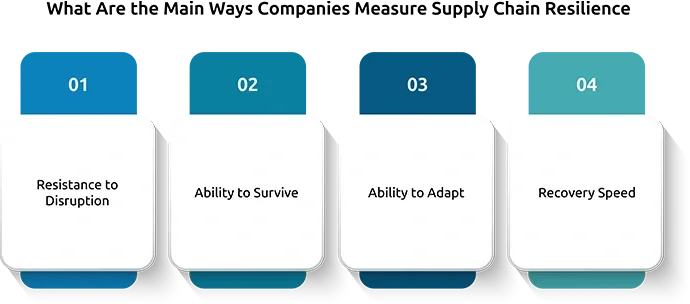
What Are the Main Ways Companies Measure Supply Chain Resilience?
Businesses can determine supply chain resilience in different kind of ways. Rather than focusing on one figure, they may check how well the supply chain handles problems, how quickly it recovers, how long it can keep working, & how easily it reacts to change.
1. Resistance to Disruption
This shows how well a supply chain works in the face of an issue. Businesses may check fulfilled order rates, production results, available inventory, OTIF data performance, and service levels. The supply chain may be more prepared to deal with unexpected problems if these processes hardly change during a delay.
2. Recovery Speed
Recovery speed shows the speed that a business can continue activities following an issue. Businesses can track delay, recovery time, backlog recovery time, and Time to Recover (TTR). A quicker recovery time typically shows that the company may continue operations faster.
3. Ability to Survive
When regular supply is affected, businesses also have to decide how long they can continue to survive. Time to Survive (TTS) calculates how long a company can keep going to meet demand before running out of capacity, stock, or other resources. Companies can determine whether they survive a break sufficient time to recover by using TTS and TTR.
4. Ability to Adapt
A strong supply chain must to be flexible to changing situations. Businesses may consider if they have additional shipping routes, flexible production, different sourcing centers, different suppliers, and ability to adjust to changing demand. When their regular supply chain are affected, businesses can continue operations with more flexibility.
How Often Should Companies Measure Supply Chain Resilience?
Because suppliers, need, shipping, & business factors can all change, companies should regularly check the resilience of their supply chains. When necessary, it is possible to keep track of important factors including supplier efficiency, levels of stock, delivery times, and recovery times. At least once a year, a complete review of the resilience of the supply chain should be done. Following a key problem, a change in a key supplier, a new shipping route, or an entry into a new market, new analysis is helpful. When major changes happen with trade rules, customer demand, sourcing, or logistics operations, businesses also need to evaluate their resilience. The supply chain’s scope and level of risk can affect the timing. While reduced-risk companies may review their core measures rarely, high-risk supply chains may need more regular checks.

Conclusion
Resilience of the supply chain cannot be measured by a single figure. Recovery time, inventory, supplier reliance, delivery performance, backup choices, and recovery costs are just a few of the factors that businesses must review. These methods help companies in finding weak areas, detecting problems, and making the necessary changes to create a stronger and more flexible supply chain.
Did you know
In 2025, an estimated 53% of companies were actively recruiting for new supply chain management roles, against a backdrop where 62% of industry leaders identified skilled supply chain talent shortage as a primary concern.
FAQ
How often should companies measure supply chain resilience?
Companies should track important measures regularly & conduct a detailed review at least once a year. They should also review resilience after major changes or delays.
What are common supply chain resilience metrics?
Common metrics include recovery time, inventory levels, supplier dependency, delivery performance, & Time to Survive (TTS). These help companies understand how smoothly their supply chain can handle problems.
How can companies improve supply chain resilience?
Businesses can make use of backup suppliers, flexible modes of transport, proper inventory levels, and improved planning. These steps can help them react to delays more easily.
Can technology help measure supply chain resilience?
Yes. Suppliers, stock, shipments, and risks can all be tracked by businesses using technology. It can also give a quick warning of possible problems.
What is the main goal of measuring supply chain resilience?
Finding problems and being ready for any problems are the main goals. This makes it easier for businesses to develop a supply chain that can change and recover back.