Introduction
Global technology deployments are rapidly growing as businesses build data centers, cloud infrastructure, & IT networks across borders. To keep these projects on track, businesses must have strong supply chains that can deal with unexpected challenges without affecting operations. Global supply chains are currently facing many types of risks, including geopolitical issues, customs delays, supplier problems, transportation challenges, & changing trade rules. These difficulties can cause delays in the supply of servers, networking equipment, telecom devices, & other important IT hardware. Even small delays can effect project deadlines & increase expenses. A resilient supply chain helps businesses in preparing for these risks by improving planning, increasing supply chain visibility, and increasing compliance. Companies with the proper logistics strategy, customs support, and reliable Importer of Record (IOR) and Exporter of Record (EOR) services can ensure business continuity, reduce delays, and complete global technology installations more efficiently.
What Is a Resilient Supply Chain?
A strong supply chain is one that helps businesses to keep their products moving even when unwanted problem happen. It is intended to deal with delays, supplier issues, customs problems, & changing trade laws. It helps global technology deployments in making sure IT equipment reaches its location with fewer delays. A resilient supply chain has a few important features. It improves supply chain visibility, works with multiple suppliers, keeps proper inventory, follows trade compliance rules, & gives many types of delivery methods. These processes allow businesses to handle challenges easily when they happen & keep projects on track. Speed is important, but reliability is also more important. A fast shipment is not useful if it gets delayed due to customs or missing documents. A resilient supply chain focuses on better planning, risk management, & efficient logistics so that businesses may avoid delays & continue working. A typical supply chain focuses on quick delivery & low costs. A resilient supply chain focuses on being flexible & ready for change. It helps businesses to handle supply chain problems, following to import & export rules, & supporting efficient technology deployments in multiple countries.
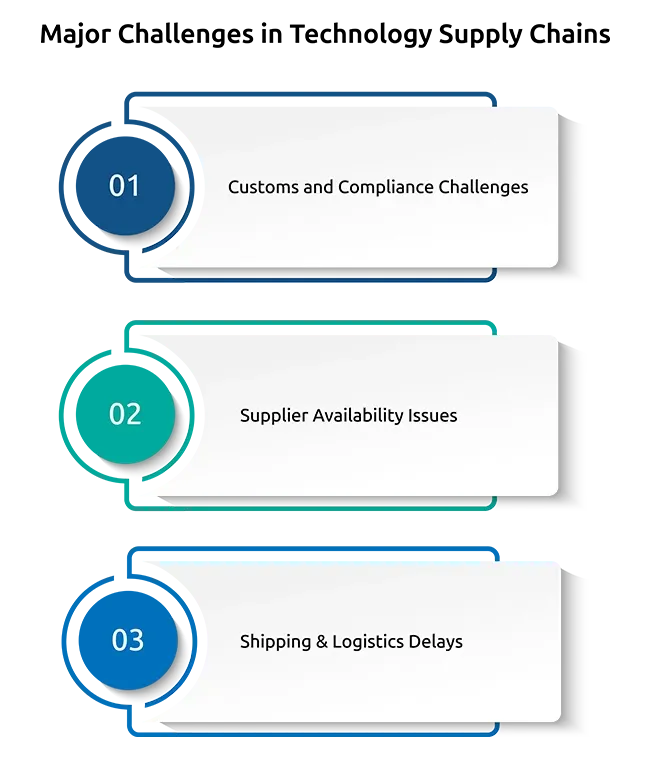
Major Challenges in Technology Supply Chains
To deliver IT equipment on time, technology companies depend on efficient supply chains. However, many types of challenges could affect shipments & cause technology deployments to be delayed. Understanding these challenges helps businesses to improve supply chain resilience & handling risks.
Customs and Compliance Challenges
Every country has its own customs rules & import restrictions. If documents are missing or incorrect, shipments may be delayed during customs clearance. Following trade regulations & preparing the required documents helps to shipping of goods.
Supplier Availability Issues.
Due to production problems or strong demand, suppliers are not always available to deliver products on time. This can cause server, networking, & other IT product delivery delays. Using many suppliers reduces this risk.
Shipping & Logistics Delays
Shipments may be delayed because of congested ports, restricted shipment capacity, weather issues, & route changes. These issues have the ability to impact delivery timeline & slow down global technology deployments. Proper logistics planning helps to reduce these delays.
Low inventory levels.
If a company stores very small inventory, it may not have enough IT equipment as demand increases. This might cause project delays & have an impact on business activities. Proper inventory management helps to make sure that critical products are available when they are needed.
Changes in Global Trade
New tariffs, trade restrictions, & changing import laws all have an impact on global shipping. Businesses must keep track of these developments & change their supply chain management planning to reduce unnecessary delays.
How AI and Automation Improve Supply Chain Resilience
AI and automation help businesses in developing supply chain resilience by improving planning & reducing delays in technology supply chains. Predictive analytics & demand forecasting help companies in planning for future needs, while artificial intelligence improves inventory management by maintaining the proper amount of IT equipment on hand. Automation also provides real-time visibility through shipment tracking, making it easy to track a delivery. It helps in the development of smart customs documents, improves trade compliance, & reduces paperwork errors. AI also helps in risk management, allowing businesses to detect issues early & keep technology deployments going smoothly.
Why Customs Compliance Is Critical for Global Technology Deployments
Customs compliance is critical for smooth global technology installations. Import & export rules are different in every country. To send IT equipment without delay, businesses must follow these rules. Correct documents, valid HS codes, & proper shipment details all support faster customs clearance. If the documents are incorrect or missing, the shipment may be delayed or reject at customs. Businesses must also follow country specific laws, as import regulations change by country. An Importer of Record (IOR) is responsible for handling import documents & making sure shipments follow to local import regulations. Before a shipment leaves the country, an Exporter of Record (EOR) handles export documents & makes sure compliance. Using IOR and EOR services helps businesses to reduce shipment delays, meet trade compliance needs, & complete technology deployments more quickly.

Conclusion
A strong technology supply chain enables businesses to change & keep technology deployments on time. Companies can reduce delays & increase efficiency by improving supply chain resilience, following to customs regulations, & using the proper logistics strategy. Importer of Record (IOR) & Exporter of Record (EOR) services improve international shipping by helping businesses with following import & export standards, resulting in simpler global operations.
Did you know
Global trade reached a record value of more than US$35 trillion in 2025, an increase of about 7.5%, and trade is expected to remain positive in 2026.
FAQ
How does automation benefit supply chain operations?
Automation reduces manual work, improves shipping tracking, and allows more efficient stock control.
Businesses can improve planning, use many suppliers, follow to trade rules, and increase supply chain visibility.
What are the primary risks to technology supply chains?
Common risks include customs delays, supplier issues, delivery delays, and changes to trade rules.
How can IOR and EOR services support global technology deployments?
IOR and EOR services help companies in following import and export standards, completing customs clearance, and reducing shipment delays.
How do resilient supply chains support global business growth?
They help businesses deliver IT equipment more reliably, follow trade requirements, & grow into new markets with greater confidence.