Overview
For years, companies used China Plus One to minimize reliance on a single production base. The plan was practical: keep essential capacity in China while adding production or buying in another country. But supply-chain planning has moved beyond simply finding a second factory. Companies now have to consider political alignment, supplier depth, customs exposure, logistics routes, local system & the ability to move production when conditions change. This next stage is often described as Friend-Shoring 2.0—a broader approach that combines diversification with trusted trade relationships and operational flexibility.
What Is Friend-Shoring 2.0?
Traditional friend-shoring focused on moving selected sourcing or manufacturing activities toward countries considered reliable strategic partners. The newer approach is less about choosing one “friendly” country and more about building a network of dependable locations. A business may source components from several countries, assemble products in another market and serve customers through regional distribution hubs. This creates more options when tariffs, regulations, political tensions or transport disruptions affect one route.
The change matters because moving production does not automatically remove supply-chain risk. A factory in a new country may still depend on Chinese components, machinery, raw materials or sub-assemblies. Research on semiconductor supply chains published in 2026 found that friend-shoring has shifted some trade toward politically aligned countries, but Chinese dependence remains entrenched in mature parts of the semiconductor industry.
Why China Diversification Is Not the Final Step
China remains deeply combined into global production , making complete replacement difficult. Companies may shift final assembly while still depending on Chinese suppliers for key materials, components, or machinery. Therefore, shifting production locations does not always mean changing the complete supply chain. The better approach is to identify which critical inputs need alternative sources & diversify those areas carefully.
From China Plus One to Multi-Country Networks
Companies are moving beyond the China Plus One model toward more flexible, multi-country supply networks. Production, components, or distribution can be spread across different regions based on demand and capabilities. The goal is not to develop factories everywhere, but to minimize need on one country, supplier, or transport route. Businesses can start with dual sourcing for critical components & expand capacity as demand grows.
Supplier Diversification Becomes More Important
A diversified manufacturing network can still face disruption if critical components depend on one supplier. Companies therefore need to assess supplier concentration alongside production locations. Key items such as chips, batteries, connectors, displays, or specialised materials may need alternative sources. The focus should be on critical components where shortages could stop production, making focused diversification more practical and cost-effective.
Logistics Must Be Part of the Strategy
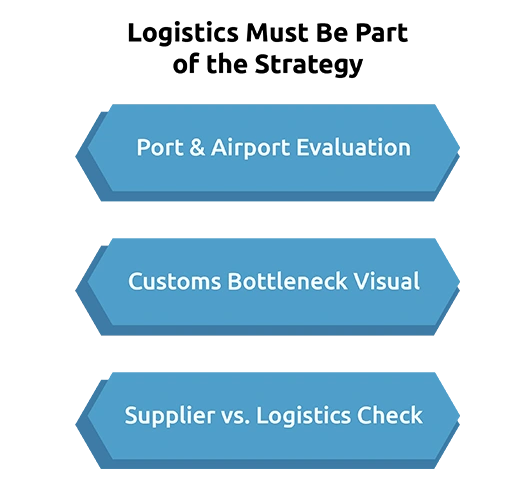
Changing suppliers without reviewing logistics can create a new problem. A factory may offer cost-effective production costs but have limited shipping capacity, long inland shipping distances or weak connections to the target market. Businesses therefore need to evaluate ports, airports, customs processes , transit times and alternative transport routes before approving a new sourcing location.
This becomes especially important for high-value technology equipment. Servers, networking hardware, telecom products, medical devices and other specialised equipment may require careful customs classification, product approvals, documentation and secure transportation. A supply chain that looks diversified on paper may still have a single point of failure at the customs or logistics stage.
Trade Compliance Moves to the Centre
Friend-Shoring 2.0 also increases the importance of trade compliance. When goods move through more countries, companies may face different tariff classifications, import requirements, origin rules, product regulations and customs documentation. A change in manufacturing location can also affect the product’s country of origin, depending on where substantial manufacturing takes place.
Businesses should review compliance before shifting production rather than after the first shipment. The product’s HS classification, origin evidence, import permits, technical standards, customs value and importer responsibilities should be checked for each target market. This helps prevent a diversification project from creating unexpected delays at the border.
Friend-Shoring 2.0 Is Not About Leaving China Completely
One of the biggest misunderstandings is that diversification requires companies to abandon China. In many sectors, that would be expensive and operationally unrealistic. China continues to provide large manufacturing ecosystems, specialised suppliers and extensive system. The more practical plan is to reduce excessive concentration while retaining useful relationships.
This creates a hybrid model. Companies can continue buying from Chinese suppliers while developing extra sources elsewhere. They can also maintain Chinese production for selected products while adding regional production for markets where tariffs, customer requirements or regional risks make another location attractive. UNCTAD has highlighted this broader diversification trend, while noting that friend-shoring remains above historical levels.

What Comes After China Diversification?
The next stage of global sourcing is about developing flexible & resilient supply chains rather than replacing one country with another. Companies will use multiple suppliers, regional production , flexible logistics, and stronger compliance systems.
Friend-Shoring 2.0 shifts from location diversification to network expansion , helping businesses reduce dependencies and respond faster to changing trade conditions.
Conclusion
Friend-Shoring 2.0 is changing how companies build global supply chains. Instead of depend on one alternative country, businesses are creating flexible networks with multiple suppliers, regional production, and stronger logistics planning. This approach helps reduce critical links & manage delays more effectively. The future of sourcing will rely on developing supply chains that can adapt as global trade conditions continue to change.
Did You Know?
The IMF’s 2025 research found that targeted supply-chain diversification can reduce exposure to trade shocks while avoiding unnecessary costs, especially for critical products.
FAQs
What is Friend-Shoring 2.0?
Friend-Shoring 2.0 is an modern supply-chain plan that combines supplier expansion , regional production, trusted trade relationships and flexible logistics. Instead of simply moving production away from China, companies develop multiple sourcing and production options to reduce focus risk.
Is Friend-Shoring the same as China Plus One?
Not exactly. China Plus One generally means keeping China as an essential production base while adding at least one alternative country. Friend-Shoring 2.0 goes further by developing broader networks of suppliers & production locations based on stability, market access & planned relationships.
Does Friend-Shoring mean companies must leave China?
No. Many businesses can continue using Chinese suppliers while reducing dependence on a single country. The practical objective is to create option sources for complex products or components rather than remove China from the supply chain.
Which industries can benefit most from this approach?
Industries with focused suppliers or high delays costs can benefit significantly. These include electronics, semiconductors, automotive, medical equipment, telecom, data-center hardware, batteries & other technology-strong sectors.
What should companies check before moving production?
Companies should assess supplier capacity, product classification, country-of-origin rules, tariffs, customs requirements, logistics routes, system , labour supply & regulatory approvals. They should also check whether the new factory still rely heavily on components from the original sourcing country.