Introduction
The race to build advanced computing network is no longer only about securing powerful processors. Increasingly, the bigger challenge is finding enough electricity to operate the facilities that house them.
Data center developers are expanding campuses, ordering servers and planning larger computing clusters, but many projects are running into a physical limitation that cannot be solved simply by buying more hardware: access to reliable grid power.
The global energy agency noted that global data center electricity use enhanced by 17% in 2025 , while electricity use from specilized sides on AI computing workload increased by around 50%. The IEA indicate total data center electricity use to increase from about 485 TWh in 2025 to about 950 TWh by 2030.
This shift is change how companies plan data centers. Electricity availability, cooling systems and power network are becoming just as essential as servers and processors.
Why Electricity Has Become the New Data Center Constraint
A modern data center requires far more than a building filled with computing equipment. Every server needs continuous electricity, while cooling systems, networking equipment, storage, backup systems and facility operations add to the overall load.
High-density computing makes the situation even more demanding. Advanced computing racks can consume significantly more power than conventional enterprise equipment. According to the IEA, the power density of computing equipment increased about elevenfold between 2020 and 2025, with further increases expected.
This creates a difficult planning problem. A company may have the capital to purchase servers and secure land for a facility, but without sufficient electrical capacity, those servers cannot be deployed at full scale.
The result is a growing gap between hardware availability and infrastructure readiness.
Grid Connections Are Taking Center Stage
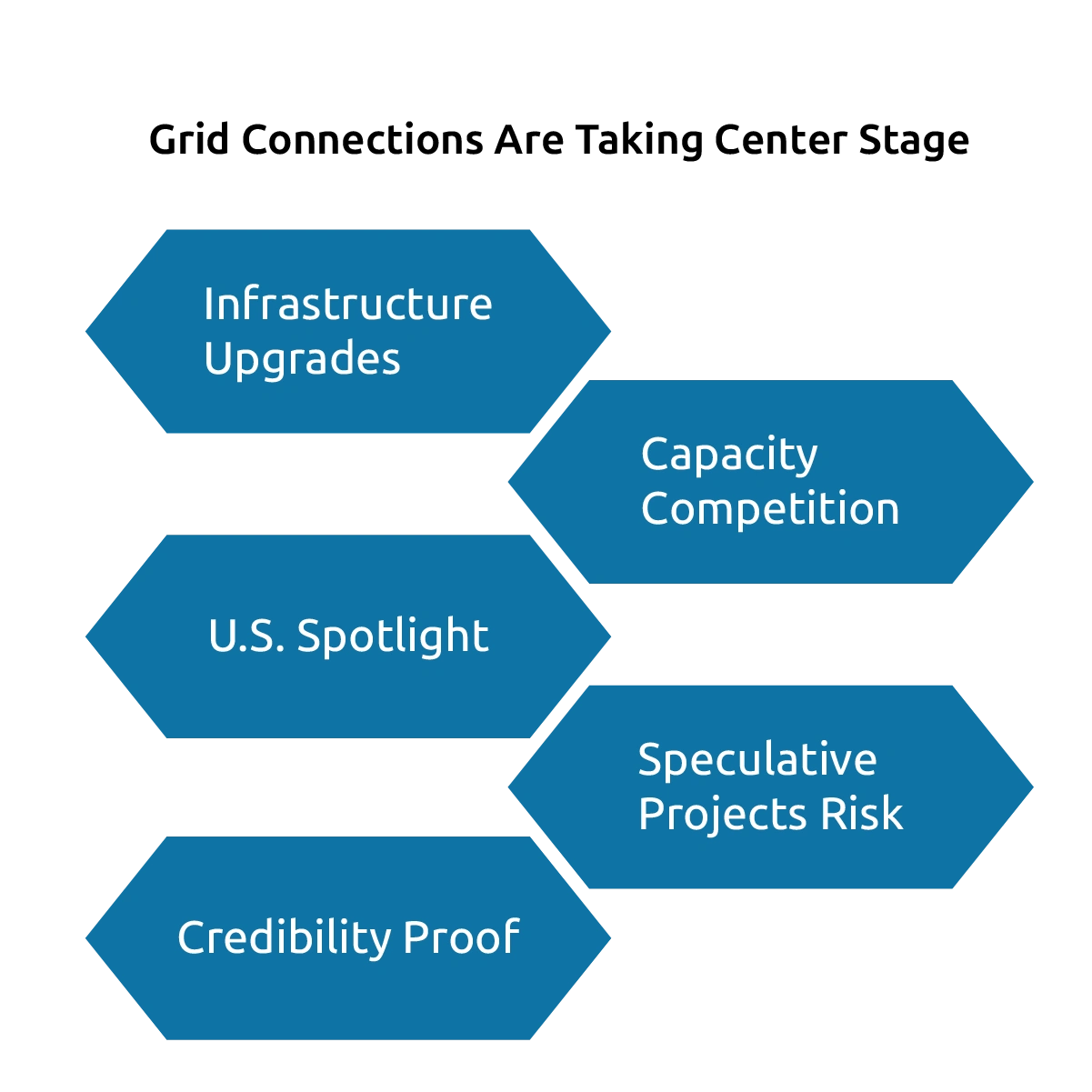
Connecting a large data center to the electricity grid is not as simple as requesting additional power from a utility. Developers may need transmission upgrades, substations, transformers and new distribution infrastructure before a site can support its planned load.
In several markets, data center projects are also competing for limited grid capacity with manufacturing facilities, residential development, transportation electrification and other large electricity users.
The problem has become particularly visible in the United States. Recent reporting from Reuters found that some states are dealing with exceptionally large data center power requests, including speculative projects that may never reach construction. Texas has moved to review new connection requests more closely, while other states are examining similar issues.
This means developers increasingly need to prove that their projects are financially and technically credible before utilities commit valuable grid capacity.
Why Transformers and Power Equipment Matter
The electricity challenge does not stop at the availability of generation. Data centers also depend on physical equipment that moves and manages electricity.
Transformers, switchgear, power distribution systems and other electrical components are becoming critical parts of data center construction. The IEA has warned that supply chains for energy technologies, including transformers, are tightening as data center expansion accelerates.
For international projects, this introduces additional logistics considerations. Large transformers, electrical systems, cooling equipment & computing hardware may be production in different countries and shipping to the same project location. Their movement requires careful coordination of customs documentation, product classifications, duties, taxes and local compliance requirements.
Why Companies Are Looking Beyond the Grid
Slow grid connections are pushing some data center developers to consider alternative power arrangements.
On-site generation, renewable energy contracts, battery storage and other solutions are being explored to reduce dependence on delayed grid capacity. The IEA reports that technology companies accounted for around 40% of corporate renewable power purchase agreements signed in 2025. It also noted growing interest in nuclear and other emerging power sources.
Battery storage can also help handle short-term changes in electricity demand. This is specifically related because high-density computing workloads can create rapid changes in power consumption. Reliable storage and power management can help facilities manage these variations without compromising operations.
The Impact on Data Center Construction Timelines
Electricity constraints are changing how data center projects are planned. Securing sufficient grid capacity may need to happen before major construction and equipment procurement begin. A site is not suitable simply because land is available; access to substations, transmission infrastructure and reliable power can determine the project timeline. In some cases, securing the electrical connection may take longer than building the facility itself.
What This Means for International Data Center Equipment Shipments
Power delays can affect international equipment deliveries. Servers, networking systems, cooling units and electrical equipment may arrive before the facility is ready, creating additional storage and handling needs. Import planning should therefore match the project schedule, with customs documents, importer responsibilities and product requirements reviewed before dispatch. An Importer of Record arrangement can also support eligible shipments when the company has no local importing entity.
Conclusion
Data centers are facing a increased power challenge as computing demand increases. Reliable electricity, grid capacity, voltage convertor and cooling network are becoming critical to project timelines. For international deployments, equipment sourcing , customs clearance and delivery schedules must be aligned with site readiness. Proper import planning can help avoid delays and unexpected costs. For eligible shipments, an Importer of Record arrangement can support the required import process.
Did You Know?
The U.S. Department of Energy’s 2025 update estimates that data centers could account for 11.8% of total U.S. electricity consumption by 2030, with scenarios ranging from 9.5% to 15.3%.
Frequently Asked Questions
Why are data centers navigating electricity shortages?
Data centers are used more electricity because computing workloads are becoming larger & more high demand. At the same time, grid infrastructure, generation capacity and electrical equipment cannot always expand at the same speed as new data center projects.
Is electricity becoming more important than GPUs for data center expansion?
In many projects, both are important, but electricity availability can become the immediate limiting factor. A facility cannot operate its computing equipment at scale without sufficient power and supporting electrical infrastructure.
How does high-density computing affect data center power requirements?
Higher-density computing places more equipment & processing capacity within the same physical space. This increases electricity use or produces more heat, requiring stronger power distribution and cooling systems.
Can on-site power solve the data center electricity problem?
On-site generation & battery storage can offer additional capacity or flexibility, specifically where grid connections are delayed. However, these systems still require approvals , equipment, or energy sources, maintenance and careful technical planning.
What does the power bottleneck mean for international data center equipment shipments?
Power delays can change when equipment should be imported, installed and commissioned. Companies may need to coordinate customs clearance, storage, delivery and installation schedules more carefully so expensive equipment does not arrive significantly before the facility is ready.