A product no longer has to be made in just one country. Today, a single piece of business equipment can pass through some countries before reaching its final location. Components may be produce in Asia, electronics sourced from Europe, assembly completed in another country, & the finished product shipped to a customer thousands of miles away.
For customs authorities, knowing where a shipment came from is not always enough. They may need to understand where the components were produced, what processing took place, & whether the final production activity changes the product’s origin under the applicable rules.
What Makes a Product “Multi-Origin”?
A multi-origin product is not necessarily a product that has some legal countries of origin. Rather, the term describes a product whose components, materials, & developing processes with multiple countries.
Its processor could be manufactured in Taiwan, memory modules could come from South Korea, the chassis could be produced in China, & the final server could be assembled in Malaysia. The completed server may then be exported from Malaysia to a customer in France.
There are several countries involved in the product’s supply chain, but that does not mean the product automatically has several countries of origin.
The applicable customs rules determine how its origin should be established.
This distinction is becoming increasingly important as manufacturers divide production between different locations.
Why Final Assembly Does Not Automatically Determine Origin
Depending on the country, product and circumstances, authorities may consider whether the goods have undergone sufficient processing or a substantial transformation in the final manufacturing location.
The answer can depend on factors such as the product’s tariff classification, the nature of the manufacturing process and, in certain situations, the value contributed by materials or processing.
For example, simply installing imported components into a finished enclosure may not have the same origin implications as a complex manufacturing process that creates a commercially different product.
This is why importers should avoid using a simple rule such as “final assembly country equals country of origin.”
The Bill of Materials Is Becoming More Important
For products containing hundreds or thousands of components, understanding the bill of materials can be particularly useful.
Take an AI server, networking appliance, or industrial control system. Its major components may come from several countries, and some components may themselves contain materials sourced internationally.
An importer needs to know more than the name of the finished product.
It may need to understand where key components were manufactured and what happened to those components during production.
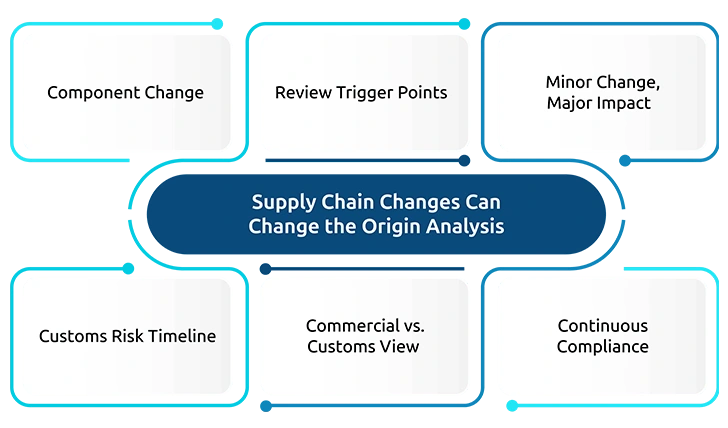
Supply Chain Changes Can Change the Origin Analysis
Another challenge is that supply chains rarely remain unchanged.
A manufacturer might move assembly from one country to another. A processor supplier could change. A company might replace a power supply, introduce a new circuit board or source a critical component from a different manufacturer.
These changes may appear minor from a commercial perspective, but they can affect customs analysis.
This means companies should not assume that an origin determination made several years ago remains appropriate forever.
Product changes, supplier changes and manufacturing-location changes should trigger a review where they could affect the applicable customs treatment.
Preferential Tariffs Make Origin Even More Important
Country of origin can become particularly significant when a company wants to claim preferential tariff treatment under a trade agreement.
A product may be manufactured or assembled in a country that has a trade agreement with the destination market. However, that does not automatically mean the product qualifies for the agreement’s preferential rate. Specific rules of origin may apply to the product.
If the requirements are not met, an importer could incorrectly claim preferential treatment and later face additional duties, penalties or requests for supporting evidence.
Therefore, businesses should establish eligibility before making a preferential tariff claim rather than relying only on the country from which the goods were shipped.
Why Importers Need Better Supplier Information
Global manufacturing puts greater responsibility on companies to collect reliable information from suppliers.
In the past, an importer might have focused primarily on price, quantity, delivery date and product specifications.
Now, origin-related information can also be important.
Companies may need suppliers to provide accurate details about manufacturing locations, component origins and production processes. For frequently imported products, maintaining this information in a centralized system can make future customs reviews much easier.
This is especially useful for technology and data-center equipment, where products can contain components sourced from numerous countries.
Technology Can Make Origin Management Easier
Managing origin information manually becomes difficult when a company has hundreds of products and a large international supplier network.
Digital supply-chain and enterprise systems can help connect product information with supplier, manufacturing and logistics records.
Ideally, an importer should be able to trace a product from its finished model back through its major components and manufacturing locations.
This creates a clearer information trail and can help identify changes that may require an origin review.
The goal is not simply to store more data. It is to make the right data available when a customs or compliance question arises.

What Importers Should Do Before Shipping
Businesses importing globally assembled products should review their documentation before the shipment reaches the border.
Start by identifying the countries involved in manufacturing and sourcing. Then determine what processing takes place at each stage.
The applicable origin rules should be reviewed for the destination country and the specific product. If preferential tariff treatment is being claimed, the relevant trade agreement requirements should also be checked.
Conclusion
Global assembly has become a normal part of modern manufacturing. Companies are spreading production across countries to access technology, suppliers, manufacturing capacity and new markets.
But a more global product also creates a more complicated compliance trail.
For importers, country of origin should therefore be treated as more than a box on a customs declaration. It is the result of a managing & supply-chain story that needs to be supported by correct information.
As supply chains become more distributed, companies that manage clear records of their components, suppliers, & manufacturing processes will be better prepared to answer customs questions & handle cross-border shipments.
Did you know?
Rules of origin are used to determine where goods are considered to have been produced for trade purposes, including whether products can qualify for preferential tariff treatment under a free trade agreement. The World Trade Organization’s overview of rules of origin explains why determining origin is an important part of international trade.
FAQ
1. What is a multi-origin product?
A multi-origin product contains components, materials, or parts sourced from multiple countries and may undergo manufacturing or assembly in different locations before reaching the final market.
2. Does the final assembly country determine the country of origin?
Not necessarily. The country of origin depends on the applicable customs rules and the nature of the processing performed. Final assembly alone may not be enough to establish origin.
3. Why is country of origin important for import documentation?
Country of origin can affect customs declarations, duty treatment, preferential tariffs, origin marking, and other import requirements. Accurate origin information also helps businesses respond to customs queries.
4. What documents can support a product’s country of origin?
Depending on the shipment and destination, supporting evidence may include commercial invoices, certificates or statements of origin, supplier declarations, manufacturing records, bills of materials, and production information.
5. Can changing a supplier affect a product’s country of origin?
Yes, it can. Changing the source of an important component or moving manufacturing or assembly to another country may affect the origin analysis and should be reviewed under the applicable rules.