Introduction
For companies installing servers, network switches, routers, storage systems, and other IT equipment, Brazil is an important market. Data centers, business centers, telecom networks, and IT projects may require these devices. However, it might be challenging for a foreign business without a local legal entity to import IT equipment into Brazil. Before the shipment reaches, it is required to properly handle customs rules, product classification, documents, taxes, & other compliance demands. For a foreign company that applies, an Importer of Record (IOR) in Brazil can help in handling the import duties. Before the shipment, it is important to confirm who will serve as the importer and to make sure that the required goods and customs information is available.
Why Brazil Can Be Challenging for Enterprise IT Imports
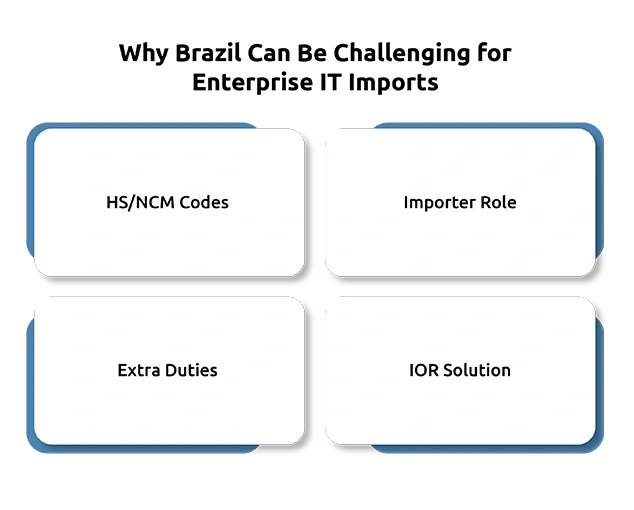
Importing servers, switches, routers, storage systems, and other IT equipment is required by specific rules in Brazil. Before exporting, businesses must check a customs registration, documents required, product-specific regulations, customs value, and the proper HS/NCM classification. Depending on the type of equipment and its features, these needs may change. IT hardware needs accurate product details because different models and configurations may have different requirements. Some networking equipment may also need telecom-related checks. Missing or incorrect information can lead to questions from customs and slow down Brazil customs clearance.
For foreign companies without a Brazilian entity, deciding who will act as the importer can be another challenge. Incorrect HS/NCM codes, missing approvals and unexpected duties or taxes can also increase delays and costs. An Importer of Record Brazil solution can help manage these importing responsibilities where applicable.
Can a Foreign Company Import Servers into Brazil Without a Local Entity?
A foreign company may be able to import servers into Brazil without a local entity by using a suitable local importing structure. The importer must be clearly identified before shipping and is responsible for meeting applicable customs requirements. The seller, consignee, importer and end user may all be different parties, so their roles should be clearly defined.
An Importer of Record Brazil can help a foreign company import IT equipment when it does not have its own Brazilian entity. The IOR takes responsibility for the import process, prepares or coordinates required information and works with the customs broker to support Brazil customs clearance and compliance. An IOR is different from a Brazil customs broker. The IOR takes the legal importing responsibility, while the broker handles customs procedures and declarations for the importer. Duties and taxes are part of the importer’s responsibilities, based on the agreed arrangement.
Duties, Taxes and Landed Costs When Importing Servers into Brazil
The HS/NCM classification, customs value, place of origin, related taxes, and product-specific regulations all impact how much it costs to import servers into Brazil. The overall cost may also increase due to freight and insurance. Companies can plan their budget and avoid unexpected costs by calculating Brazil import duties and taxes before to shipment. It also helps ensure payments are ready for customs clearance.
Companies should look beyond the customs duty rate because Brazil import taxes may include several charges. Checking the complete landed cost gives a better idea of the total import expense.

What Documents Are Needed to Import Servers and Networking Equipment?
The Brazil import documentation should clearly describe the shipment. The commercial invoice should include seller and buyer details, product description, quantity, value, currency and Incoterms. The packing list should show package details, weight, dimensions and equipment information. An air waybill or bill of lading is also required, along with shipment references and consignee details. Technical documents should include the manufacturer, model, specifications, datasheets, serial numbers where applicable and country of origin. Accurate details support Brazil customs clearance.
Some networking or telecom-related equipment may need specific approvals or registration. Companies should check the latest requirements with the relevant Brazilian authorities before shipping.
How One Union Solutions Helps With Brazil IOR Services
One Union Solutions provides Brazil IOR services for qualifying shipments, helping foreign companies import servers, networking equipment and other IT hardware when they do not have a local entity. The service helps establish a clear importing structure and manage the required import responsibilities. The team can review shipment details, coordinate with the Brazil customs broker and help keep commercial, technical and customs documents consistent. It can also support landed-cost planning and coordinate required duties and tax payments.
From Brazil customs clearance to final delivery, the shipment can be coordinated through the import process, helping companies keep their IT equipment deployment organized.
Conclusion
Importing servers and networking equipment into Brazil without a local entity requires proper planning. Companies need to confirm the importer, check HS/NCM classification, prepare accurate documents and understand applicable duties, taxes and approvals. Using an Importer of Record Brazil can help foreign companies manage these requirements without setting up their own local entity. With the right import structure and customs support, companies can reduce delays and make IT equipment deployment in Brazil easier.
Did You Know
Brazil’s total imports in 2025 are estimated between $285 billion and $295 billion, reflecting strong international trade demand.
FAQ
Can I import servers into Brazil without opening a Brazilian company?
Yes, it may be possible through a suitable local importing structure, such as an Importer of Record Brazil, where the arrangement is legally permitted.
Do servers require special approval to enter Brazil?
Not every server needs the same approval. The requirements depend on the equipment, its features and how it is classified. These should be checked before shipping.
Do networking devices have different import requirements in Brazil?
They can. Networking devices with communication or telecom functions may have additional regulatory requirements, so the exact model should be checked before import.
Can I ship IT equipment to a Brazilian data center without having a local entity?
Potentially, yes. However, having a delivery address in Brazil does not by itself solve the importing requirement. The correct importer must be arranged before shipment.
Can an IOR and customs broker handle the same Brazil import shipment?
Yes. Although their duties are different, they can works together. While the Brazil customs broker helps with customs processes and declarations, the IOR takes responsibility for imports.