International logistic industry is changing. Organizations mainly depend on large warehouses located outside major cities, where products can be stored in bulk & shipped when orders arrive. This infrastructure worked well when customers were ready to wait a few days for delivery & when traffic issues were less of a concern.
Customers expect quicker delivery, businesses need better stock availability, and cities are getting denser. Rising transportation costs, labor issues, sustainability objectives, and the growth of e-commerce are forcing logistics companies to reevaluate how goods travel through the later stages of the supply chain.
This is where micro-hubs are gaining attention. By moving selected inventory closer to customers, micro-hubs can help companies shorten delivery distances, enhance responsiveness, & create more flexible urban issues networks.
What Are Micro-Hubs?
Small-scale logistics facilities called “micro-hubs” are situated close to places where customer demand is great. Micro-hubs concentrate on a specific city, neighborhood, or delivery zone as opposed to normal supply centers, which can cover wide geographic areas.
These businesses may operate out of parking lots, small warehouses, empty retail spaces, or other carefully selected venues. After products from a larger regional supply facility arrive at the micro-hub, they are sorted for local delivery.
The concept is mainly useful for products that need quick fulfillment. Instead of sending every order directly from a distant warehouse, businesses can position frequently ordered products closer to customers.
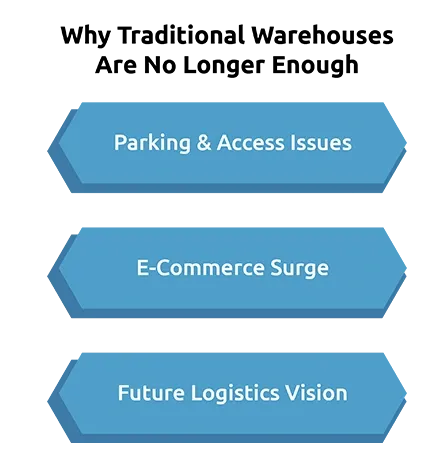
Why Traditional Warehouses Are No Longer Enough
Large distribution centers remain useful for global supply chains. They provide economies of scale, centralized inventory management, automation, & efficient connections to highways, ports, airports, & rail networks. Their distance from densely populated areas can create challenges during the final delivery stage.
A truck traveling from an outer-city warehouse into a busy urban area may face traffic issues, parking limitations, delivery problems, & longer travel times. These issues become more significant as online shopping increases the number of individual deliveries.
Micro-hubs address this problem by bringing inventory closer to the point of consumption.
Instead of one large facility serving a whole metropolitan area, a logistics network can combine a regional warehouse with some smaller urban facilities.
The Role of Micro-Hubs in Last-Mile Delivery
The last mile is often one of the most difficult parts of distribution. It involves shipping goods from a transportation or fulfillment facility to the customer’s location.
Delivery vehicles can traverse a shorter distance thanks to micro-hubs. In certain versions, final deliveries are handled by smaller cars, cargo cycles, electric vans, or other local transportation choices after bigger trucks convey combined supplies to a micro-hub. There are a number of benefits to this strategy.
First, since merchandise is already near customers, deliveries can be finished more quickly. Second, before approaching crowded locations, shipments might be combined. Third, companies may be able to deliver goods in cities using smaller, greener cars.
For cities dealing with congestion & emissions, this model can also support broader urban mobility objectives.
Technology Is Making Micro-Hubs Smarter
Micro-hubs are not simply smaller warehouses. Their effectiveness depends heavily on technology.
Warehouse management systems can track inventory across many locations, while transportation management systems can help coordinate deliveries between regional facilities, micro-hubs, & customers.
Artificial intelligence and predictive analytics can also help businesses understand where demand is likely to occur. By analyzing historical orders, seasonal patterns, traffic conditions, & customer behavior, companies can determine which products should be positioned at particular micro-hubs.

Micro-Hubs and Sustainable Logistics
Sustainability is another reason businesses are exploring decentralized urban logistics. Long delivery routes can increase fuel use & emissions, mainly when vehicles make multiple individual stops across congested areas. A micro-hub model can consolidate inbound shipments & shorten local delivery routes.
Companies may also have more opportunities to use electric vans, cargo bikes, or other lower-emission transportation options for the final stage.
However, micro-hubs are not automatically sustainable. Operating multiple facilities can increase energy consumption, property costs, & handling requirements. Businesses therefore need to carefully analyze delivery density, facility utilization, energy sources, & transportation patterns before developing a micro-hub network.
The Impact on Global Distribution
The growth of micro-hubs does not mean traditional distribution centers will disappear. Instead, global distribution is becoming more layered.
A typical network may include a manufacturer, global transportation, a regional distribution center, an urban micro-hub, & finally the customer.
This creates a hybrid model in which large facilities handle huge storage & global or regional flows, while micro-hubs provide localized fulfillment.
For global businesses, this can make distribution networks more responsive. Inventory can be positioned according to regional demand rather than depending mainly on centralized facilities.
Additionally, it can assist businesses in adapting to unforeseen changes. More inventory can be placed closer to high-demand locations at seasonal peaks, significant events, or abrupt spikes in demand.
Challenges Businesses Need to Consider
Micro-hubs also introduce new operational challenges.
Real estate can be costly in urban locations, and suitable facilities may be difficult to secure. Businesses must also handle many inventories instead of depending on one centralized stock location.
Regulatory requirements can vary between cities, particularly around delivery hours, vehicle access, zoning, & emissions. Labor availability & local operating costs can also influence the success of a micro-hub.
The key is not simply to create more facilities. Companies need to determine where smaller facilities mainly enhance service levels & where traditional issues remain more efficiently addressed.
Conclusion
The future of global distribution is likely to combine scale with proximity. Large warehouses will continue to support global & local supply chains, while micro-hubs will bring selected inventory closer to urban customers.
As e-commerce grows & delivery expectations become faster, logistics networks will need to become more flexible. Technologies such as AI, real-time tracking, automation, predictive demand forecasting, & intelligent routing will play an mainly important role in making these networks efficient.
Did you know?
Urbanisation is responsible for the e-commerce boom. Global online retail sales are projected to exceed $6.8 trillion by 2028. This represents a significant increase that will further strain supply chain networks.
FAQ
What is a micro-hub in urban logistics?
A micro-hub is a small logistics facility located close to customers or high-demand areas. It helps businesses store, sort, and dispatch goods locally, reducing delivery distances and improving last-mile efficiency.
How do micro-hubs improve last-mile delivery?
Micro-hubs bring inventory closer to customers, allowing delivery vehicles to travel shorter distances. This can help reduce delivery times, improve route efficiency, and support faster order fulfillment.
Are micro-hubs replacing traditional warehouses?
No. Micro-hubs are generally designed to complement traditional warehouses rather than replace them. Large warehouses remain important for bulk storage and regional distribution, while micro-hubs support localized fulfillment.
How can micro-hubs support sustainable logistics?
Micro-hubs can shorten local delivery routes and make it easier to use electric vans, cargo bikes, and other lower-emission vehicles. However, their overall environmental benefit depends on factors such as facility energy use, delivery density, and transportation planning.
What technologies are used in micro-hub operations?
Micro-hubs can use warehouse management systems, transportation management systems, real-time inventory tracking, AI, predictive analytics, automated sorting, and intelligent routing to coordinate inventory and deliveries.