Introduction
For high-value companies, choosing the correct freight method is important, as shipping costs may affect the total cost of a shipment. Businesses that transport high-value products, like electronics, medical equipment, aviation parts, and technology equipment, have to find a balance between delivery demands, cost, speed, and security.
Air freight may speed up the delivery of goods to companies. It can reduce the amount of time goods need in delivery and inventory delays. However, air freight is typically more costly, even for large or heavy loads. Ocean freight is usually more cost-effective for large products & has much more capacity, but it takes longer and requires more planning. The freight cost is less than the cost of transportation. Handling costs, handling charges, insurance, freight value, storage, and the cost of delays are other factors that businesses must take in consider. Longer shipping times can also have an economic effect because high-value cargo can be valued at a lot of money while it’s in transit.
Why Freight Economics Matter More for High-Value Industries
The cost of freight is just one part of the total company costs for high-value businesses. Delays can result in production delays, delayed deliveries, canceled projects, or lost revenues because costly equipment may be involved in a shipment. This makes the logistics of high-value freight important. Valuable goods that require careful handling are commonly moved by industries like technology, electronics, semiconductors, medical equipment, aviation, automotive, & data centers. For heavier goods that are not urgent, ocean freight may be more feasible, but air freight may be helpful when timely delivery is required. High-value technical and AI-related goods are also in high demand, according to current air cargo trends. Businesses should consider the cargo value, delivery time, inventory needs, and possible delay costs along with the freight price. This helps improve freight cost management and logistics cost optimization.
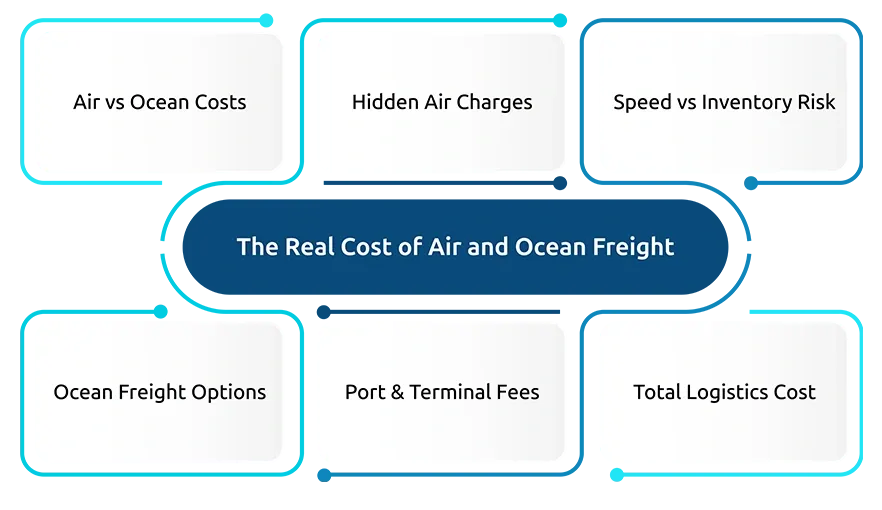
The Real Cost of Air and Ocean Freight
The total cost of shipping includes above the freight charge. Because of limited space and increased operating costs, air freight is typically more costly. Because ships can carry a lot of goods, ocean freight is typically cheaper for large and heavy goods.
Air Freight Costs
Actual weight and charged weight, includes volumetric weight when a shipment takes more space than its actual weight, can calculate the cost of air freight.
Volumetric Weight = L × W × H ÷ 6000
Fuel, security, handling, airport, and customs charges may also be fixed in the final air shipping costs. Faster delivery can reduce inventory costs, inventory risk, production delays, and reduced sales even when air freight is more costly.
Ocean Freight Costs
For large goods, ocean freight is typically cost-effective. When products divide ship space, LCL (Less than Container Load) is used, while FCL (Full Container Load) is used for a full container. Additionally, port handling, terminal, documents, customs, storage, charges, and storage fees can apply to ocean goods. Because money is fixed up in goods for longer periods of time, longer shipping may result in higher inventory carrying fees. Also, before choosing air or ocean freight, businesses should review the total logistics cost, not only the given freight price.
Air Freight vs Ocean Freight at a Glance
Air freight & ocean freight are the two main methods for global freight, but they are better for different reasons. Because air freight is much faster, it is a good choice for shipments that are important, valuable, lightweight, & time-sensitive. It typically has less cargo space & is more costly. Ocean freight can transport large, heavy goods in huge amounts, but it takes longer & is typically less cost-effective. When delivery time is dependent, and companies want to keep shipping costs under control, it usually becomes a better choice. The decision is also affected by business needs and inventory. Businesses can get equipment or products faster by using air freight, which reduces the time that goods are in transport. Because goods may be in transport for weeks, ocean freight requires more planning. The value of the cargo, the size of the cargo, the delivery time, handling, security, and possible delays all need to be considered by businesses. Because of this, deciding between air and ocean freight is a company decision that takes care of the needs and total cost of every shipment rather than just the freight cost.

Sustainability and the Economics of Freight Choice
Decisions on freight continue to focus on sustainability. Ocean freight may move heavy cargo with less affect on the ecosystem, while air freight is faster but typically results in higher emissions. Because of this, ocean shipping is a great choice when delivery times are flexible. By choosing air freight when speed is necessary and ocean freight for planned shipments, businesses can support green logistics. This can fulfill delivery needs while reducing supply-chain levels, freight releases, & the ecological impact on air freight.
Conclusion
Air freight, that are more costly but provides faster delivery, helps reduce delays and inventory time. Ocean freight is generally cost-effective for large, non-critical goods. Businesses in high-value industry should consider the risk, inventory needs, delivery time, shipment value, and total logistics cost before making a decision. A balance between cost, reliability, and speed can be done for many shipments by using both air and ocean freight.
Did you know
The global air freight services market is estimated to be valued at US$ 170.03 Bn in 2026 and is expected to reach US$ 259.05 Bn by 2033, exhibiting a compound annual growth rate (CAGR) of 6.2% from 2026 to 2033.
FAQ
Does shipment size affect the choice of freight?
Yes. Ocean freight is typically more suitable for large, heavy shipments. Air freight may be better for smaller, important goods.
How does delivery time affect freight choice?
If goods are needed quickly, air freight can be useful. If there is more time, ocean freight can help reduce shipping costs.
Why is ocean freight useful for large shipments?
The amount of goods that ships can move is large. Because of this, ocean freight is a better choice for companies shipping heavy loads of goods.
Is air freight always better for high-value goods?
No. The goods, delivery time, shipment size, and total cost all impact the best option. If the shipment is big and not important, ocean freight might make sense.
What factors should businesses check before choosing air or ocean freight?
Before making a choice, businesses should consider cargo value, weight, size, delivery time, shipping costs, inventory needs, & possible delays