Introduction: Central Asia’s Growing Role in Global Trade
Central Asia is developing as an important trade and shipping center, connecting China, Europe, Russia, & the Middle East. Businesses looking for new methods to transport goods between Asia and Europe can benefit from its location. China and Europe are connected through the Middle Corridor, also known as the Trans-Caspian Global Transport Route (TITR), which travels through Central Asia, the Caspian Sea, the South Caucasus, & Turkey. Interest in this different trading route has grown due to increasing international issues and supply-chain problems. International transport is also being improved by increases in digital customs systems, ports, roads, railroads, and logistics. Central Asia might add strongly to international trade and global supply chains with long-term investment and improved trade rules.
What Is the Central Asian Trade Corridor?
The Central Asian trade corridor supports the shipment of goods between important markets by a system of roads, railways, ports, & border crossings. Its important route, the Middle Corridor (TITR), connects China with Europe by Kazakhstan, the Caspian Sea, Georgia, Azerbaijan, or Turkey. It supports improved supply chain connectivity and offers companies a better option for trading between China and Europe. In order to help the more smooth shipment of goods within the area, current development focuses on improving shipping routes, border processes, and customs systems. The Middle Corridor includes different types of transportation, unlike a single road or railroad. As a result, it serves as a multimodal trade route and is important for Central Asia’s growing entry into global trade.
Why Central Asia Is Becoming a New Trade Corridor
Because of its location, Central Asia is becoming an important location for trade & logistics between Asia and Europe. The Middle Corridor, which helps diverse supply chains and provides companies with a different means of shipping, has received more focus because of the growing need for different routes. Investment on the path is also growing. A new 322-km railroad in Kazakhstan and improvements to Georgia’s transport system were some the important rail and road plans that the World Bank approved in 2026. These efforts try to improve regional trade connectivity, reduce roadblocks, & increase cargo flow.
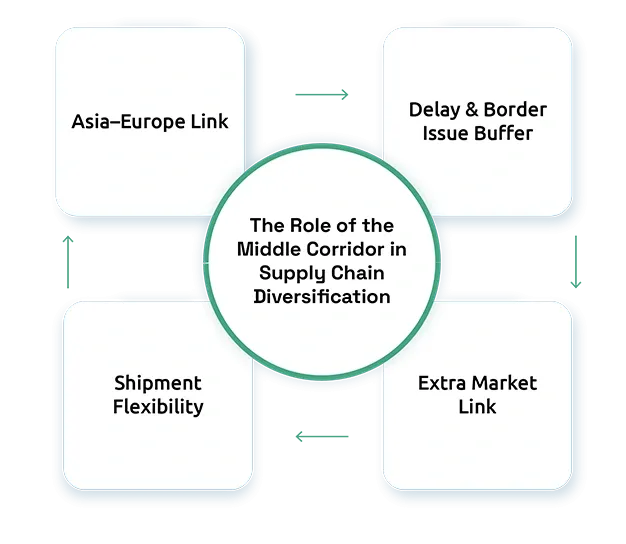
The Role of the Middle Corridor in Supply Chain Diversification
The Middle Corridor provides companies another way of transporting goods from Asia to Europe. Businesses can better handle delays, border issues, & other trade problems by using multiple routes rather than depend on only one. For manufacturers, logistics companies, importers, & exporters, this provides improved supply chain resilience and shipment flexibility. Also, the corridor supports route selection by developing an extra link between markets in Europe and China.
Challenges Facing the Central Asian Trade Corridor
The Middle Corridor continues to face a number of issues that may affect transit times and trade links. Because different countries have different customs rules, documents, and permit processes, border crossings may be delayed. Also, the route depends on road, rail, and sea transport; therefore, poor coordination among these systems could delay the flow of freight. The issue may be made worst by poor infrastructure at some ports, train lines, terminals, and border crossings. Businesses might need to follow to different processes in every country because of customs and regulatory differences, which provides a further challenges. Companies must also closely track their suppliers, routes, and shipments because of global instability and regulatory compliance. Stronger trade support, easier customs processes, & improved regional cooperation may all add to the corridor’s increased reliability.
How the New Trade Corridor Could Affect Global Trade
As a way to reduce depend on a single route, the Middle Corridor may provide companies with another way of transporting goods between China and Europe. This can increase the safety of the supply chain and provide businesses with more choice when other routes are affected by trade delays. Also, the growing corridor provides the way for investment in infrastructure, transport services, & logistics companies across Central Asia and the Caucasus. Central Asia may play more important part in Eurasian trade and global supply chains as these relations develop.

Conclusion: Central Asia’s Growing Role in Global Trade
Due to its location, improved transport infrastructure, and growing focus on supply chain diversification, Central Asia is growing in importance in international trade. While new investments are improving ports, railroads, roads, logistics, & customs processes, the Middle Corridor is developing a new link between China and Europe. International companies now have more chances due to this growth, but they still have to handle logistics, customs, & compliance needs in multiple countries. Central Asia may play an important part in global supply chains & Eurasian trade as connections increase.
Did you know
Modeling projects a 37 percent increase in trade between Azerbaijan, Georgia, and Kazakhstan, and a 28 percent increase between these countries and the EU by 2030.
FAQ
What is the Trans-Caspian International Transport Route?
It is another name for the Middle Corridor. It connects Asian and European markets through Central Asia & the Caspian Sea.
How can companies use the Middle Corridor?
Companies can consider it when planning China-Europe shipments & compare its cost, transit time, customs needs, and route conditions with other options.
Why are businesses interested in Central Asia?
Central Asia offers a useful link between Asian & European markets. This can give companies more choices for international shipping.
How does the Middle Corridor connect China and Europe?
It ships goods from China through Central Asia, across the Caspian Sea, & through the Caucasus & Türkiye to Europe.
What makes Central Asia suitable for a trade corridor?
Its central location & growing transport network make it a useful link between major trading areas.